Poetic Rendering

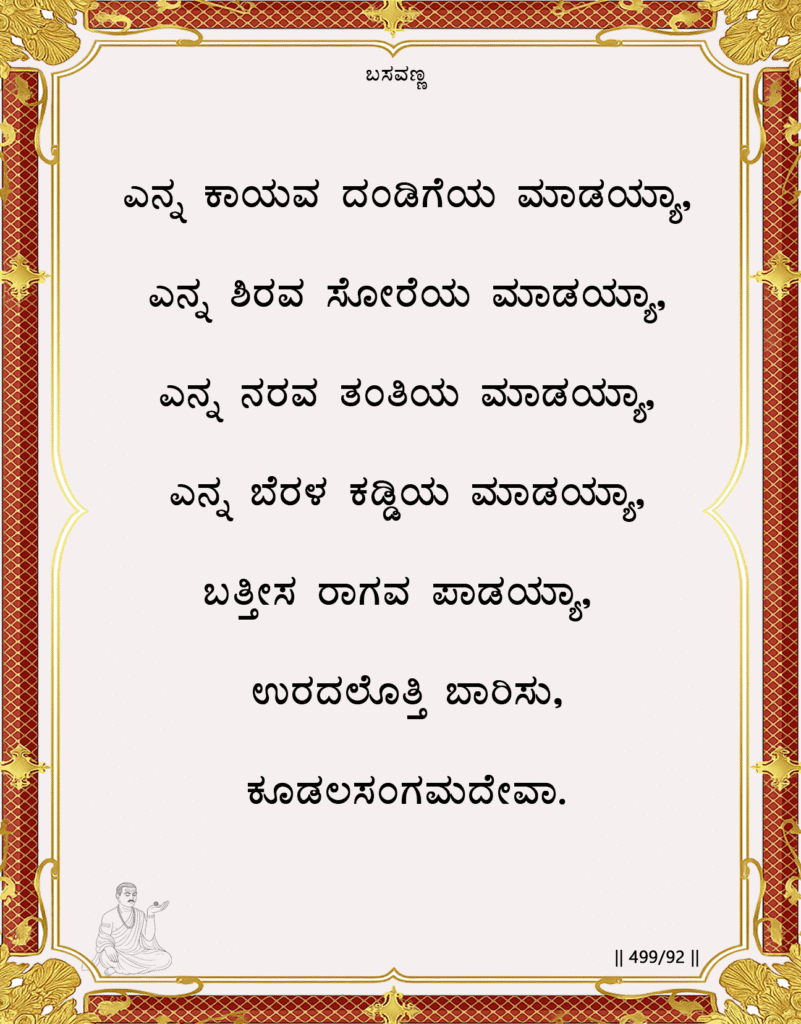
Lord, make my body Your flute.
Let my head become Your single-stringed bow,
my nerves the stretched and trembling strings,
my fingers the living plectrum in Your hand.
Play upon me, Lord,
as the cotton wick plays with the flame
soaking the oil, offering itself,
becoming light by surrender.
Let me burn bright in that music,
all of me consumed in Your radiance,
O Koodalasangamadeva.
Basavanna prays for his entire body to become an instrument through which the Divine plays. The imagery shifts to a cotton wick that becomes light only by surrendering itself to the flame. Likewise, the devotee must offer every part of the selfbody, mind, and breathso that the Lord alone shines through. The vachana teaches total self-offering at the feet of Koodalasangamadeva.
Spiritual Context
Core Spiritual Principle: The ultimate surrender is not merely of action but of substance. The seeker must be wholly consumed in the fire of the Divine, transforming their individual identity into pure, illuminating consciousness. The path is one of self-immolation in God.
Cosmic Reality Perspective: This Vachana depicts the final stage of non-dual realization. The individual soul (jiva) is like the wick, a temporary form sustained by the oil of latent tendencies (vasanas). The Supreme Self (Linga) is the transcendent flame. Union occurs when the form of the wick is entirely sacrificed to the flame, leaving only the inseparable, radiant light.
Historical Reality (Anubhava Mantapa Context): This continues the radical, experiential theology of the Veerashaiva movement. It moves beyond instrumental service to total self-annihilation (aham nasa). It is the logical conclusion of the principle of Dasohathe offering of the self is the final and most complete offering.
Interpretation
1. Instrumental Surrender (Flute & Bow): The initial verses establish the theme of active service and divine expression, as seen in the previous Vachana. The body is an instrument for the divine music.
2. The Alchemical Shift (The Wick and the Flame): The metaphor shifts dramatically from expression to consumption. The wick does not merely transmit sound; it is destroyed to produce light. The “oil” represents the sum total of the individual’s karma, samskaras, and egoic identity. To “soak” in it is to fully accept and offer one’s entire psychological and karmic substance.
3. “Becoming light by surrender”: This is the core of the transformation. The wick’s nature is to be dark and combustible. Its surrender to the flame transmutes its very nature into radiance. Similarly, the ego’s surrender to the Divine transmutes human consciousness into divine consciousness.
4. “Let me burn bright in that music…”: This sublime line unites the two metaphors. The “music” is the divine play, and the devotee’s role in it is to be the light produced by their own consumption. The music and the light are onethe expression of the Divine. The individual’s life is not the melody itself, but the radiant energy that makes the melody visible and felt.
The Cosmic Reality
Anga (Human Dimension): The Anga is the composite of wick and oilthe physical and subtle bodies, along with all latent impressions. It is the fuel for the divine fire, offered in its entirety.
Linga (Divine Principle): The Linga is the Flamethe pure, transformative, consuming consciousness of Koodalasangamadeva. It is the power that transmutes base substance into luminous spirit.
Jangama (Dynamic Interaction): The Jangama is the burning itself. It is the dynamic, irreversible process where the Linga consumes the Anga. This is not a destructive act but a transformative one. The relationship is one of total transmutation: the offered self (Anga) becomes the very medium through which the Divine (Linga) illuminates the world.
Shata Sthala
Primary Sthala: Aikya Sthala. This is the stage of Union, achieved not through merging but through consummation. The separate identity of the wick is gone; only the light of the flame remains. This is the fulfillment of the spiritual journey.
Supporting Sthala: Prasadi Sthala. The state of being the flame-light is the ultimate Grace (Prasada). It is the final gift, where the devotee becomes a permanent source of divine illumination for others, having been utterly transformed by it.
Practical Integration
Arivu (Awareness Practices): Meditate on the flame of a lamp. Identify your sense of “I” with the wick and your thoughts/desires with the oil. Contemplate the process of surrender, where the “I” is consumed to reveal the pure, unattached light of awareness behind it.
Achara (Personal Discipline): Practice offering every thought, emotion, and sensation as “oil” to the inner flame. When negativity arises, instead of suppressing it, offer it as fuel for transformation. Live with the constant inner attitude of “Thy will be done,” even if it means your own plans are consumed.
Kayaka (Sacred Action): Let your work be the “burning.” Perform your duties with such selflessness that your personal ambitions and desires for reward are consumed, and only the pure, illuminating action remains.
Dasoha (Communal Offering): The ultimate Dasoha is to become light for others. A being who has been consumed by the Divine radiates wisdom, peace, and compassion naturally, guiding others out of their own darkness without any sense of personal doing.
Modern Application
The Burden of Self-Curation and Identity Anxiety. In the modern world, individuals are obsessed with building, maintaining, and projecting a perfect personal identity (on social media, in careers, etc.). This creates immense pressure, inauthenticity, and a deep fear of being “canceled” or becoming irrelevanta fear of being extinguished.
This Vachana offers liberation from the exhausting project of the self. It reveals that our true brilliance and peace are found not in building a better ego, but in surrendering it to a transformative fire. It replaces the anxiety of self-preservation with the joy of self-offering, teaching that we become our most radiant, authentic, and useful selves only when we stop clinging to the limited wick of our personal identity.
Essence
This body, Your flute; this mind, Your string.
But take this wick of self I bring.
Let Your flame, my oil consume,
And in its place, let only brilliance bloom.
No more the singer, nor the song,
Just Light, where all that’s “me” belongs.
1. The Metaphysics of Combustion: The wick-and-flame metaphor illustrates a change of state, not a relationship. The wick (Anga) and the flame (Linga) are not two entities in cooperation; they are two stages of one reality. The wick is the unactualized potential for light; the flame is its final, liberated form. The surrender is the catalyst that allows this potential to realize itself. This is the pinnacle of non-duality (Advaita), where the means and the end are the same.
2. The Alchemy of Consciousness: The “oil” is a profound symbol for the Vasanas (latent tendencies) and Agami Karma (future-producing karma). To “soak the oil” is to consciously draw all these latent energies into the process of surrender. It means not hiding any part of one’s psyche from the transformative fire. The “burning” is the dissolution of the causal body (Karana Sharira), the final repository of individuality.
3. Jangama as Transubstantiation: The Jangama process here is one of transubstantiation. The base metal of the egoic self is turned into the gold of divine consciousness. The resulting “light” is not a personal achievement but an impersonal radiance. The devotee becomes a Jivanmukta (liberated while living), not as an individual who has attained something, but as a locus through which the Divine light shines unimpeded. Their “music” is now the silent, radiant influence of their presence, and their “action” is the spontaneous, flawless expression of divine will, free from any personal doer-ship.
The universal message is that our deepest fear the loss of selfis in fact the gateway to our true and glorious identity. We are not the fragile, temporary wick, but the eternal, luminous light that is revealed when the wick is gone. The path to ultimate freedom and fearlessness is through the conscious, willing, and joyful sacrifice of the small self. In this sacred combustion, we do not find oblivion, but our true nature as boundless, illuminating consciousness.

Views: 0