

Summary
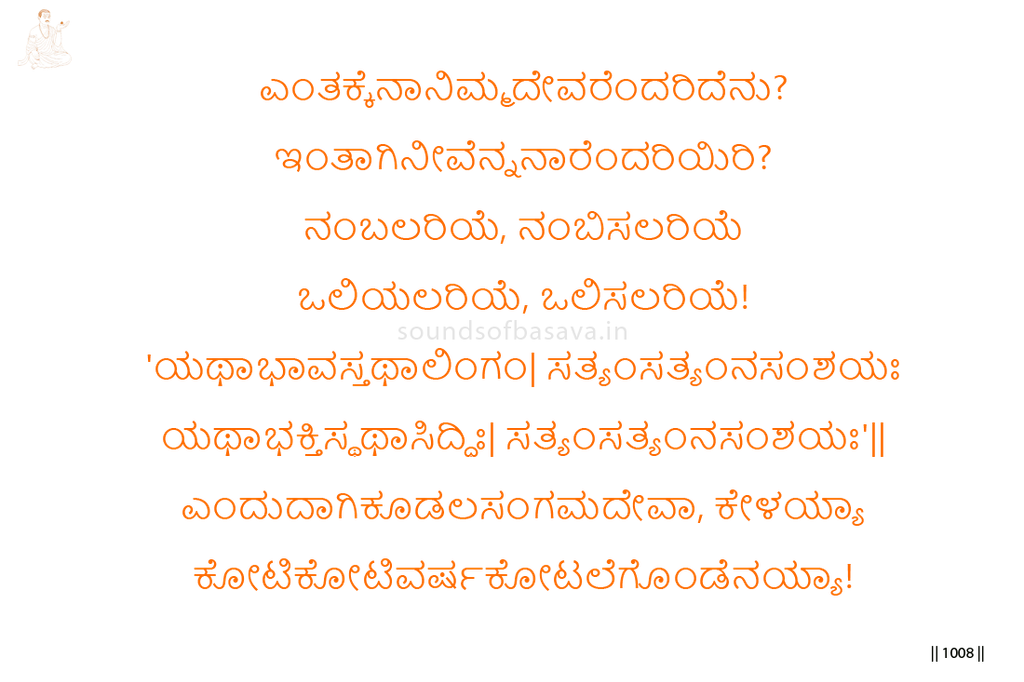
Basavanna questions his own speech: why did he call Kudalasangama Deva “my God”? The phrase appears intimate, but he sees that it can still carry hidden separation. If God is held as “mine,” then the one who says “mine” may still stand apart.
He then asks: if this is so, what do You know me as? The question turns the error back upon the speaker. The problem is not in Kudalasangama Deva, but in the way the speaker has positioned himself before the Lord.
The lines that follow show the consequence of divided devotion. He cannot know, cannot make another know, cannot be pleased, and cannot please. The Aikya source explains that devotion which reinforces distance cannot culminate in Aikya, because the very grammar of separation becomes the obstacle.
The final cry says that he has been struck or trapped for countless ages. Time itself cannot solve a wrongly held relation. If separation remains at the root, even long striving only continues the distance.
Imagery & Symbolic Relevance
The opening phrase, “Why, why did I say You are my God?” gives the central self-questioning of the vachana. Basavanna is not blaming another person or another doctrine. He examines his own devotional speech.
The phrase “my God” is the hidden image of the vachana. It sounds like closeness, but Basavanna sees that it may still contain possession. “My” can preserve the one who owns, and “God” can remain as the one owned or addressed from a distance.
The question “then what do You know me as?” deepens the self-examination. If the speaker has placed Kudalasangama Deva outside himself through possessive language, then his own identity before the Lord has also become uncertain.
The line “I do not know” gives the first consequence. When the Divine is held as separate possession, knowledge remains incomplete. One may speak of God, but not truly know the relation.
The line “I cannot make another know” gives the second consequence. A divided seeker cannot guide another into undivided seeing. What remains unresolved within cannot be transmitted as truth.
The line “I cannot be pleased” gives the third consequence. Inner satisfaction does not arise where separation remains. Devotion that keeps distance cannot give rest.
The line “I cannot please” gives the fourth consequence. If the relation itself is divided, even the attempt to please the Lord remains uncertain. Offering is weakened when the offerer still stands apart in possessive identity.
The address to Kudalasangama Deva makes the confession direct. Basavanna does not turn this into abstract debate. He speaks the error before the Lord Himself.
The final phrase about “crores and crores of years” gives the image of endless duration. The source states that countless ages signify the futility of prolonged seeking built upon a false orientation. More time does not heal separation if the root-position remains wrong.
Together, the lines show that the obstacle is subtle. Basavanna is not rejecting devotion; he is purifying it from possession. The speech “my God” must become free of the hidden distance between the one who claims and the One who is claimed.
Lingayoga
In Lingayoga, this vachana teaches the seeker to examine the language of devotion. Even sacred speech can preserve separation if it is rooted in ownership.
The practice-point is direct: do not allow “my God” to become a possessive relation. Let remembrance, worship, and speech soften the one who says “mine.” If the speaker remains separate and God remains an object of possession, the practice has not reached its inward truth.
The source says that the issue here is mistaken positioning: seeking across time cannot resolve what is misframed at the level of being. Therefore the seeker must correct the root-relation before Kudalasangama Deva, not merely prolong effort.
Editorial Commentary
This vachana should be read with great care. Basavanna does not forbid loving address to God. He exposes the danger of possessive devotion when the word “my” protects the separate self.
The force of the vachana lies in its inward honesty. The speaker sees that even devotion can hide division. The correction is not less devotion, but truer devotion: devotion in which Kudalasangama Deva is no longer held as an external possession.
Related Vachana
Supporting Vachana
Sharana Sthala Vachana 27 — The Impossibility of Self-Perfection
Sharana Vachana 27 supports this Aikya vachana by removing the ground of self-claim. There, Basavanna asks whether he can gather his virtues and faults before Kudalasangama Deva, asks how he can be equal to the incomparable Lord, and finally asks what he can do apart from Him. The source explains that the seeker cannot complete himself through self-arrangement and must place all capacity before Kudalasangama Deva.
Aikya Vachana 269 carries this surrender into the subtler field of devotional speech. In Sharana Vachana 27, the separate self cannot arrange itself into completion. In Aikya Vachana 269, even the phrase “my God” is examined because it may still preserve the one who claims and the God who is held apart. The self-claim questioned in Sharana becomes, in Aikya, a correction of possessive devotion itself.
Advancing Vachana
Aikya Sthala Vachana 960 — Inner and Outer, Self and World: One Alone
Aikya Vachana 960 advances this teaching within Aikya Sthala. In Vachana 269, Basavanna exposes the error of holding Kudalasangama Deva as “my God” in a way that preserves distance. In Vachana 960, the remaining divisions are dissolved more fully: inner and outer, self and world, are seen as one, and Kudalasangama Deva is named as the primal ground beyond subtle sound and seed.
Thus Vachana 269 corrects the hidden division inside devotional possession, while Vachana 960 shows the wider Aikya recognition in which inner and outer no longer stand apart. The error of “my God” gives way to the seeing that nothing is outside Kudalasangama Deva’s ground.
