

Summary
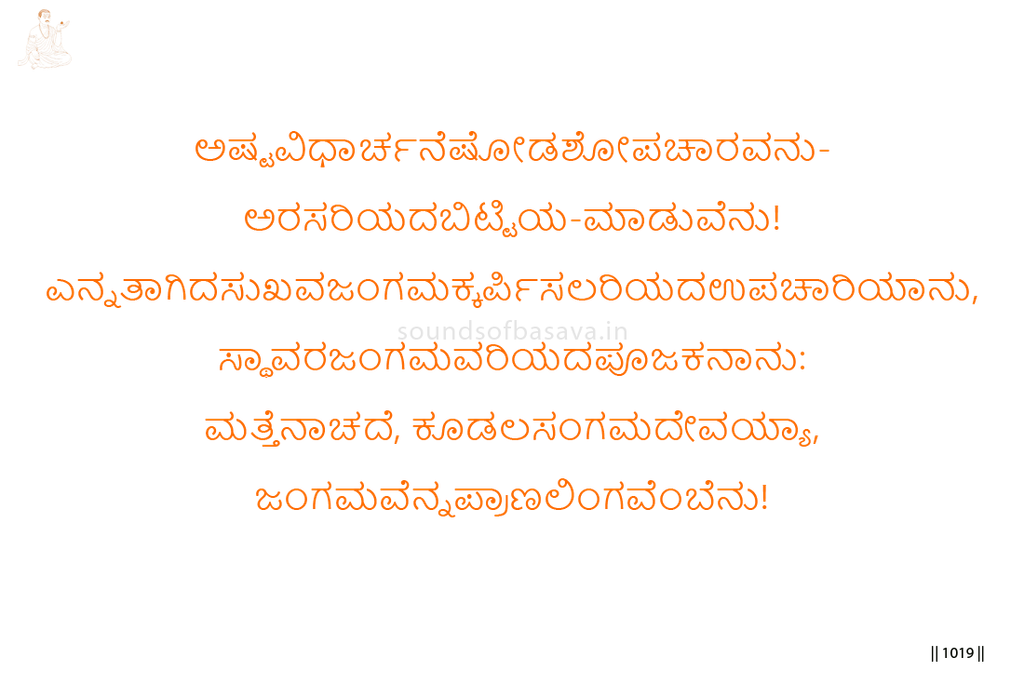
Basavanna confesses that he performed Aṣṭavidha Archane and Ṣoḍaśopachāra, the eightfold worship and sixteen sacred offerings. These acts are not dismissed as useless; they are acknowledged as part of worship and discipline.
Yet he also sees a lack within himself. The joy that arose in him through worship was not offered to the Jangama. He had remained an upachari, one engaged in sacred offering, but he had not completed the offering by returning its fruit to the living sacred presence.
He then names his earlier limitation: he was a worshipper who did not know Sthavara and Jangama together. The final turn is decisive: without further hesitation, before Kudalasangama Deva, he declares that Jangama itself is his Pranalinga. The Aikya source identifies this as the movement from symbolic worship to living realization, where the fixed Linga is not abandoned but fulfilled through recognition of the living Jangama.
Imagery & Symbolic Relevance
The mention of Aṣṭavidha Archane gives the first image. Basavanna begins with established worship: ordered, reverent, and disciplined. The eightfold worship represents structured devotion offered to the Linga.
The mention of Ṣoḍaśopachāra gives the second image. The sixteen offerings represent fuller ritual attention. Basavanna does not mock these offerings. He admits that he performed them.
The line about performing these offerings shows the first stage of the vachana. Worship has taken place. Discipline has taken place. The seeker has not been careless or irreligious.
The line “the joy that arose in me” gives the inward result of worship. Ritual has produced sukha, inner joy. This means the worship was not empty; it generated a real devotional fruit.
The phrase “I did not know to offer it to the Jangama” gives the central confession. The problem is not that joy arose. The problem is that joy remained inwardly held and was not returned to the living sacred presence.
The word “upachari” gives the self-description. Basavanna sees himself as one who performed offerings, but whose offering had not yet become complete. The one who offers to Linga must also know how to offer to Jangama.
The line “I was a worshipper who did not know Sthavara and Jangama” gives the deeper correction. Sthavara is the fixed sacred form; Jangama is the moving sacred presence. Basavanna’s earlier worship was incomplete because these were not yet known together.
The phrase “without further shame or hesitation” gives the moment of awakening. Having recognized the incompleteness, Basavanna no longer hides behind ritual correctness. He speaks plainly before Kudalasangama Deva.
The final declaration, “Jangama is my Pranalinga,” completes the vachana. Pranalinga is the living Linga, the Linga joined with life-breath. The Aikya source says that Jangama here is not merely a wandering ascetic or social saint, but the living movement of Divine presence through conscious life.
Together, the lines move from ritual worship, to inward joy, to failure of offering, to recognition of incompleteness, and finally to the living declaration that Jangama itself is Pranalinga.
Lingayoga
In Lingayoga, this vachana teaches that Linga-worship must not remain confined to fixed form, ritual sequence, or private inward joy. Worship matures when the joy received from Linga flows toward Jangama.
The practice-point is direct: do not keep worship as inward possession. Let the fruit of worship return to living presence. If Linga is held in reverence but Jangama is not recognized, the practice remains divided.
The source states that spiritual realization which does not return to life remains partial. Therefore, the movement here is not rejection of Linga, but expansion of Linga-recognition into Pranalinga, where the Divine is known as living, breathing, moving presence.
Editorial Commentary
This vachana should be read as confession and maturation, not as rejection of ritual. Basavanna does not say that Aṣṭavidha Archane and Ṣoḍaśopachāra are meaningless. He says that even after such worship, the fruit remained incomplete when it was not offered to Jangama.
The strongest line is the final one: “Jangama is my Pranalinga.” It should govern the reading. The fixed Linga has opened into living presence; worship has moved from offering to realization.
Related Vachana
Supporting Vachana
Sharana Sthala Vachana 398 — The Living Altar
Sharana Vachana 398 supports this Aikya vachana by teaching that Linga-archane without Jangama is like water poured into a broken pot. Worship is present, and the water may be pure, but the vessel cannot hold it when Jangama-presence is absent. The Sharana source states that Linga-archane in the presence of Jangama is the path of Bhakti, and that Jangama-Prasada itself becomes Linga-archane.
Aikya Vachana 380 carries this teaching inward. In Sharana Vachana 398, Linga-worship without Jangama is shown as incomplete. In Aikya Vachana 380, Basavanna confesses that although worship produced joy, he had not offered that joy to Jangama. The earlier teaching becomes personal realization: Jangama is not secondary to Linga; Jangama is Pranalinga.
Advancing Vachana
Aikya Sthala Vachana 393 — No Greater, No Lesser
Aikya Vachana 393 advances this teaching within Aikya Sthala. In Vachana 380, Basavanna declares that Jangama is his Pranalinga. In Vachana 393, the remaining hierarchy between Linga and Jangama is dissolved: touching the Linga with the hand and bowing the head before the Jangama are no longer ranked as greater or lesser, and the Jangama itself is declared to be the Linga.
Thus Vachana 380 establishes the decisive transition from fixed Linga to living Jangama, while Vachana 393 completes that movement by removing residual comparison. What is recognized in Vachana 380 as Pranalinga becomes, in Vachana 393, the direct non-difference of Jangama and Linga before Kudalasangama Deva.
