

Summary
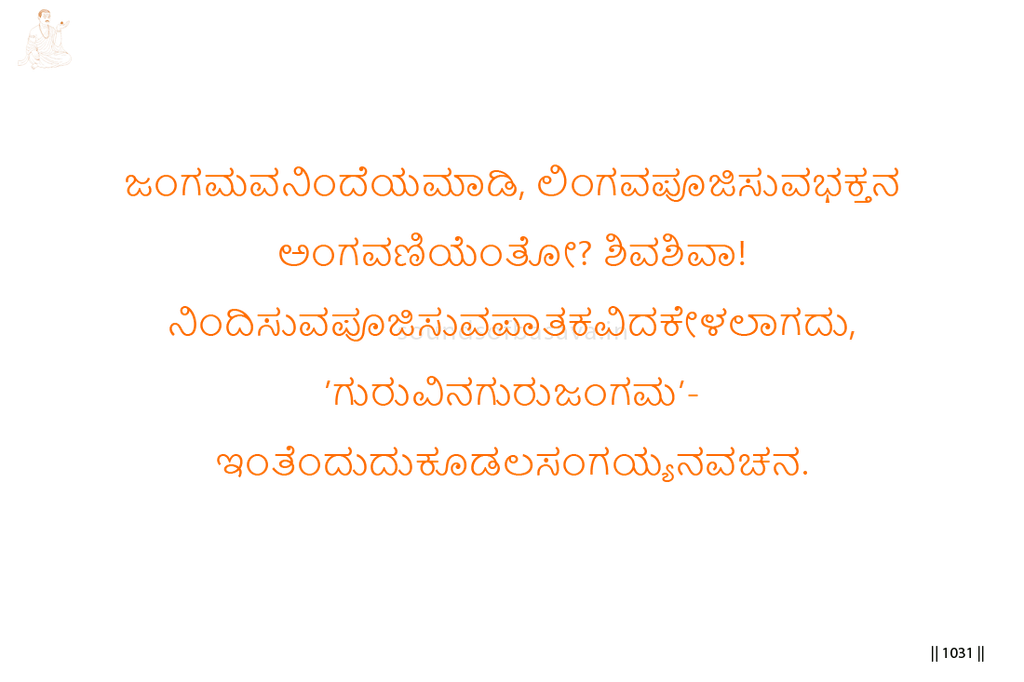
Basavanna questions the devotee who worships the Linga while speaking ill of the Jangama. The contradiction is not minor. It shows worship divided against living sacred recognition.
The cry “Shiva, Shiva” gives the vachana its alarm. Basavanna says that such a fault — condemning and worshipping at once — is not fit even to be heard. Devotion cannot remain true when reverence is offered in one place and rejection is directed toward the living Jangama.
The final line gives the corrective measure: the Guru of the Guru is the Jangama. Basavanna places this as Kudalasangama’s vachana. The devotee cannot use Linga-worship, Guru-reverence, or sacred identity to stand above the Jangama.
Imagery & Symbolic Relevance
The first image is the devotee who reviles the Jangama. The word “reviling” shows active disparagement, not mere ignorance. The Jangama is not simply overlooked; he is condemned.
The second image is the same devotee worshipping the Linga. Basavanna places worship and reviling side by side to reveal the contradiction. Linga-worship cannot be whole when the Jangama is dishonored.
The question about what kind of devotee this is turns the judgment inward. Basavanna is not asking about ritual correctness alone. He is asking what kind of embodied devotion can contain such division.
The cry “Shiva, Shiva” marks sacred alarm. It is the response to a condition in which worship itself has become fractured.
The phrase “condemning and worshipping” gives the central contrast. The mouth, mind, and conduct are divided: one movement honors, another rejects. Basavanna calls this a fault that should not even be heard.
The statement that the Guru of the Guru is the Jangama completes the correction. Even Guru-reverence cannot be separated from Jangama-recognition. The Jangama stands as the living sacred presence before which fixed hierarchy and selective reverence are tested.
The closing statement, “this is Kudalasangama’s vachana,” seals the teaching. Basavanna does not present this as personal preference. He places the measure before Kudalasangama Deva.
Lingayoga
In Lingayoga, this vachana teaches that Linga-worship must not be separated from Jangama-recognition. The act of worship loses truth when the living Jangama is reviled.
The practice-point is direct: do not let reverence become selective. If the Linga is worshipped, the Jangama cannot be dishonored. If the Jangama is condemned, the worship of Linga has already become divided.
This vachana also corrects spiritual pride. The seeker may claim devotion, worship, or relation to Guru, but none of these can justify disregard for Jangama. Practice must become whole in speech, conduct, worship, and living recognition.
Editorial Commentary
This vachana should be read as a severe correction of divided devotion. Basavanna does not criticize Linga-worship; he criticizes Linga-worship that coexists with reviling the Jangama. The force of the vachana lies in the impossibility of holding both movements together. Worship that dishonors living sacred presence becomes spiritually self-contradictory before Kudalasangama Deva.
Related Vachana
Supporting Vachana
Sharana Sthala Vachana 395 — The Living Temple
Sharana Vachana 395 supports this Aikya vachana by declaring that Jangama itself is Linga. There, Basavanna turns away from many sacred places and trusts the living Jangama as Linga before Kudalasangama Deva. Aikya Vachana 425 sharpens the same recognition into warning: if Jangama is Linga, then worshipping Linga while reviling Jangama is a direct contradiction of the sacred relation itself.
Advancing Vachana
Aikya Sthala Vachana 1341 — Where There Is Slander, There Is No Linga
Aikya Vachana 1341 advances this teaching by showing the fuller consequence of slander. In Vachana 425, Basavanna says that reviling Jangama while worshipping Linga is a fault not fit to be heard. In Vachana 1341, the measure becomes still sharper: where Linga is truly present, slander cannot remain. Thus the warning against reviling Jangama advances into the Aikya condition where fault-finding itself has no place before Kudalasangama Deva.
