

Summary
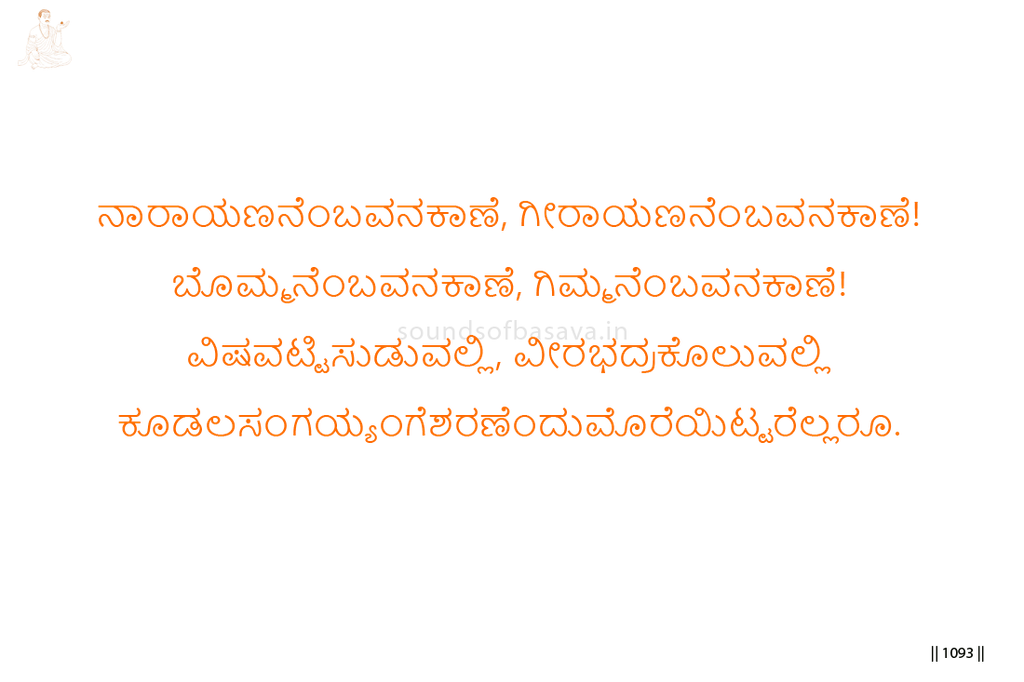
Basavanna points to those called Nārāyaṇa, Vīrāyaṇa, Bomma, and Imma.
When poison burns and Vīrabhadra strikes, all of them cry out for refuge in Kudalasangayya.
The vachana tests the many names at the moment of danger. Whatever names may be borne, the decisive cry of refuge is directed to Kudalasangama Deva.
Imagery & Symbolic Relevance
The repeated expression “see the one called” governs the opening. Basavanna asks the listener to look at each named figure rather than merely accepting the name as proof of independent greatness.
Nārāyaṇa is named first.
Vīrāyaṇa follows as another named figure.
Bomma and Imma complete the sequence. The vachana places the four names side by side without explaining or ranking them.
The movement changes sharply with the burning of poison. The names are no longer considered under ordinary conditions; they are tested when danger becomes immediate.
The phrase “when Vīrabhadra strikes” introduces a second moment of force and ordeal. What appears secure through name or reputation is brought under pressure.
The final action belongs to all of them. The many named figures do not maintain separate claims at the decisive moment.
They cry “Śaraṇu” to Kudalasangayya. The vachana therefore ends not with the four names, but with their common act of seeking refuge.
Lingayoga
In Lingayoga, refuge must be known where fear, suffering, or severe testing exposes the actual direction of dependence.
A sacred name or claimed power is not enough by itself. The decisive question is where the mind turns when danger arises.
The vachana directs the seeker toward undivided refuge in Kudalasangama Deva. Practice should not remain scattered among names while inward dependence rests elsewhere.
The practical direction is clear: let the refuge sought in crisis be the refuge held continuously in awareness.
Editorial Commentary
The poison and Vīrabhadra remain actual source-images. They establish the condition in which ordinary claims are tested.
The closing “all of them” is essential. Basavanna’s emphasis is not simply that Kudalasangayya has another name, but that every named figure in the sequence finally appeals to Him for refuge.
Related Vachana
Sharana Sthala Vachana 1372 — The Fearless Walk
Sharana Vachana 1372 presents samsara as a forest containing tigers and bears, yet the Sharana of Kudalasangama Deva does not tremble. Fearlessness does not arise because danger disappears, but because refuge in the Lord has become firm.
This directly prepares Vachana 549. In Sharana, refuge gives steadiness while danger remains. In Aikya Vachana 549, poison and Vīrabhadra expose where refuge truly lies: all the named figures cry to Kudalasangayya.
Advancing Vachana
Aikya Sthala Vachana 550 — The God of Gods
Vachana 549 states that when poison burns and Vīrabhadra strikes, all cry “Śaraṇu” to Kudalasangayya.
Vachana 550 returns directly to the poison-image. During the churning for nectar, when the poison burns, the gods run to Śiva for refuge. Basavanna then identifies Kudalasangayya as the God of gods and the others as dependent upon Him.
The common cry of refuge in Vachana 549 therefore advances into explicit discernment in Vachana 550: those who themselves require refuge cannot be the final refuge; Kudalasangama Deva is the One to whom they turn.
