

Summary
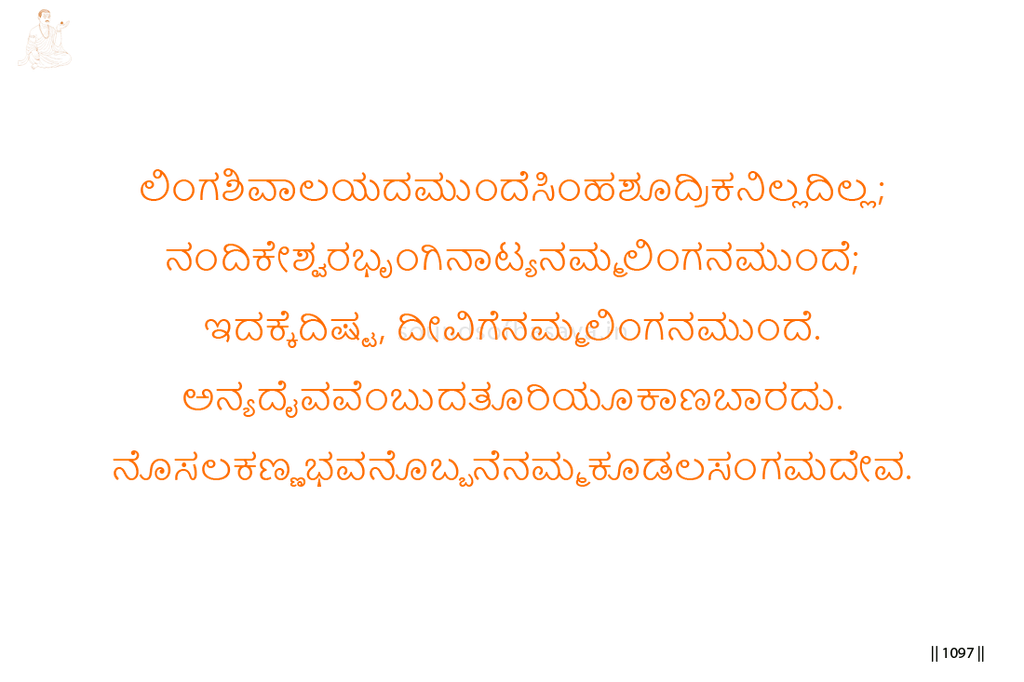
Basavanna places lion-like power, Nandikeshwara, Bhringi’s dance, and the directional deities before the Linga. None of them can stand as another independent Divine reality before Kudalasangama Deva.
He then declares that another deity cannot be shown or seen.
The forehead-eyed Abhava alone is God. The vachana ends every possibility of a second Divine centre in Kudalasangama Deva.
Imagery & Symbolic Relevance
The lion-like force gives the first image. Power, fierceness, or sovereignty cannot by itself establish the final Divine before the Linga.
Nandikeshwara stands closely associated with Shiva. His nearness and devoted service are sacred, yet they do not make him another God beside the Linga.
Bhringi’s dance presents intense devotional movement. Even such concentrated devotion remains an action performed before the Linga; it is not the Linga itself.
The directional deities extend the sequence into cosmic order. Powers connected with the directions may guard and govern their fields, but they do not form separate ultimate realities before Kudalasangama Deva.
The repeated phrase “before our Linga” gives the measure of every image. Power, service, dance, and guardianship are all placed before the One by whom they must be understood.
Basavanna then says that another deity cannot be shown or seen. The statement removes both presentation and perception: no second God can be pointed out as standing apart from the Linga.
The expression “forehead-eyed” identifies Shiva through the third eye.
The name Abhava presents Him as the One not subject to ordinary arising or becoming.
The closing statement—“He alone is God, Kudalasangama Deva”—gathers the whole vachana. The many sacred figures and powers do not become rivals, equals, or independent centres beside Him.
Lingayoga
In Lingayoga, the seeker must distinguish the Linga from every power, attendant, devotional action, or sacred function associated with it.
Power is not the Linga. Nearness to the Linga is not the Linga. Dancing before the Linga is not the Linga. Guardianship within the cosmic order is not the Linga.
The seeker should therefore not stop at an intermediary, however sacred or closely related to Shiva it may appear.
The practical direction is clear: let awareness remain centred in Kudalasangama Deva without constructing a second Divine support beside Him.
Editorial Commentary
The named figures should not be treated as false or meaningless. The Kannada places them before the Linga and refuses to identify them as another independent God.
The force of the vachana lies in the distinction between sacred association and ultimate Divinity. Nandikeshwara, Bhringi, and the directional powers may stand in relation to the Linga, but relation does not make them a second Linga.
Abhava means the One not governed by arising or becoming.
The final line is explicit. The forehead-eyed Abhava alone is God, and He is identified as Kudalasangama Deva.
Related Vachana
Sharana Sthala Vachana 751 — The Hollow Drum
Sharana Vachana 751 compares misdirected religious action to placing rice upon a drum. The drum may produce sound, but it cannot receive the rice as nourishment. The vachana concludes by instructing the seeker not to say that another deity exists apart from Kudalasangama Deva.
This directly prepares Vachana 564. In Sharana, devotion is disciplined against misplaced offering and divided refuge. In Aikya, even sacred attendants, devotional movement, power, and cosmic guardianship are placed before the Linga, and no second deity can be shown or seen.
Advancing Vachana
Aikya Sthala Vachana 567 — Beyond Name and Difference
Vachana 564 declares that no other deity can be shown or seen and that the forehead-eyed Abhava alone is God.
Vachana 567 carries this recognition into the discipline of speech. It warns against speaking of Shiva and Vishnu through divisive formulations when Kudalasangama Deva has not been directly known.
The absence of a second Divine centre in Vachana 564 therefore deepens in Vachana 567 into freedom from verbal division. When the One is known, sacred names are no longer used to construct separation, rivalry, or another ultimate reality.
