

Summary
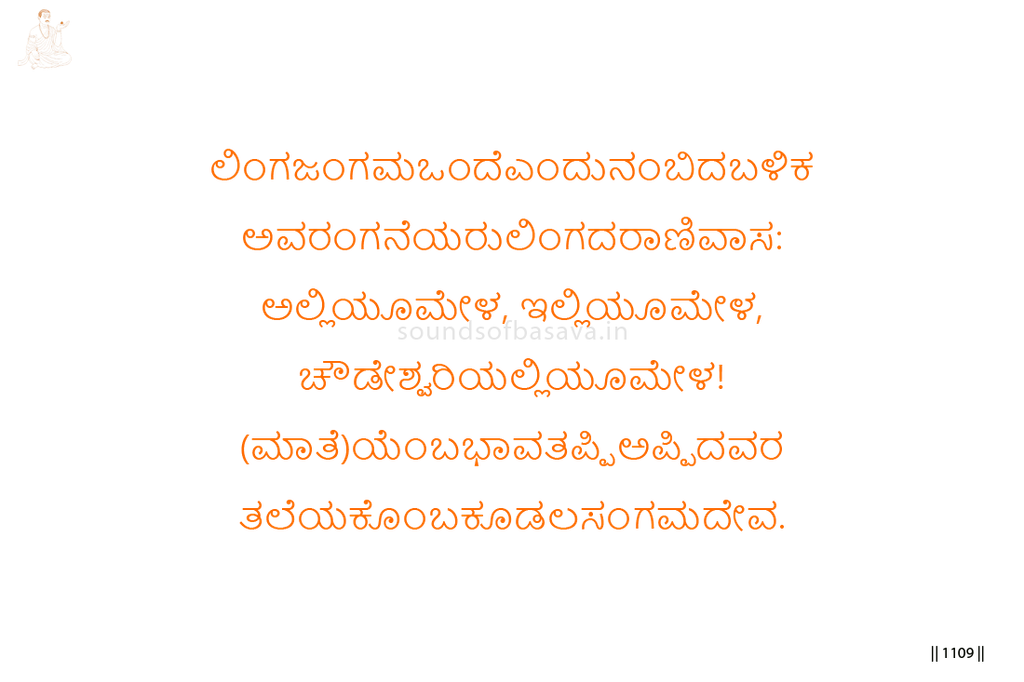
When Linga and Jangama are known as one—not merely spoken of as one or accepted through belief, but directly realized—their presence is no longer divided.
Those established in this realization know the dwelling of the Beloved. Presence is recognized there and here, rather than sought through separation.
The final warning concerns pride. The moment one thinks, “I am higher,” “I am holier,” or “I stand above another,” a division is placed between Linga and Jangama. The head in which such pride arises already belongs to Kudalasangama Deva.
Imagery & Symbolic Relevance
The opening phrase, “when Linga and Jangama are known as one,” gives the foundation of the vachana.
The word known carries more than verbal agreement. The unity must become realized recognition. A person may repeat that Linga and Jangama are one while continuing to treat them through separation or hierarchy; such speech has not yet become knowing.
The next line concerns the residence of the Beloved. Once Linga and Jangama are realized as one, the dwelling of the Divine is no longer unknown or placed at a distance.
The question concerning being together there and together here extends the realization beyond one location. Unity cannot be confined to a single place, occasion, or sacred gathering.
Chowdeshwari, the feminine Divine image named in the vachana, enters this same question of presence. The line tests the tendency to place Divine nearness elsewhere after the unity of Linga and Jangama has already been realized.
The final movement turns toward pride.
The thought “I am higher” creates hierarchy.
The thought “I am holier” turns realization into personal status.
The thought “I stand above another” places distance where unity has been recognized.
Even the faintest shadow of such pride divides Linga from Jangama in the seeker’s awareness.
The image of the head belonging to Kudalasangama Deva gives the correction its severity. The very centre that produces the claim of superiority is already under the Lord’s authority. Pride therefore has no independent ground upon which to stand.
Lingayoga
In Lingayoga, Linga–Jangama unity must become lived realization rather than doctrinal speech.
Once this unity is known, the seeker no longer searches for Divine presence by moving between separate sacred locations or identities. The Beloved’s dwelling is recognized through the undivided field of Linga and Jangama.
This realization also removes spiritual hierarchy. Knowledge, practice, status, or proximity cannot become reasons to stand above another.
The discipline is inward and exact: watch for the first movement of superiority. Where pride enters, unity has already been obscured.
Editorial Commentary
The governing contrast is between realized unity and the pride that recreates separation.
The references to “there,” “here,” and Chowdeshwari concern the recognition of Divine presence without dividing it among separate locations or images.
The final head-image places spiritual pride directly before Kudalasangama Deva. The one who claims higher or holier standing has forgotten that the head making the claim already belongs to the Lord.
Related Vachana
Supporting Vachana
Sharana Sthala Vachana 398 — The Living Altar
Sharana Vachana 398 compares Linga-worship separated from Jangama to water poured into a broken pot. The worship may be present, but its fruit cannot be retained while the living Jangama relation is absent.
This prepares Vachana 640 directly. In Sharana, the separation of Linga and Jangama is shown to make worship incomplete. In Aikya Vachana 640, their unity is no longer merely maintained through practice; it is known through realization.
What Sharana Vachana 398 protects from separation becomes, in Vachana 640, an undivided awareness in which pride, hierarchy, and the search for a separate Divine dwelling lose their ground.
Advancing Vachana
Aikya Sthala Vachana 393 — No Greater, No Lesser
Vachana 640 warns that the slightest thought of being higher, holier, or above another places a shadow between Linga and Jangama.
Vachana 393 removes that hierarchy explicitly. It places touching the Linga with the hand beside bowing the head before the Jangama and asks which is greater and which is lesser. Its conclusion is direct: knowing no difference between the two, Jangama itself is Linga.
The pride rejected in Vachana 640 therefore advances into complete non-comparison in Vachana 393. Neither fixed Linga nor living Jangama is placed above the other; greater and lesser disappear in realized unity.
