

Summary
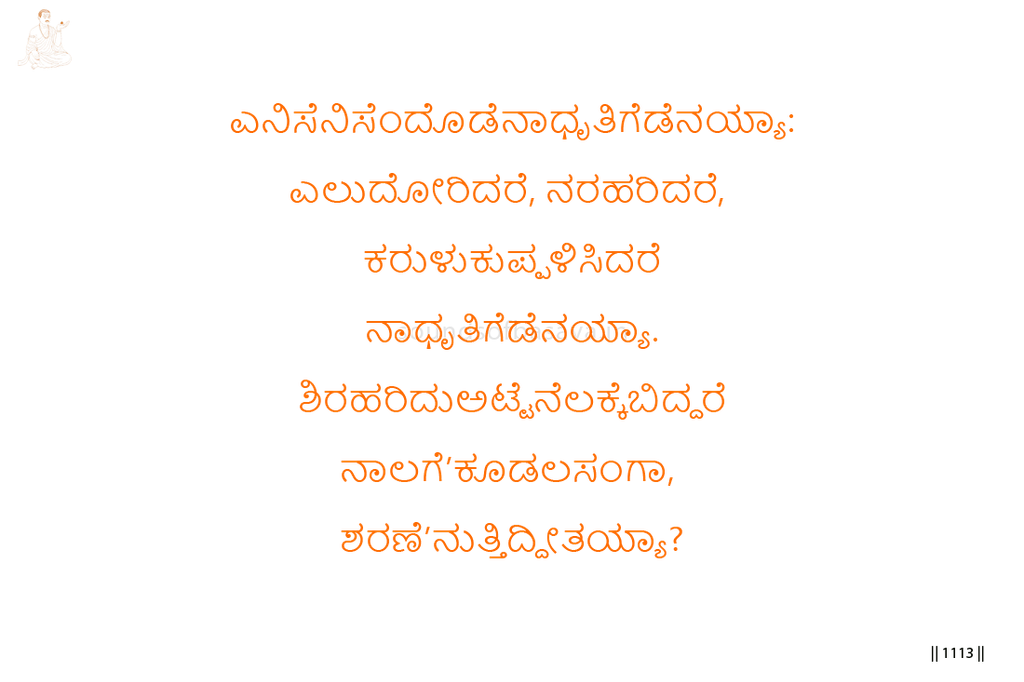
Basavanna declares that whatever may happen, he will not lose steadiness. Even if the bones are exposed, the nerves are torn, and the entrails spill out, his inward firmness will remain unchanged.
The bodily images intensify until the head itself is severed and falls to the ground. Yet the tongue continues to utter, “Kudalasanga, Sharanu.”
The vachana presents surrender that no longer depends upon bodily safety or survival. When every physical support is removed, refuge in Kudalasangama Deva remains the final and unbroken movement.
Imagery & Symbolic Relevance
The repeated declaration, “I shall not lose steadiness,” governs the entire vachana. Dhriti is tested not through ordinary inconvenience but through the most extreme destruction of the body.
The exposed bones form the first bodily image. What is normally protected by flesh is laid bare. The image removes bodily security and outward protection.
The torn nerves or sinews deepen the injury. The body’s power of movement and sensation is broken, yet the speaker does not identify this physical rupture with the loss of inward firmness.
The spilling entrails bring the body to the edge of complete collapse. Basavanna does not soften the image. He places devotion where bodily integrity can no longer be preserved.
The severed head falling to the ground is the final physical image. The head, normally associated with speech, recognition, and conscious direction, can no longer support ordinary action.
Yet the tongue continues to say, “Kudalasanga, Sharanu.” The image declares that surrender has entered more deeply than deliberate speech. “Sharanu” is no longer a word chosen only in safety; it has become the final expression of belonging.
The movement is therefore exact: the body is progressively opened, torn, emptied, and brought down, while steadiness remains. Bodily continuity ends, but refuge does not turn elsewhere.
Lingayoga
In Lingayoga, this vachana tests whether remembrance remains dependent upon comfort, health, or self-preservation.
The body may suffer and lose its capacities, but the relation to Linga must not be abandoned with them. Dhriti is the firmness by which awareness remains turned toward Kudalasangama Deva when bodily support fails.
The final utterance shows surrender becoming spontaneous. The practitioner no longer needs to construct refuge through effort; belonging to the Linga has entered the deepest movement of life.
Editorial Commentary
The severe bodily imagery establishes the extremity of the test. It does not glorify injury or make suffering desirable. Its purpose is to show that no physical condition can compel the Sharana to abandon refuge.
The tongue speaking after the head has fallen is an image of surrender outlasting ordinary bodily agency. Its force lies in the unbreakable continuity of “Kudalasanga, Sharanu.”
Related Vachana
Supporting Vachana
Sharana Sthala Vachana 697 — Death Is No Threat to the One Who Walks With the Lord
Sharana Vachana 697 says that what is expected tomorrow may come today, and what is expected today may come this very moment. Since death is certain for one who is born, the Sharana neither fears nor grieves over its arrival. What Kudalasangama Deva has written cannot be altered even by Hari or Brahma.
This prepares Vachana 692 by freeing the seeker from fear of death. Vachana 697 establishes acceptance of death under Kudalasangama Deva’s will; Vachana 692 reveals the steadiness that remains when bodily destruction actually confronts the devotee.
The Sharana first ceases to bargain with the time of death. In Aikya, that freedom matures into surrender that continues through the body’s final collapse.
Advancing Vachana
Aikya Sthala Vachana 693 — The Unbroken Drum
Vachana 692 shows the body torn apart and the severed tongue still uttering “Kudalasanga, Sharanu.” The devotee’s steadiness survives the destruction of bodily capacity.
Vachana 693 carries this further into public violence, ridicule, and desecration. Even if the body is treated like a beaten drum, the cry of “Sharane” is mocked, and the fallen corpse is trampled, remembrance of Kudalasangama Deva’s feet does not cease.
The movement is direct: Vachana 692 establishes surrender at the destruction of the living body; Vachana 693 shows that neither humiliation nor the treatment of the body after death can break that surrender. The final utterance becomes an unbroken rhythm of refuge.
