

Summary
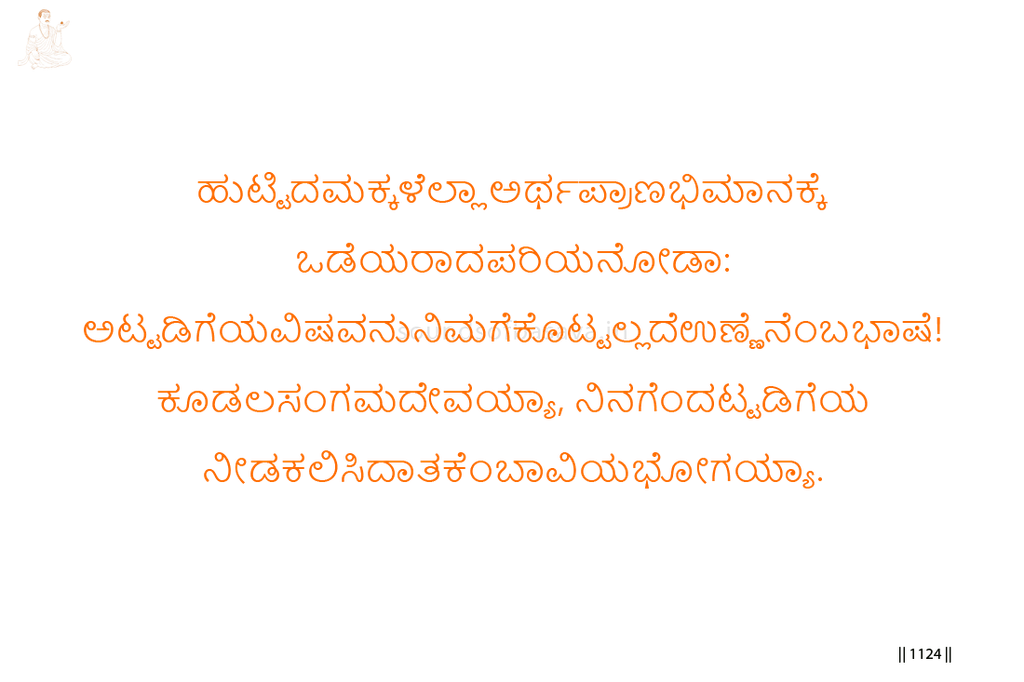
Basavanna observes how children, once born, come to exercise mastery over wealth, life, and affection or self-regard. Family attachment allows these deeply held possessions to pass under another’s claim.
Against this movement of ownership, he recalls Kembhavi Bhogayya’s vow: cooked food is to be regarded as poison unless it is first offered to Kudalasangama Deva.
Bhogayya teaches that even the food sustaining the body must not be received as private possession. It is first given to the Lord and only then eaten. The vachana therefore moves from worldly claims over wealth and life to disciplined offering before receiving.
Imagery & Symbolic Relevance
The children born into the household form the first image. Basavanna draws attention to how quickly they become masters over what the householder values.
Artha gives the first field of mastery. It refers to wealth, substance, or material resources. What a person gathers and protects becomes directed toward those born into the family.
Prana gives the second field. Children do not receive only material provision; they command the parent’s care, labour, anxiety, and life-energy.
Abhimana gives the third field. It includes affection, attachment, pride, and the possessive feeling by which a person identifies another as “mine.” The child therefore becomes master not only over property, but over inward attachment.
The phrase “see how they become owners” exposes the force of household possession. One may outwardly claim ownership over wealth and family, yet inwardly become governed by the very relationships one calls one’s own.
Cooked food forms the next image. Food is the immediate means by which embodied life is sustained. It is ordinarily taken as something prepared for personal or household consumption.
Bhogayya calls that food poison unless it is first given to Kudalasangama Deva. The food is not inherently condemned. It becomes poison when it is consumed under private claim, without first acknowledging the Lord’s ownership.
The vow “I will not eat unless I have given it to You” changes the direction of receiving. Appetite does not take first. The offering comes before consumption.
Kembhavi Bhogayya is named as the one who taught this discipline. Basavanna does not present the practice as his own invention. He receives it through the lived conduct of a Sharana.
The prepared food meant for Kudalasangama Deva completes the movement. What had appeared to belong to the household is first recognized as the Lord’s. Only after that recognition can it be received without the same possessive claim.
The vachana therefore moves from children mastering wealth, life, and attachment to Bhogayya’s correction of ownership at the daily meal. What is held most closely must first be returned to Kudalasangama Deva.
Lingayoga
In Lingayoga, ordinary receiving must remain joined to Linga.
Food should not enter life merely through appetite and private ownership. Offering it first to Kudalasangama Deva changes consumption into disciplined receiving.
The same correction applies to wealth, life-energy, and affection. They cannot remain centred entirely in family possession while the seeker claims belonging to Linga.
Kembhavi Bhogayya’s conduct gives the practical measure: recognize the Lord’s claim before one’s own and receive nourishment without forgetting its source.
Editorial Commentary
The children are the agents of the opening line: they become masters over wealth, life, and attachment. The line does not say that parents possess the child.
The word “poison” gives force to Bhogayya’s vow. It marks food consumed without prior offering as spiritually dangerous; it does not declare cooked food inherently harmful.
The vachana joins two apparently different scenes through ownership. Family attachment claims wealth and life, while Bhogayya’s discipline returns even daily food to Kudalasangama Deva before it is consumed.
Related Vachana
Supporting Vachana
Sharana Sthala Vachana 1159 — Who Truly Feeds the Lord?
Sharana Vachana 1159 examines the pride that can arise in sacred service. Hand, eye, and tongue participate in what they touch, see, and taste, but the servant must still ask who truly receives the offering.
Basavanna rejects the arrogant thought, “I have fed the Lord who contains the entire universe.” He turns instead to Madivala Machayya and asks how Kudalasangama Deva is truly satisfied.
This prepares Vachana 733 directly. Vachana 1159 removes the pride of imagining oneself to be the Lord’s feeder. Vachana 733 presents Kembhavi Bhogayya’s corresponding discipline: food must first be given to Kudalasangama Deva, yet the act cannot become a claim of personal generosity.
The Sharana teaching establishes humility in offering. The Aikya vachana brings that humility into the daily act of eating, where nourishment is first released from private ownership.
Advancing Vachana
Aikya Sthala Vachana 1162 — The Giver and the Receiver Are Kudalasanga
Vachana 733 shows the discipline of giving food to Kudalasangama Deva before eating it. The seeker no longer treats nourishment as independently possessed.
Vachana 1162 carries this recognition further by declaring that the giver is Kudalasanga, the receiver is Kudalasanga, and Kudalasangayya alone gives throughout the three worlds. The boast “we are the givers” is rejected completely.
The movement is exact: in Vachana 733, personal ownership is corrected through offering; in Vachana 1162, even the separate identity of the one who offers disappears. Food, giver, receiver, and the power of giving are known as belonging to Kudalasangama Deva.
