
Summary
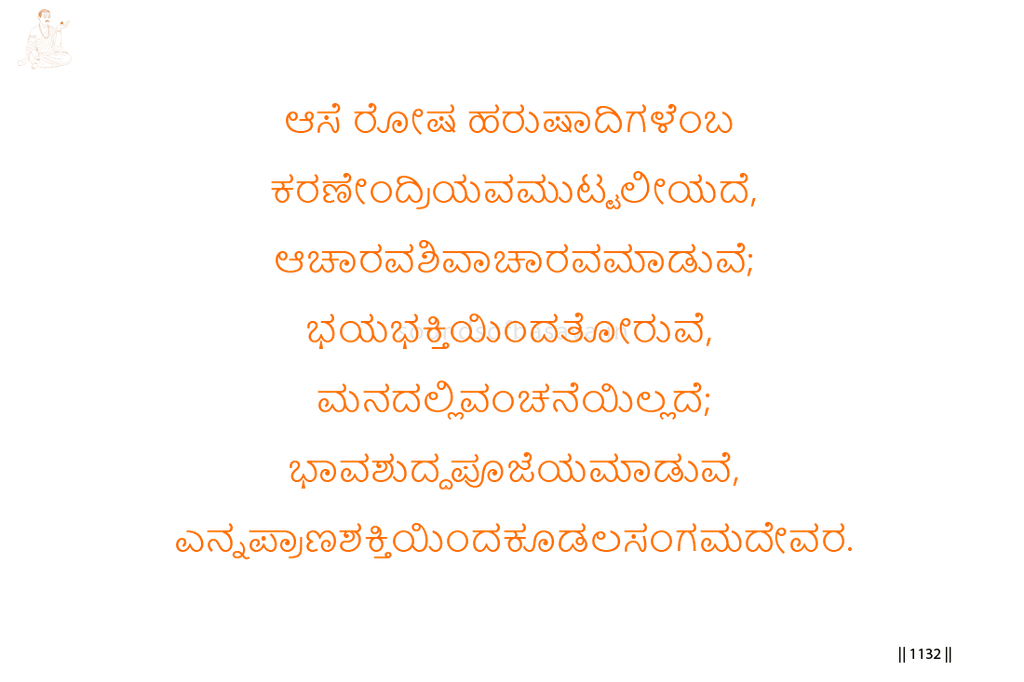
Basavanna resolves not to allow desire, anger, delight, and the movements of the sensory faculties to touch and govern him. He establishes his conduct as Shivachara and expresses it through reverential devotion.
With no deceit in the mind, he performs worship arising from purified bhava. Outer conduct, inward intention, and worship therefore proceed without contradiction.
The movement culminates in joining Kudalasangama Deva through prana-shakti. The life-force itself becomes the means through which disciplined conduct and inwardly pure worship enter living Divine relation.
Imagery & Symbolic Relevance
Desire, anger, and delight form the opening group of inner movements. Basavanna does not allow these changing impulses to determine his conduct.
The sensory faculties widen the field of restraint. What enters through sensation and what moves through embodied faculties must not seize the practitioner and redirect him.
The expression “not allowing them to touch” gives the first concrete image. These forces may arise near the field of experience, but they are not permitted to enter and govern the inner condition.
Achara becoming Shivachara gives the positive movement. Basavanna does not remain only in resistance to desire and the senses. His conduct is deliberately established as conduct belonging to Shiva.
Bhaya-bhakti gives the manner in which Shivachara is expressed. This is devotion joined with reverence, seriousness, and awareness before the Divine. Conduct does not become casual merely because outward disturbance has been restrained.
The mind without deceit gives the inward test. Shivachara cannot remain true when the outward act appears devotional but the mind secretly holds another intention.
Bhava-shuddha puja follows from this absence of deception. Worship arises from purified inner feeling rather than from display, calculation, or divided intention.
Prana-shakti gives the final and deepest movement. Basavanna does not stop with regulated conduct or inward purity. Through the living power of prana, he joins Kudalasangama Deva.
The sequence is therefore exact: disturbing impulses and sensory movements are restrained; conduct becomes Shivachara; reverential devotion gives it expression; deceit leaves the mind; worship becomes pure in bhava; and prana-shakti enters union with Kudalasangama Deva.
Lingayoga
In Lingayoga, restraint is meaningful only when it leads into Shivachara and purified worship.
The senses and emotional movements are not allowed to command conduct. Mind, bhava, worship, and prana must remain directed toward the same Linga-relation.
The final practice-point is integration: Shivachara is lived outwardly, deceit is removed inwardly, and prana-shakti joins Kudalasangama Deva.
Editorial Commentary
The opening line does not say that the senses are destroyed. It states that desire, anger, delight, and sensory movements are not allowed to touch and govern the practitioner.
Bhaya-bhakti should be understood as reverential devotion, not as panic or fearfulness. It gives seriousness and humility to Shivachara.
Bhava-shuddha puja is worship arising from an undeceiving and purified inner condition. It should not be reduced to emotional intensity alone.
The Kannada culminates in joining Kudalasangama Deva through prana-shakti.
Related Vachana
Supporting Vachana
Sharana Sthala Vachana 47 — The Cry of Helplessness
Sharana Vachana 47 asks how Basavanna can speak of Shiva-bhakti or live Shiva-achara while desire, anger, greed, delusion, pride, and jealousy bind him. Hunger, thirst, habit, the senses, and the bodily elements further disturb his steadiness, leaving him to cry helplessly before Kudalasangama Deva.
This prepares Vachana 765 directly. Vachana 47 identifies the forces that prevent Shiva-bhakti and Shiva-achara from becoming lived truth. Vachana 765 shows those forces no longer being allowed to touch and govern the practitioner.
What appears in Sharana as helpless recognition matures in Aikya into disciplined Shivachara, reverential devotion, a mind without deceit, purified worship, and union through prana-shakti.
Advancing Vachana
Aikya Sthala Vachana 1022 — The Vigilance of Complete Offering
Vachana 765 establishes a condition in which desire, anger, delight, and sensory movements no longer govern conduct. Shivachara, pure bhava, and prana-shakti are gathered toward Kudalasangama Deva.
Vachana 1022 carries this further into complete vigilance. The six inner enemies cannot enter; the bondage of the five elements is transformed into Prasada; and the powers of the five senses are gathered, refined, and fulfilled.
The continuation is precise: Vachana 765 establishes restraint, sincerity, and prana-centred joining; Vachana 1022 reveals these as settled vigilance after complete offering. What begins as disciplined non-contact with disturbance matures into a state in which the elements and senses themselves are gathered within Kudalasangama Deva.
