
Summary
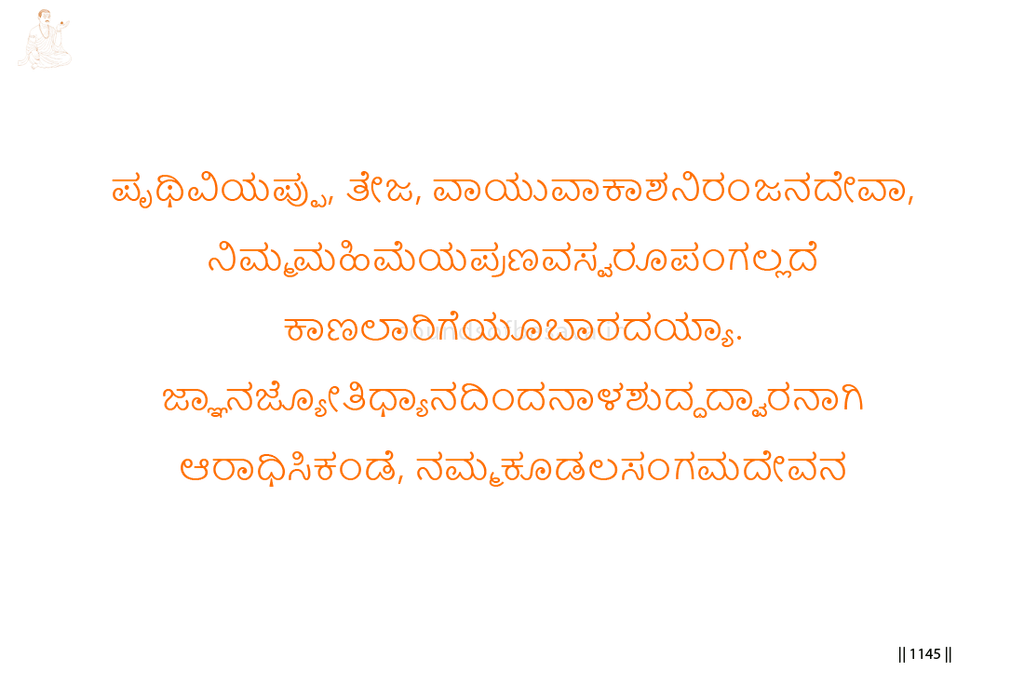
Basavanna names earth, water, fire, air, and space—the five elements through which embodied existence appears. Yet Kudalasangama Deva, addressed as Niranjana, cannot be fully known through these elemental forms.
The Lord’s greatness belongs to the sacred field of Pranava, but cannot be grasped merely by examining material existence or depending upon ordinary perception.
Through meditation upon the light of knowledge and worship through the doorway of inward purification, Basavanna beholds Kudalasangama Deva.
Imagery & Symbolic Relevance
Earth gives solidity and bodily foundation. Water gives flow, nourishment, and adaptability. Fire gives heat, light, and transformation. Air gives movement and breath. Space gives room for all forms to arise.
Together, the five elements represent the complete field of manifested and embodied existence. Everything visible and tangible is formed through their combination.
Basavanna names them before addressing Niranjana Deva. Niranjana means the stainless One—the Lord who is not limited or stained by the forms appearing through the elements.
The elements may express Divine order, but they cannot contain the Lord’s complete greatness. What is formed, perceived, and measured cannot by itself reveal that which exceeds form and measure.
Pranava gives the subtler sacred reference. The Divine greatness is related to Pranava, the primal sacred sound and source-form. Yet even this cannot be reduced to an object grasped by the senses.
The light of knowledge gives the decisive inward image. This is not accumulated information or intellectual skill. It is the illumination through which the seeker’s understanding becomes clear.
Meditation gathers that light instead of scattering attention among external forms. Knowing is therefore joined to inward steadiness.
The purified doorway gives the final movement. The inner pathway must be cleared of disturbance and division so that worship may become direct.
Basavanna does not merely state that Kudalasangama Deva exists beyond the elements. He says, “I worshipped and saw.” The movement culminates in lived beholding.
Lingayoga
In Lingayoga, the five elements are the field in which the body and its experience operate, but they are not the final measure of Linga.
The practitioner should neither reject the elements nor mistake them for complete realization. Attention must move from elemental appearance toward the light of inward knowing.
Meditation and purification prepare a clear inner passage through which worship becomes direct recognition of Kudalasangama Deva.
Editorial Commentary
The five elements should retain their concrete meaning while also representing the manifested field of embodied life.
Niranjana means stainless or untainted. It indicates that Kudalasangama Deva is not limited by the qualities and changes of the elements.
The reference to Pranava should remain restrained. It presents the sacred source-form associated with Divine greatness, not a complete cosmological system.
The purified doorway may indicate purification of the inner channels or pathway. The Kannada does not require an elaborate account of subtle-body techniques; its central movement is from purification and meditation to worshipful beholding.
Related Vachana
Supporting Vachana
Sharana Sthala Vachana 807 — Grace Alone Reveals the Moment
Sharana Vachana 807 teaches that water does not become a pearl by itself, nor does a pearl arise merely because water is present. The proper conjunction must occur. Likewise, Shiva-tattva does not become known through effort or favourable conditions alone; the Sadguru’s compassion must make the mind fit, and Kudalasangama Deva’s grace must hold it.
This prepares Vachana 814. Vachana 807 establishes that spiritual knowing cannot be manufactured by the mind. Vachana 814 shows the inward condition in which knowing becomes luminous: meditation, purification, worship, and direct beholding.
What begins in Sharana as the mind being prepared by grace matures in Aikya as the vision of Kudalasangama Deva beyond elemental limitation.
Advancing Vachana
Aikya Sthala Vachana 960 — Inner and Outer, Self and World: One Alone
Vachana 814 moves beyond earth, water, fire, air, and space and beholds Kudalasangama Deva through the purified light of knowing.
Vachana 960 carries this recognition further. Inner and outer, self and world, are known as one, while Kudalasangama Deva is revealed as the primal ground beyond Nada and Bindu—beyond even subtle sound and seed.
The continuation is precise: Vachana 814 passes beyond elemental forms into direct beholding; Vachana 960 removes the remaining division between the one who beholds and the world beheld. Elemental transcendence deepens into undivided abidance in Kudalasangama Deva.
