

Summary
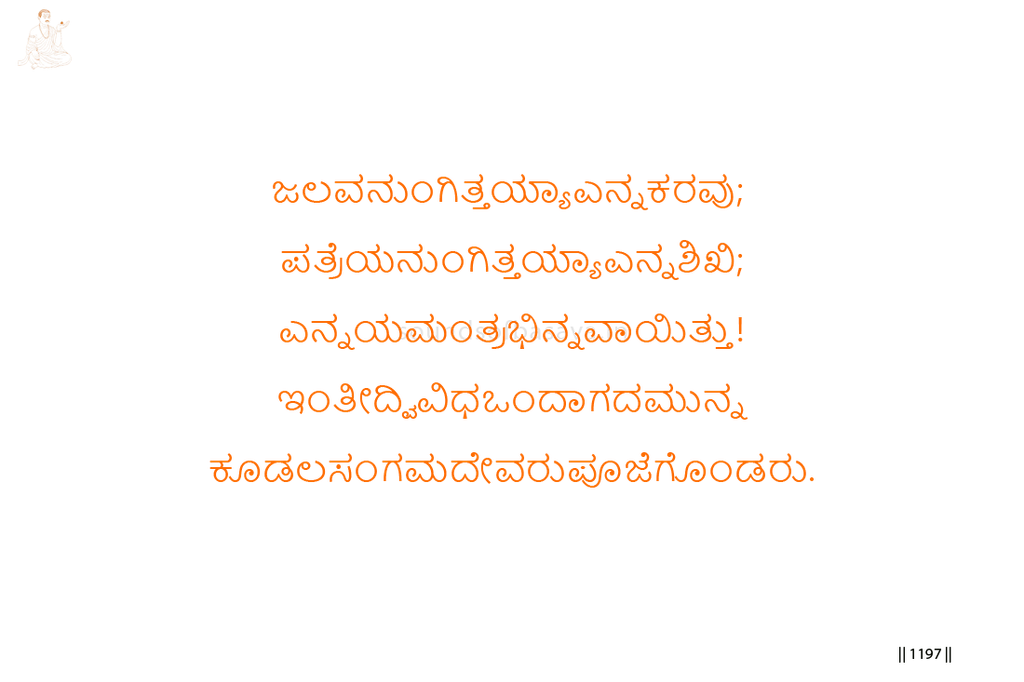
Basavanna describes worship in which the hand swallows the water, the shikhe swallows the leaf, and the mantra becomes divided. The acts of worship are present, but they have not yet become one integrated movement.
Even in this incomplete condition, Kudalasangama Deva receives the worship. The vachana therefore does not claim that unity has already been achieved; it declares that Divine acceptance precedes its completion.
Imagery & Symbolic Relevance
The hand swallowing the water is the first concrete image. Water has entered the bodily action of worship, but Basavanna deliberately says that the hand “swallowed” it. The material has been taken into the act rather than remaining merely before the worshipper.
The shikhe, the ritual tuft or crest of the head, swallowing the leaf gives the second image. As with the water, the leaf is not described abstractly. It is taken up through a specific bodily and ritual location.
The mantra becoming bhinna marks the decisive disturbance. Bhinna means broken, divided, or separated. Although the ritual actions have occurred, the sacred utterance does not remain whole.
The phrase “this twofold” indicates a condition that has not yet become one. The preceding sequence places bodily ritual action and mantra beside one another, but the Kannada does not explicitly name the two members of the pair. Their identity should therefore not be fixed more narrowly than the vachana allows.
The final declaration changes the force of the entire passage. Kudalasangama Deva received the worship before the twofold became one. The worship is neither dismissed as worthless nor presented as complete. It is accepted while integration is still unfinished.
Lingayoga
This vachana tests whether bodily worship and mantra have become one inward movement. Correct ritual action alone does not establish wholeness when the mantra remains divided.
At the same time, the final line prevents incompleteness from becoming despair. The practitioner continues toward integration from a worship already received by Kudalasangama Deva, not from a claim of perfected unity.
Editorial Commentary
The verb nungittu must retain its concrete meaning, “swallowed”; it should not be softened into “held” or “offered.”
Bhinna describes the mantra as divided or broken. It does not indicate that the mantra has dissolved into a higher silence.
The Kannada says, “before this twofold became one.” It does not say “before duality divided” or “before the two arose.”
The final verb is declarative: Kudalasangama Deva received the worship. The vachana’s distinct teaching lies in this acceptance before completed integration.
Related Vachana
Supporting Vachana
Sharana Sthala Vachana 1337 — Show Me the Difference Between Prana and Prana-Linga
Sharana Vachana 1337 confesses that worship remained outward because the living relation between Prana and Prana-Linga had not been understood. It prepares Vachana 937 by exposing worship whose inner relation is still unresolved; Vachana 937 then declares that Kudalasangama Deva receives worship even before the twofold becomes one.
Advancing Vachana
Aikya Sthala Vachana 960 — Inner and Outer, Self and World: One Alone
Vachana 937 leaves the twofold not yet unified. Vachana 960 advances the movement by declaring inner and outer, self and world, to be one, with Kudalasangama Deva as the primal ground beyond their division.
