
Summary
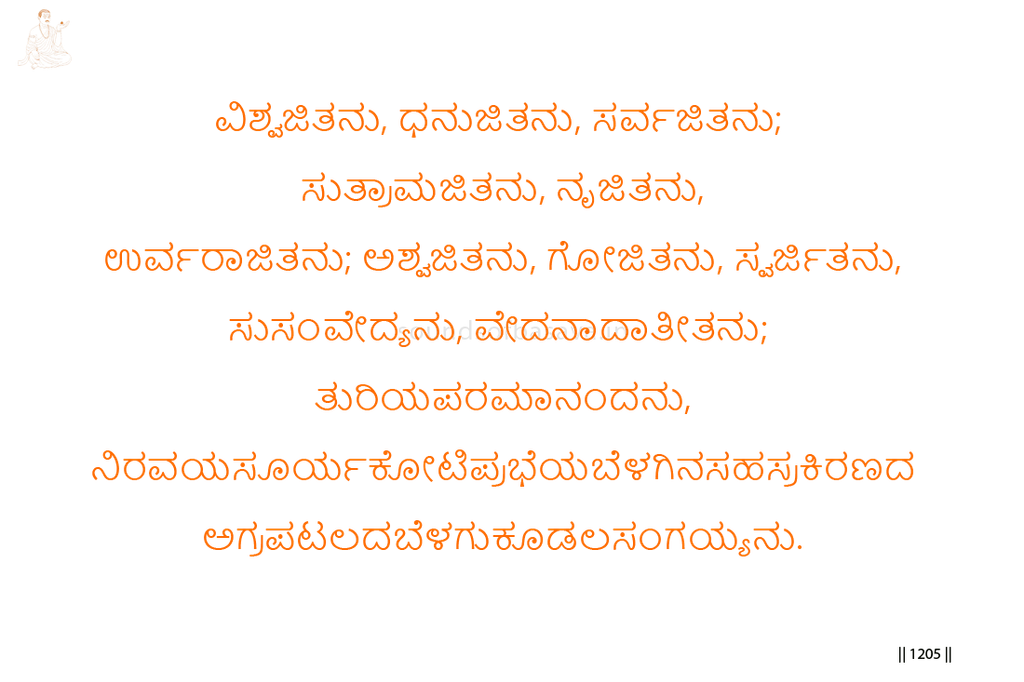
Basavanna names Kudalasangamayya through a succession of victory-titles: conqueror of the world, Danu, heaven, Sūtrāma, human beings, fertile earth, horses, and cattle—yet Himself unconquered.
He is self-aware, beyond Veda and Nāda, and the partless Turya-Paramananda. The vachana culminates in light: Kudalasangamayya is the radiance at the foremost expanse of a thousand rays within the brilliance of a crore suns.
Imagery & Symbolic Relevance
The opening movement is formed by a long series of names ending in -jita, victory or conquest.
Viśvajita names victory over the world or total field of existence. The sequence begins at its widest extent.
Danujita names victory over Danu. The vachana preserves Danu as the object of conquest without further explanation.
Svarjita names the winning or conquering of svar, the heavenly realm.
Sūtrāmajita names victory over Sūtrāma. As with Danu, the figure is not explained further in the source.
Nṛjita brings the movement into the human field: victory over nṛ, human beings or the human realm.
Ūrvarājita names victory over fertile earth or cultivated ground. The series now enters the field of land and sustenance.
Aśvajita and Gojita name victory over horses and cattle. These are concrete signs of strength, wealth, movement, and possession within ordinary royal and agrarian life.
The movement culminates in Ajita—the unconquered. After naming victories across cosmic, heavenly, human, territorial, and animal domains, Basavanna does not merely add one more conquest. He names Kudalasangamayya as the One whom no conquest contains.
Svasaṃvedanu gives the next inward movement. Kudalasangamayya is self-aware or self-known; His knowing is not dependent upon another witness.
Veda–Nāda–atītanu carries the description beyond sacred word and sacred sound. Veda represents scriptural revelation; Nāda represents sound or resonance. Neither becomes the final measure of Kudalasangamayya.
Turya-Paramananda introduces the condition of the fourth and supreme bliss. It is joined to Niravaya, partless or undivided. The bliss named here is not assembled from many parts or dependent upon separate conditions.
The imagery then changes from conquest and inward awareness to overwhelming luminosity.
The radiance of a crore suns establishes an immeasurable field of brilliance. The number magnifies the image beyond any single visible sun.
Within that brilliance appear a thousand rays. Rays normally spread light outward, yet Basavanna looks toward their agra-paṭala, their foremost plane, surface, or luminous expanse.
Kudalasangamayya is named as the light of that foremost expanse. The imagery does not merely say that He shines like a sun. It layers radiance upon radiance—crore suns, their brilliance, a thousand rays, their foremost luminous field—and places Kudalasangamayya as the light there.
The sequence is therefore exact: victory across every named domain, the unconquered One, self-awareness, transcendence of Veda and Nāda, partless Turya-Paramananda, and finally the light beyond accumulated light.
Lingayoga
In Lingayoga, spiritual life cannot be measured by conquest, possession, authority, or the accumulation of attainments. Even victory over extensive outer domains does not establish the final relation to Linga.
Veda and Nāda may guide worship and remembrance, but the practitioner must move from received word and sacred sound into direct awareness. Linga cannot remain only what is read, recited, heard, or conceptually mastered.
Niravaya gives the inward measure: practice becomes whole when Linga-relation is no longer divided among worshipper, method, attainment, and object. The radiance image then places awareness before Kudalasangamayya rather than before personal accomplishment.
Editorial Commentary
The opening words are cumulative epithets qualifying Kudalasangamayya:
Viśvajita — conqueror of the world or all;
Danujita — conqueror of Danu;
Svarjita — conqueror or winner of heaven;
Sūtrāmajita — conqueror of Sūtrāma;
Nṛjita — conqueror of the human realm;
Ūrvarājita — conqueror of fertile earth;
Aśvajita — conqueror of horses;
Gojita — conqueror of cattle;
Ajita — unconquered.
The source does not provide a separate doctrinal explanation of Danu or Sūtrāma, so the names remain attached to their stated conquest-form.
Svasaṃvedanu means self-aware or self-knowing.
Vedanādātītanu is read as Veda–Nāda–atītanu: beyond Veda and Nāda.
Niravaya means partless, without division, or undivided.
The final image is concrete and cumulative: the radiance of a crore suns, a thousand rays, their foremost luminous expanse, and Kudalasangamayya as its light.
Related Vachana
Supporting Vachana
Sharana Sthala Vachana 209 — The Living Truth Beyond Scripture
Sharana Vachana 209 distinguishes Veda, Shastra, and Gita-speech from truth embodied in the living Sharana. Sacred word must become realized presence rather than remain heard or repeated language.
It prepares Vachana 955 by carrying the seeker beyond dependence upon scripture alone. What becomes living truth through the Sharana in Vachana 209 is named here as self-awareness beyond Veda and Nāda, radiant in Kudalasangamayya.
Advancing Vachana
Aikya Sthala Vachana 956 — The Great Light Within All Lights
Vachana 956 repeats the decisive expressions Veda–Nāda–atīta, Turya-Paramananda, and Niravaya, while expanding the field through successive Purusha-names, radiance-fields, and Mahabelagu—the Great Light within light.
Vachana 955 moves from conquest-titles into the foremost radiance of a thousand rays. Vachana 956 advances this by passing beyond even exalted Purusha-designations and revealing Kudalasangamayya as the Great Light within every light.
