

Summary
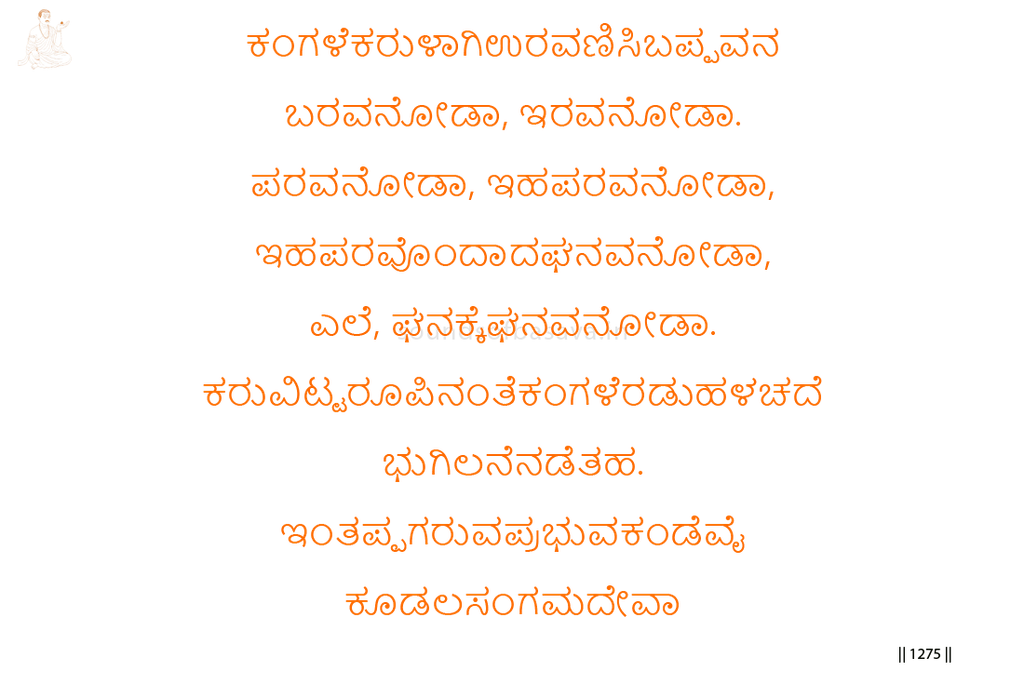
Basavanna calls for direct seeing. The eyes become inward vision through which one beholds coming and abiding, what is beyond, this world and the beyond, and the Great Reality in which both are one.
This seeing is unwavering. Like eyes fixed steadily upon a form, it neither wanders nor loses its ground. Movement and abidance no longer divide awareness.
The vision culminates in the beholding of Guru-Prabhu. Basavanna declares that he has seen such a Guru, such a Prabhudeva, before Kudalasangama Deva.
Imagery & Symbolic Relevance
The opening image transforms the function of the eyes. They do not merely receive outward forms; they become the means of inward seeing.
Basavanna first commands: see the coming. The realized presence is not treated as a distant idea. Its approach must be directly recognized.
He then says: see the abiding. Coming and remaining are both included. The vision does not depend only upon a passing appearance; it recognizes the presence that stands and continues.
The command “see the beyond” turns attention beyond what is immediately visible. The beyond is not left as something merely believed or imagined.
The next command joins this world and the beyond within one field of seeing. Basavanna does not reject what is here in favour of another realm. He asks that both be beheld.
The phrase “see the Great Reality in which here and beyond have become one” removes the division between them. They are no longer approached as two separate regions requiring later reconciliation.
The call “Come, see the Vast within the Vast” deepens the same movement. The Vast is not viewed from an outside position. It is beheld within a reality that is itself Vast.
This expression should remain attached to the source sequence. It follows the seeing of here, beyond, and their oneness; it does not introduce an unrelated cosmology.
The two eyes fixed upon a form give the central image of steadiness. Their attention does not scatter toward other objects.
The absence of wavering shows that the vision is no longer repeatedly gained and lost. It has become settled.
The image of remaining without interruption strengthens that steadiness. The Kannada does not require a literal practice of refusing to blink; it describes undivided attention.
The phrase concerning movement and abidance holds action and stillness together. The vision remains steady whether there is movement or rest.
The final line identifies the one beheld as Guru-Prabhu. Basavanna does not end with an abstract statement about vision. He points to the realized Guru in whom this condition has become visible.
In this context, Prabhu refers to Allama Prabhudeva. Kudalasangama Deva is the Lord before whom Basavanna declares that he has beheld such a Guru.
The complete movement is therefore ordered: the eyes become inward seeing; coming and abiding are beheld; beyond and here-and-beyond are seen; their oneness is recognized; the Vast is seen within the Vast; vision becomes unwavering; and Guru-Prabhudeva is directly beheld.
Lingayoga
In Lingayoga, this vachana teaches that seeing the Linga must mature beyond an outward act into a stable mode of awareness.
The practitioner must not divide immediate life from the Divine beyond. When attention remains centred in Linga, here and beyond are no longer competing directions.
The practical relevance is steadiness: seeing must not continually wander between objects, concepts, and imagined spiritual destinations. It becomes fulfilled when the living Guru is recognized without division before Kudalasangama Deva.
Editorial Commentary
The repeated “see” is the governing action of the vachana. Basavanna asks for direct recognition rather than conceptual explanation.
“Here” and “beyond” should not be restricted to geographical places. They express the distinction between immediate existence and what is regarded as transcendent.
“The Vast within the Vast” indicates indivisible greatness already contained within greatness. It should not be enlarged into an unsupported doctrine of worlds or cosmic levels.
The image of unwavering eyes describes sustained awareness, not a physical instruction to stare without blinking.
Prabhu is Allama Prabhudeva in the final clause. Kudalasangama Deva remains the Divine addressee.
Related Vachana
Supporting Vachana
Sharana Sthala Vachana 5 — The Eye-Opening Conduct
In Sharana Vachana 5, Basavanna remembers that Kudalasangama Deva sent His Sharana into the mortal world. He asks why the Sharana was sent and discovers the answer by observing the Sharana’s conduct. Through repeated seeing, his eye opens.
This prepares Vachana 1121 directly. In the Sharana vachana, seeing the lived conduct of the Sharana opens Basavanna’s vision. The eye learns to recognize truth through the presence before it.
In Aikya Vachana 1121, that opened eye becomes unwavering inward vision. It beholds coming and abiding, here and beyond as one, and finally Guru-Prabhudeva himself. What begins as eye-opening through Sharana-conduct matures into vision beyond division.
Advancing Vachana
Aikya Sthala Vachana 1122 — Behold the One Beyond Body and Ego
Aikya Vachana 1122 describes a realized being in whose eyes there is no darkness, in whose body there is no Maya, and in whose mind there is no ego. He cannot be confined either to the body or to bodilessness and remains like the hidden thread holding a garland together.
Having received the unity of Linga and Jangama as Prasada, he stands as Mahaprasadi in the true state. Basavanna identifies this condition in Marulashankaradeva and calls Chennabasavanna to behold it.
Vachana 1121 establishes the undivided vision through which Guru-Prabhudeva is beheld. Vachana 1122 immediately advances from the act of seeing to the condition of the realized one who is seen.
The progression is precise: in Vachana 1121, vision becomes steady and passes beyond the division of here and beyond; in Vachana 1122, the fruit of that vision is embodied in one who is free from darkness, Maya, ego, and the opposition between body and bodilessness.
