

Summary
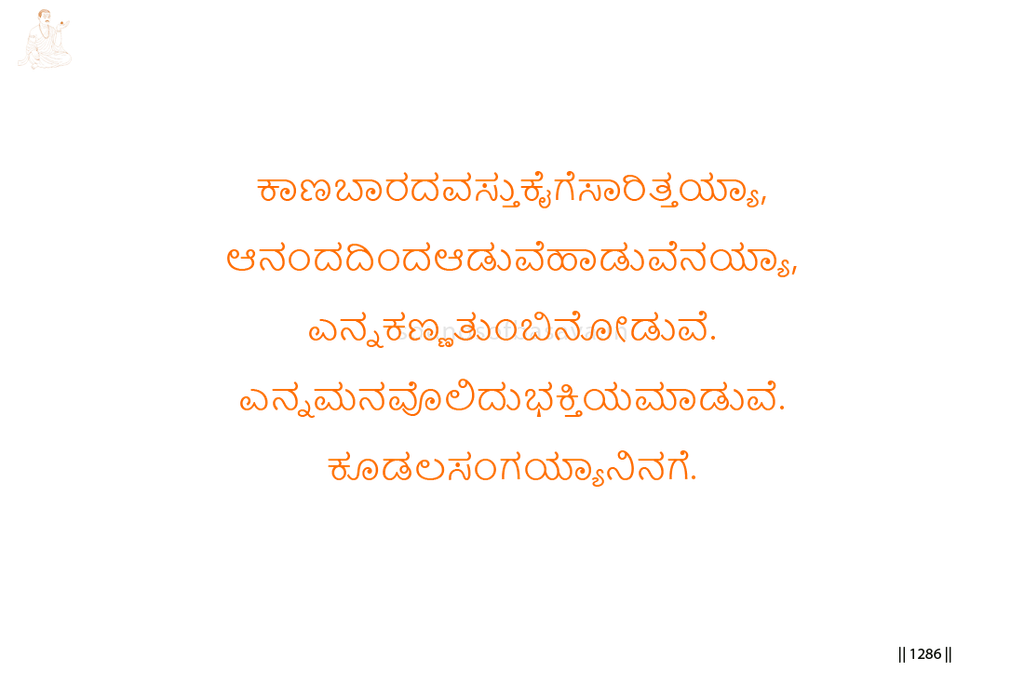
The Reality that could not be seen has come directly into Basavanna’s hands. Its nearness fills him with joy: he dances, sings, and beholds it with eyes filled.
This direct seeing does not end devotion. With his mind willingly and joyfully turned toward Kudalasangama Deva, Basavanna offers Bhakti to Him. What was formerly beyond sight has become immediate, and the whole response is joy, beholding, and devotion.
Imagery & Symbolic Relevance
The “object that could not be seen” is the central expression. Vastu indicates the Reality itself, not merely an idea formed about it. Its being unseen signifies that it could not be reached through ordinary sight.
The statement that it has “come into the hand” brings what was beyond perception into direct nearness. Basavanna does not say that he produced, captured, or mastered it. It has come to him and become directly receivable.
Joy immediately follows this reception. Basavanna dances and sings. The dance expresses joy through bodily movement, while the song gives that joy a voice. Neither is presented as a deliberate performance; both arise from what has become directly present.
The phrase “I will behold with my eyes filled” shows sustained seeing. The Reality is not merely glimpsed and then forgotten. The eyes remain fully directed toward what has come into the hand.
The final movement turns from beholding to Bhakti. Basavanna says that, with the mind gladly consenting and turning toward the Lord, he will offer devotion to Kudalasangayya. The vachana therefore joins direct presence, joy, sight, mind, and devotion without separating them.
Lingayoga
In Lingayoga, the Linga in the hand must become directly beheld rather than remaining an external object handled through habit. Karasthala and seeing are joined: what is received in the hand must also fill the vision and turn the mind toward Kudalasangama Deva.
The result is not self-satisfaction in having received the Linga. Direct recognition flowers as Bhakti. The body dances, the voice sings, the eyes behold, and the mind willingly offers devotion.
Editorial Commentary
The Kannada says that the unseen vastu has “come into the hand.” The expression indicates direct reception and accessibility, not personal ownership of the Divine.
The sequence must remain intact:
the unseen Reality comes into the hand;
joy becomes dance and song;
the eyes behold fully;
the mind turns willingly toward Bhakti;
that Bhakti is offered to Kudalasangayya.
The final “to You” governs the devotional conclusion. Kudalasangama Deva is the recipient of Basavanna’s Bhakti.
Related Vachana
Supporting Vachana
Sharana Sthala Vachana 1355 — The Linga Placed in My Hand
In Sharana Vachana 1355, the Sadguru places directly in Basavanna’s Karasthala the incomparable Linga that cannot be reached through Veda and Vedanta, divided by Nada and Bindu, or grasped by speech and mind. Basavanna then declares that he has truly lived because what he longed for has reached his hand.
This prepares Vachana 1138 precisely. The Sharana vachana establishes the gift: the inaccessible Linga is placed in the hand through the Sadguru. In Aikya Vachana 1138, the response to that direct reception unfolds completely. What has come into the hand fills Basavanna with joy, becomes the object of sustained beholding, and awakens willing devotion to Kudalasangama Deva.
Advancing Vachana
Aikya Sthala Vachana 1143 — No Difference Between the Sign and the Source
Aikya Vachana 1143 compares the revealed sign to a rainbow in the sky. The rainbow appears visibly, yet it does not possess an existence separate from the sky. In the same way, the sign received from Prabhudeva stands in Kudalasangama Deva without difference, while the body remains as its bearer.
Vachana 1138 establishes direct reception: what could not be seen has come into the hand and is beheld with joy and devotion. Vachana 1143 removes any remaining possibility of treating revealed presence as an independent object or personal possession. What is received and visibly manifested does not stand apart from its Divine source.
The movement is therefore from direct nearness to non-difference. The Reality received in Vachana 1138 awakens joy and Bhakti; Vachana 1143 clarifies that true revelation remains inseparable from Kudalasangama Deva.
