

Summary
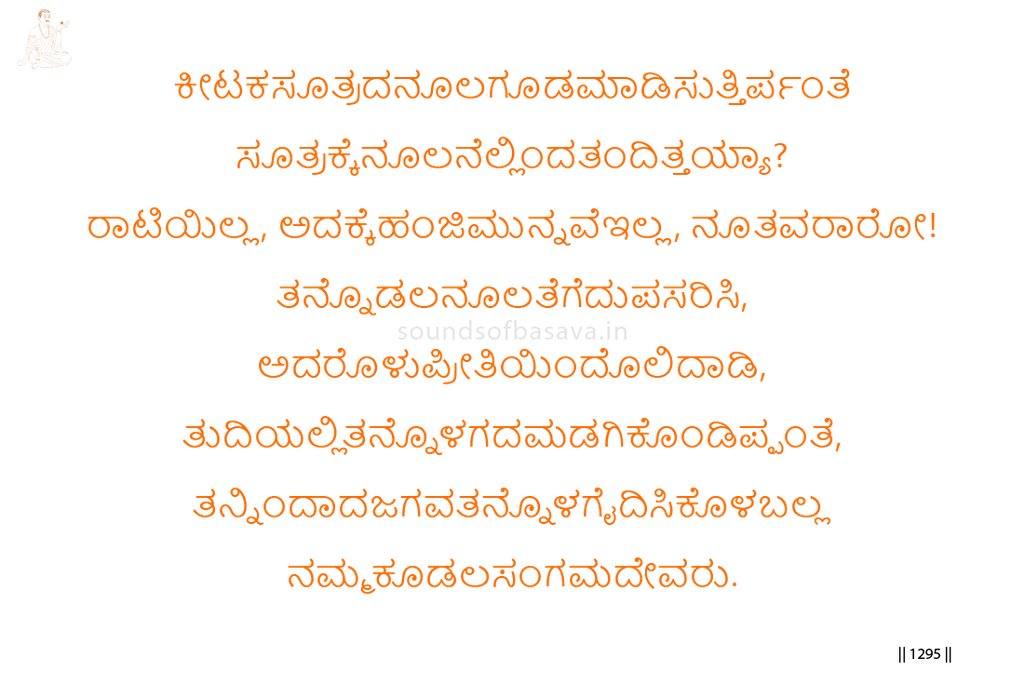
Basavanna compares Kudalasangama Deva’s relation to the world with a silkworm drawing thread from its own body, spreading it around itself, moving within it with delight, and finally gathering it back into itself.
No material, instrument, or separate maker stands outside this movement. In the same way, the world that arises from Kudalasangama Deva remains within Him and can be gathered back into Him.
Imagery & Symbolic Relevance
The silkworm and its cocoon form the governing image. The creature surrounds itself with thread, yet the thread is not brought from elsewhere.
Basavanna asks where the thread came from. The question directs attention to its source: it emerged from the creature’s own body.
The absence of a spinning wheel, spindle, and earlier weaver removes every external means of production. There is no separate material supplier, instrument, or craftsman standing before the act.
The silkworm draws out its own thread and spreads it. The cocoon is therefore formed from what arises within the creature itself.
It then moves within what it has produced “with love” or delight. The image does not show the source abandoning what has arisen. The creature remains within its own formation and moves intimately within it.
At the end, it folds or gathers the thread back into itself. The movement proceeds from the source, remains around and within the source, and returns to the same source.
Basavanna applies this complete image to Kudalasangama Deva. The world arises from Him and is gathered into Him. It is not fashioned from material independent of the Lord, nor does it possess a separate source outside Him.
The vachana therefore preserves three connected movements: arising from Kudalasangama Deva, abiding within His own field, and returning into Him.
Lingayoga
In Lingayoga, the Anga must not regard life, action, or experience as existing independently of Linga. What appears and moves does so within the sustaining relation of Kudalasangama Deva.
This recognition removes personal ownership. The practitioner does not claim to be an independent maker or source. Whatever arises through life must remain within the Linga-relation and return without self-claim.
The practice-point is not to reject the manifested world, but to recognize that it has no independent ground apart from Kudalasangama Deva.
Editorial Commentary
The repeated questions concerning the thread, spinning wheel, spindle, and weaver deny an external material, instrument, and prior maker. The image is governed by self-derived thread and self-contained movement.
The phrase describing the silkworm moving within the cocoon with love must be retained. The formation is not presented as something foreign to or abandoned by its source.
The final grammatical subject is our Kudalasangama Deva. He brings forth the world from Himself and gathers it into Himself. Its precise teaching is that the world’s arising, continuance, and return have no independent source outside Kudalasangama Deva.
Related Vachana
Supporting Vachana
Sharana Sthala Vachana 883 — The Fire Born of Sacred Friction
Sharana Vachana 883 asks whether fire does not arise when wood rubs against wood and then burn the very wood from which it arose. It then applies the image to the company of the Mahānubhāvas: through their association, the fire of knowledge arises and burns the qualities bound to embodied identity.
This prepares Vachana 1150 by establishing that the active principle need not be imported from outside. Fire arises within the wood’s own field, just as the silkworm’s thread comes from its own body.
In the Sharana vachana, an inwardly arising fire transforms the material from which it emerges. In Aikya Vachana 1150, this source-within relation expands to the world itself: Kudalasangama Deva brings forth from Himself what remains within Him and returns into Him.
Advancing Vachana
Aikya Sthala Vachana 1182 — Can the Wave Exist Apart from the Ocean?
Aikya Vachana 1182 asks whether waves appearing within the vast ocean can arise apart from that ocean and whether, having arisen, they do not subside again within it. The wave has visible movement, but no independent source, substance, or final resting place outside the ocean.
This directly advances Vachana 1150. The silkworm image shows the world emerging from Kudalasangama Deva, moving within Him, and being gathered back into Him. The wave-and-ocean image makes the non-independent relation even clearer: what arises never leaves the source from which it appears.
What Vachana 1150 presents through Divine bringing forth and gathering, Vachana 1182 deepens as inseparability. Appearance and movement remain, but no separate existence can be established outside Kudalasangama Deva.
