

Summary
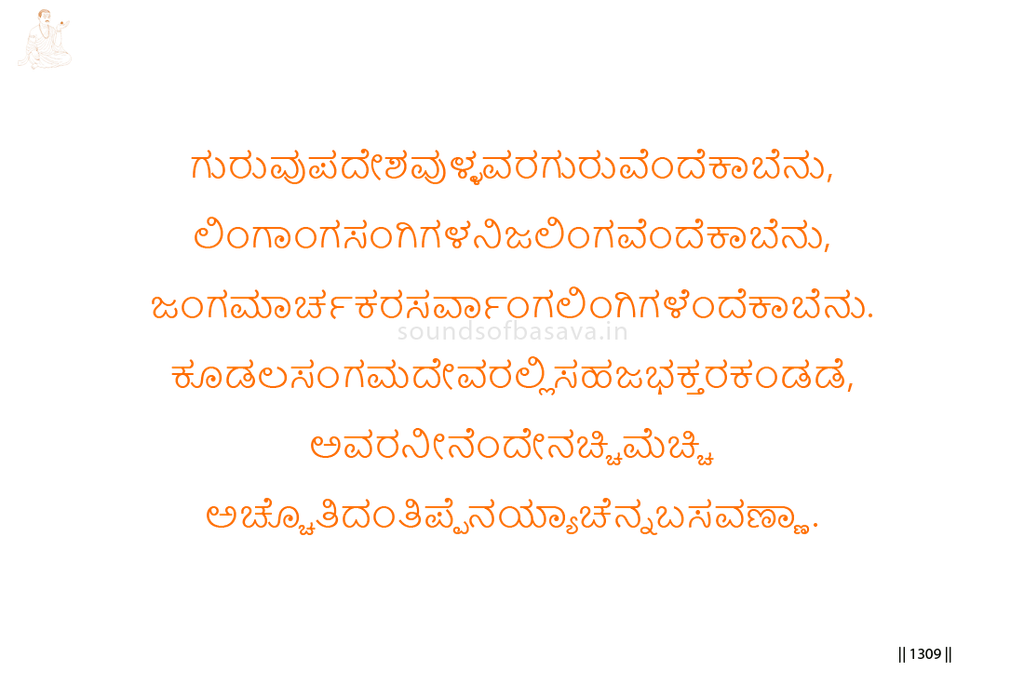
Basavanna recognizes sacred identity through lived realization. Those in whom Guru’s instruction has become established are seen as Guru. Those joined in the Linga–Anga relation are seen as Nija-Linga. Those whose lives are devoted to the worship and service of Jangama are seen as Sarvanga-Lingis.
When Basavanna encounters natural devotees established in Kudalasangama Deva, he trusts and cherishes them as bearing the very imprint of Chennabasavanna. He addresses Chennabasavanna directly, acknowledging that the natural devotees reproduce in their lives the realized pattern revealed through him.
Imagery & Symbolic Relevance
The vachana contains no external natural image. Its movement consists of four acts of spiritual recognition.
The first concerns those who possess Guru-Upadesha. This does not mean merely that they have heard instruction or can repeat the Guru’s words. Upadesha has become effective within them. Because the Guru’s direction is visible in their understanding and conduct, Basavanna recognizes them as Guru.
The second concerns the Linga–Anga Sangis. These are those in whom the relation between Linga and Anga has become living and inseparable. Basavanna recognizes them as Nija-Linga—the Linga known in its true and realized condition.
The third concerns the worshippers of Jangama. Their worship is not confined to an occasional act of reverence. Because the Jangama-relation has entered their whole being, Basavanna recognizes them as Sarvanga-Lingis—those whose entire embodied life belongs to Linga.
The sequence must remain distinct:
Guru is recognized through living Upadesha.
Nija-Linga is recognized through the Linga–Anga relation.
Sarvanga-Lingi is recognized through whole-being worship of Jangama.
The final recognition gathers these relations in the Sahaja-bhakta, the natural devotee. Sahaja indicates devotion that has become spontaneous, intrinsic, and free from artificial display. Such a devotee no longer needs to construct a religious identity; Bhakti has become the person’s natural way of being.
These natural devotees are seen “in Kudalasangama Deva.” Their devotion has no independent ground outside the Lord. Basavanna does not praise them as self-created spiritual personalities; he recognizes their establishment within Kudalasangama Deva.
He then turns to Chennabasavanna and says that, on seeing such devotees, he regards them as Chennabasavanna himself. This does not erase their individuality or identify Chennabasavanna with Kudalasangama Deva. It means that the same realized formation seen in Chennabasavanna is recognizable in them.
The expression of trusting, approving, and cherishing them culminates in the image of an imprint. The natural devotees appear as though impressed with Chennabasavanna’s stamp: his Upadesha, realization, Jangama-relation, and natural Bhakti have become visible in their lives.
Lingayoga
In Lingayoga, sacred identity must be discerned through lived relationship rather than title, appearance, or verbal claim.
Guru-Upadesha must enter understanding and conduct. The Linga–Anga relation must become lived non-separation. Worship of Jangama must involve the whole embodied being. Bhakti must become natural rather than deliberately displayed.
The practitioner must also learn to recognize realized qualities in others. Such recognition is not indiscriminate reverence. It arises after seeing that Guru, Linga, and Jangama have become livingly established within the devotee.
Chennabasavanna’s imprint provides the measure. Where his realized formation becomes visible in natural devotees, Basavanna responds with trust, appreciation, and sacred fellowship.
Editorial Commentary
The final direct address is to Chennabasavanna. Therefore, the second-person expression “you” in the concluding movement refers to Chennabasavanna.
The roles must remain distinct:
Kudalasangama Deva is the Lord in whom the natural devotees are established.
Chennabasavanna is the realized Sharana whose imprint Basavanna recognizes in them.
Basavanna is the discerning witness who trusts and cherishes those devotees.
Guru, Nija-Linga, Sarvanga-Lingi, and Sahaja-bhakta should not be reduced to interchangeable names. Each identifies a particular realized relationship, and the vachana gathers rather than erases them.
The imprint does not indicate physical resemblance or institutional affiliation. It means that Chennabasavanna’s realized teaching and condition have become recognizable in the natural devotees.
Related Vachana
Supporting Vachana
Sharana Sthala Vachana 5 — The Eye-Opening Conduct
In Sharana Vachana 5, Basavanna remembers that Kudalasangama Deva sent His Sharana into the mortal world. He then asks why the Sharana was sent and discovers the answer by repeatedly observing the Sharana’s conduct. Through that lived conduct, Basavanna’s eye is opened.
This prepares Vachana 1179 directly. Sharana Vachana 5 establishes that the Sharana is recognized not merely through name, speech, or outward position, but through the way realization is lived.
Aikya Vachana 1179 gives that opened vision precise discernment. Basavanna now recognizes Guru through living Upadesha, Nija-Linga through Linga–Anga relation, Sarvanga-Lingi through Jangama worship, and Chennabasavanna’s imprint in the natural devotees established in Kudalasangama Deva.
What begins as the opening of the eye through Sharana-conduct becomes mature spiritual recognition in Aikya.
Advancing Vachana
Aikya Sthala Vachana 1380 — One Vessel, One Offering
Aikya Vachana 1380 declares that there is no difference between the devotee and Linga and no difference between the devotee and Jangama. The true devotee shares food, rest, movement, bathing, companionship, and life itself with Guru, Linga, and Jangama. Having understood their unity, the devotee offers meaning, Prana, and the whole self to them. Where all partake as one, division, separation, impurity, and sin no longer stand.
Vachana 1179 recognizes the distinct living expressions of Guru, Nija-Linga, Sarvanga-Lingi, and Sahaja-bhakta. Basavanna sees Chennabasavanna’s realized imprint within those devotees.
Vachana 1380 carries this recognition into complete shared life. The sacred relations recognized distinctly in Vachana 1179 no longer remain externally separated: Guru, Linga, Jangama, and devotee participate in one offering and one living communion.
The progression is exact. Vachana 1179 gives the discernment by which the realized presence is recognized in the natural devotee; Vachana 1380 reveals the non-separation in which all such sacred identities partake as one before Kudalasangama Deva.
