

Summary
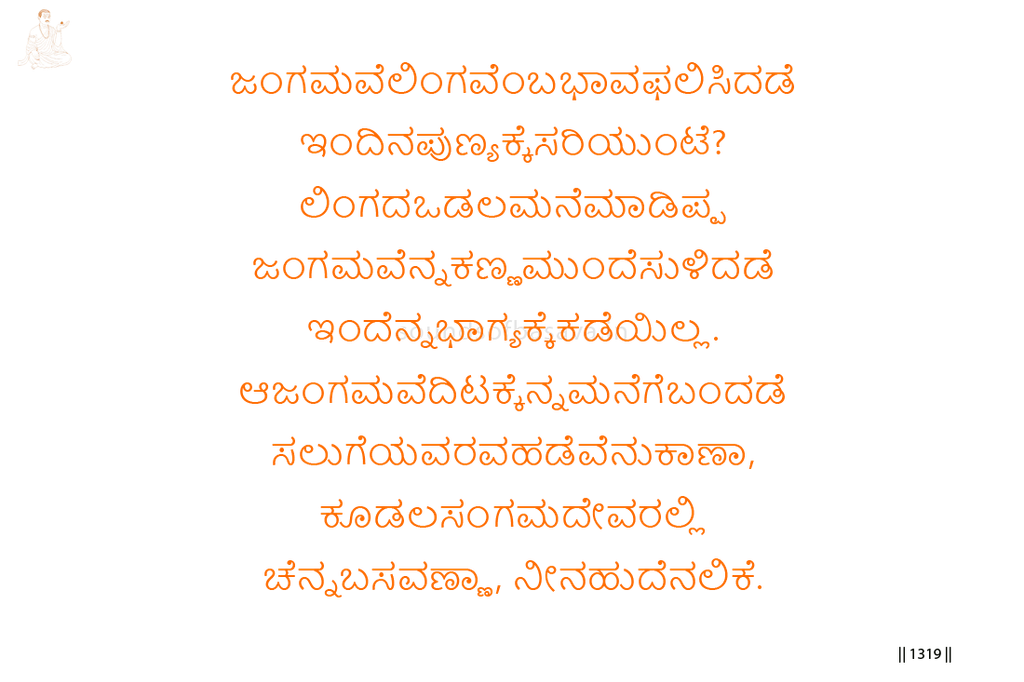
When the recognition that Jangama is Linga ripens, Basavanna asks what merit could equal the merit of that day.
To see before his eyes the Jangama whose embodied life is the dwelling of Linga is immeasurable fortune. If that Jangama comes directly to his house, the encounter becomes the boon of intimate nearness.
The closing line turns to Chennabasavanna within Kudalasangama Deva, making the recognition of living Jangama immediate and personal.
Imagery & Symbolic Relevance
The opening condition is essential: the bhava that Jangama is Linga must bear fruit. This is not verbal agreement or borrowed doctrine. The recognition has ripened into a settled way of seeing.
Basavanna’s question—whether any merit can equal the merit of this day—expresses the incomparable sacredness of the encounter. Merit here is not calculated religious credit. It is the blessed opportunity of beholding living Linga-presence.
The Jangama is described as one who has made the body a dwelling of Linga. The body is therefore not treated as separate from sacred presence. Linga is encountered through the Jangama’s embodied life.
The Jangama passing before Basavanna’s eyes gives the first movement of encounter. He is not hearing about Jangama from a distance; living presence appears directly before him.
Because the governing bhava has already ripened, this seeing is recognition rather than ordinary observation. Basavanna therefore says that his fortune has no limit.
The next movement is from sight to arrival. If that very Jangama comes to his house, living recognition enters the field of reception, hospitality, and relationship.
The boon of saluge indicates intimate nearness, familiarity, and freedom of approach born from sacred closeness. It is not casual familiarity or loss of reverence. Distance falls away while devotion remains.
The closing address names Chennabasavanna. Basavanna directs the recognition toward him within Kudalasangama Deva, so the Jangama is not left as an abstract principle. Living Jangama-presence is encountered through a realized person.
Lingayoga
In Lingayoga, worship of Linga must mature into recognition of Jangama as living Linga.
The decisive movement is not merely seeing a Jangama or receiving him at home. The governing condition is the ripened bhava through which the practitioner no longer separates embodied Jangama from Linga.
This requires the practitioner to:
recognize Jangama without placing living presence below the fixed Linga;
receive the encounter as grace rather than social visitation;
allow reverence to become hospitality and nearness;
preserve intimacy without reducing sacred relation to familiarity.
The vachana does not teach that physical sight alone produces Aikya. It shows what sight and arrival become when the recognition “Jangama is Linga” has already ripened.
Editorial Commentary
The phrase “bhava has borne fruit” means that recognition has matured and become effective in perception and relationship.
The body as the dwelling of Linga refers to the embodied Jangama through whom Linga is encountered. It need not be expanded into an independent body–cosmos symbolism.
Saluge carries the sense of intimate access, nearness, and trusted familiarity. It does not mean irreverent informality.
Chennabasavanna is the addressee in the conclusion. Kudalasangama Deva remains the Divine ground within whom Basavanna recognizes and addresses him.
Related Vachana
Supporting Vachana
Sharana Sthala Vachana 395 — The Living Temple
Sharana Vachana 395 names the sacred root-places associated with the four Yugas, but Basavanna refuses to scatter his search among many fixed places. He declares that he has trusted Jangama itself as Linga.
This prepares Vachana 1191 directly. Sharana Vachana 395 establishes the recognition that sacred presence is encountered in living Jangama rather than sought only through place-bound pilgrimage.
In Vachana 1191, that recognition has ripened. The Jangama is seen before Basavanna’s eyes, and his arrival at the house becomes immeasurable fortune and intimate grace.
What is affirmed in Sharana as trust becomes lived encounter in Aikya.
Advancing Vachana
Aikya Sthala Vachana 806 — The One Essence in All Paths
Aikya Vachana 806 declares that Sthavara and Jangama—the unmoving and moving manifestations—are one. Through whichever face the sacred appears, the fulfilment is one before Kudalasangama Deva.
Vachana 1191 recognizes Linga through the particular living presence of Jangama. The Jangama’s passing, arrival, and nearness become direct grace.
Vachana 806 widens that recognition. The unity known through living Jangama is seen across both moving and unmoving forms:
Vachana 1191 establishes direct recognition in the arriving Jangama.
Vachana 806 removes the remaining division between Jangama and Sthavara.
The face through which the sacred appears may differ, but its source and fulfilment remain one.
The intimate encounter of Vachana 1191 thus advances into undivided recognition of Kudalasangama Deva through every sacred manifestation.
