

Summary
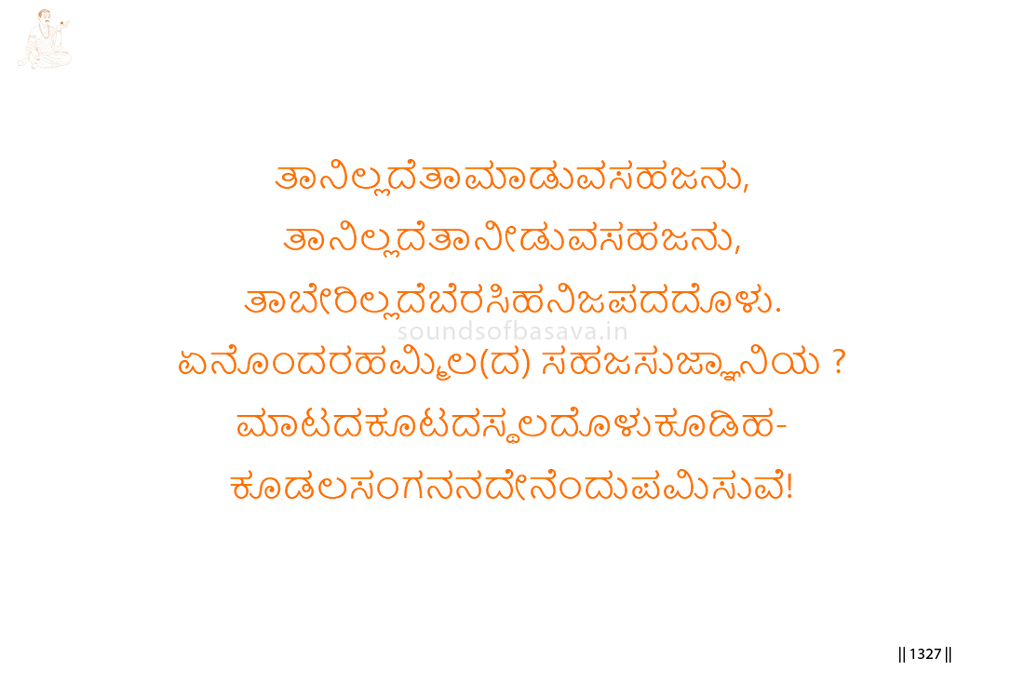
The sahaja one acts and gives without a separate sense of “I am acting” or “I am giving.” Action continues, but personal doership and ownership no longer govern it.
Without standing apart, the natural true-knower abides in the true state, free from pride or self-importance. In that gathered state, speech reaches its limit before Kudalasangama Deva, whose presence cannot be contained by comparison.
Imagery & Symbolic Relevance
The repeated phrase “without selfhood” governs the opening:
without selfhood, the natural one acts;
without selfhood, the natural one gives.
The Kannada does not say that action and giving cease. What disappears is the separate claimant who says, “I performed this,” “I gave this,” or “this merit belongs to me.”
Sahaja means natural, unforced, and arising from the established condition itself. The action is not manufactured to appear selfless, nor is giving performed to acquire merit, recognition, or spiritual identity.
The next movement places the natural one in Nijapada, the true state. He does not remain separate and then attempt to join it. The feeling of standing apart has already lost its ground.
The sahaja sujñāni, the naturally established true-knower, has no hammu—pride, conceit, or claim concerning anything. Knowledge, action, generosity, and spiritual condition are not displayed as personal greatness.
The final image is the sthala where speech is gathered. Speech has carried the recognition as far as it can, but it cannot turn Kudalasangama Deva into an object of definition or comparison.
Basavanna therefore ends with wonder: what comparison can describe Kudalasangama Deva abiding in that gathered state? The vachana moves from action without doership, through giving without ownership, to true abidance beyond pride and finally to the limit of speech.
Lingayoga
In Lingayoga, the ending of self-claim does not produce passivity. Kayaka and Dasoha continue, but the practitioner no longer preserves the identity of an independent doer or giver.
The seeker must therefore examine the subtle claims that may remain after sacred action:
“I served.”
“I offered.”
“I renounced.”
“I attained.”
“I have become selfless.”
Even the claim of selflessness restores the separate self that the vachana removes.
The sahaja condition cannot be produced by imitating effortless conduct. It arises when action, giving, and knowledge no longer serve personal possession or spiritual display.
The practical movement is to act fully, give freely, and leave both action and fruit without ownership before Kudalasangama Deva.
Editorial Commentary
Tānillade does not mean bodily absence, inactivity, unconsciousness, or loss of practical identity. It means that separate doership and ownership no longer govern action.
Sahaja means natural and uncontrived. It is the ripened condition from which action arises without calculation.
Sujñāni is the true or rightly established knower, not merely a learned person.
Hammu means pride, conceit, or self-importance.
Nijapada is the true established state. It is not a position acquired and possessed by an individual.
The final movement should remain a question of comparison. Basavanna does not claim to define Kudalasangama Deva; speech reaches its limit before the Lord abiding in that state.
Related Vachana
Supporting Vachana
Sharana Sthala Vachana 1201 — The Plea at the Feet of the Sharana
Sharana Vachana 1201 places body, mind, and wealth in the service of Kudalasangama Deva’s Sharana. It detects self-claim at its first inward arising—the thought, “I want”—and requires mind, speech, and body to know no other centre than the Lord.
This prepares Vachana 1204 directly. In the Sharana vachana, vigilance prevents body, mind, wealth, speech, and action from being reclaimed by the separate self.
In Aikya Vachana 1204, that vigilance has ripened into sahaja. Action and giving arise naturally because the claimant guarded against in Sharana Sthala no longer governs them.
What begins as disciplined freedom from “I want” becomes action without “I act” and giving without “I give.”
Advancing Vachana
Aikya Sthala Vachana 1161 — Neither Bound Nor Separate
Aikya Vachana 1161 declares that there is neither taking nor giving, neither joining nor separation. Between Basavanna and Kudalasangama Deva, no relationship remains that depends upon two separate participants, and no difference of Bhava remains.
Vachana 1204 shows action and giving continuing without selfhood. Vachana 1161 carries this further by removing the relational division underlying giver, receiver, joining, and separation.
The movement is precise:
Vachana 1204 removes personal doership and ownership from action and giving.
Vachana 1161 removes the assumption of two separate participants altogether.
What functions naturally without self-claim becomes relation without transaction or Bhava-difference.
Thus the sahaja action of Vachana 1204 deepens into the condition where neither giving nor receiving can establish difference before Kudalasangama Deva.
