

Summary
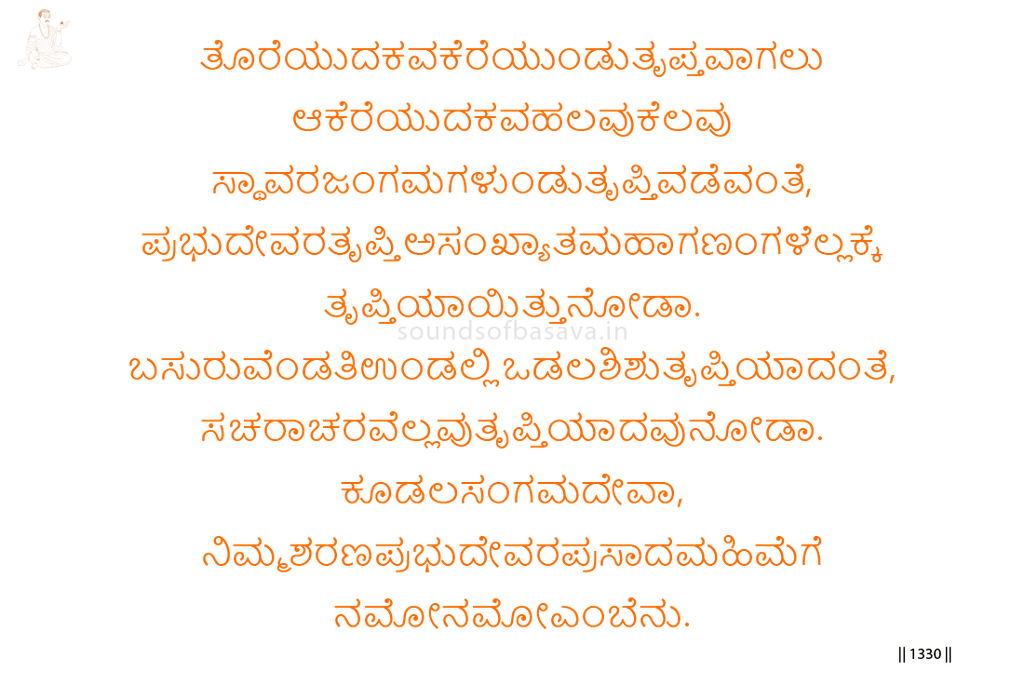
As a lake filled by flowing water satisfies the many moving and unmoving beings dependent upon it, Prabhudeva’s fulfilment becomes fulfilment for innumerable Mahaganas.
Basavanna strengthens the image through a pregnant mother: when she eats, the child within her is nourished without a separate act of receiving. In the same way, the whole moving and unmoving field shares in the satisfaction flowing through the realized Sharana.
Before Kudalasangama Deva, Basavanna bows repeatedly to the greatness of the Prasada of His Sharana Prabhudeva.
Imagery & Symbolic Relevance
The first image is a lake receiving flowing water and becoming full. The lake does not retain its fullness for itself. Its water sustains the many forms of life that depend upon it.
The moving and unmoving beings drink from the same reservoir and become satisfied. Their forms and needs may differ, but the source of nourishment is one.
This image is then applied to Prabhudeva. When Prabhudeva becomes fulfilled, that fulfilment does not remain an isolated personal attainment. Innumerable Mahaganas share in it.
The Kannada does not say that Prabhudeva separately grants an individual achievement to each being. His own fullness becomes the nourishing condition through which others receive satisfaction.
The second image is more intimate. When a pregnant mother eats, the child within her body is also nourished. The child does not perform a separate act of eating, nor does the mother divide the food and send it inward as an external transaction.
The child is sustained because it abides within the mother’s living condition. Basavanna uses this organic relation to show how the fulfilment of the realized Sharana reaches those held within his field of Prasada.
The movement from the lake to the mother deepens the relationship:
• the lake nourishes those dependent upon its water;
• the mother nourishes the child living within her;
• Prabhudeva’s fulfilment nourishes innumerable Mahaganas and the moving–unmoving whole.
The phrase sacharachara gathers all that moves and does not move. It widens the effect beyond a limited group while retaining the governing image of shared nourishment.
The conclusion identifies Prabhudeva as Kudalasangama Deva’s Sharana. Prabhudeva’s Prasada is not presented as independent power or personal possession. Its greatness arises through his fulfilled relation with the Lord.
Basavanna’s response is “namo, namo”—repeated reverence. He does not claim the fulfilment, measure it, or make himself its source. He bows before the greatness through which the whole is nourished.
Lingayoga
In Lingayoga, realization cannot be treated only as private spiritual gain.
The realized Jangama does not stand as an isolated individual protecting a personal attainment. His fulfilled condition becomes Prasada—grace, nourishment, and sustaining presence for those within the living field of relation.
The practitioner must therefore relinquish the thought that fulfilment belongs exclusively to “me.” Guru, Linga, Jangama, and Prasada reveal a sacred life in which inward ripening carries consequence beyond the individual.
The vachana does not teach that everyone automatically acquires identical realization through another’s attainment. Its claim is more precise: the fullness of the realized Sharana nourishes and satisfies the wider field, as lake-water sustains dependent life and a mother’s nourishment reaches the child within.
The proper response is receptive humility. The seeker receives Prasada without turning the realized Sharana’s greatness into personal merit or possession.
Editorial Commentary
Trupti carries the sense of satisfaction, nourishment, fulfilment, and contentment. It is wider than the satisfaction of physical hunger.
The lake is a reservoir of shared nourishment. Its fullness should not be expanded into an unsupported doctrine of water as consciousness.
The moving and unmoving beings in the lake-image are the many forms of life sustained by its water. The phrase also prepares the later widening into sacharachara, the whole moving and unmoving field.
The pregnant mother and child image expresses organic dependence and inseparable nourishment. It does not mean that the child and mother are physically indistinguishable.
Prabhudeva is Allama Prabhudeva, the realized Sharana whose fulfilment becomes nourishing Prasada. Kudalasangama Deva remains the Lord before whom Basavanna acknowledges that greatness.
The vachana does not glorify Prabhudeva as an autonomous source separate from Kudalasangama Deva. It bows to the greatness of the Prasada operating through “Your Sharana Prabhudeva.”
Related Vachana
Supporting Vachana
Sharana Sthala Vachana 1385 — The Bliss of Linga-Aikya
Sharana Vachana 1385 acknowledges that the harmony and bliss of Linga-Aikya became known only through Kudalasangama Deva and through refuge in Prabhudeva.
Basavanna does not claim that recognition as self-achieved. Prabhudeva is the living Sharana through whom the way of Linga-Aikya becomes knowable.
This prepares Vachana 1210 directly. Sharana Vachana 1385 establishes the source of the realized bliss; Aikya Vachana 1210 reveals its wider consequence.
What Basavanna first receives through refuge in Prabhudeva is now seen overflowing beyond an individual recipient. Prabhudeva’s fulfilment becomes nourishment for innumerable Mahaganas and for the whole moving and unmoving field.
Advancing Vachana
Aikya Sthala Vachana 1211 — The Throne Beyond Seeing
Aikya Vachana 1211 presents an unseen throne upon which inexpressible Greatness settles. The visible Sangamanatha disappears, repeated offerings become untraceable, and ordinary seeing cannot determine how the satisfaction occurs.
Basavanna finally asks Chennabasavanna to explain the manner of Kudalasangama Deva’s satisfaction, if it can be known.
Vachana 1210 reveals satisfaction through visible and comprehensible images: the full lake, dependent beings, the pregnant mother, and the nourished child.
Vachana 1211 advances beyond those images. Satisfaction is no longer explained through observable nourishment; it becomes a wonder beyond seeing, transaction, and adequate speech.
The movement is exact:
Vachana 1210 shows how the fulfilment of the realized Sharana nourishes the whole.
Vachana 1211 turns toward the mystery of Kudalasangama Deva’s own satisfaction.
Visible Prasada gives way to offering whose reception cannot be traced.
Repeated reverence deepens into wonder before what cannot be fully explained.
