

Summary
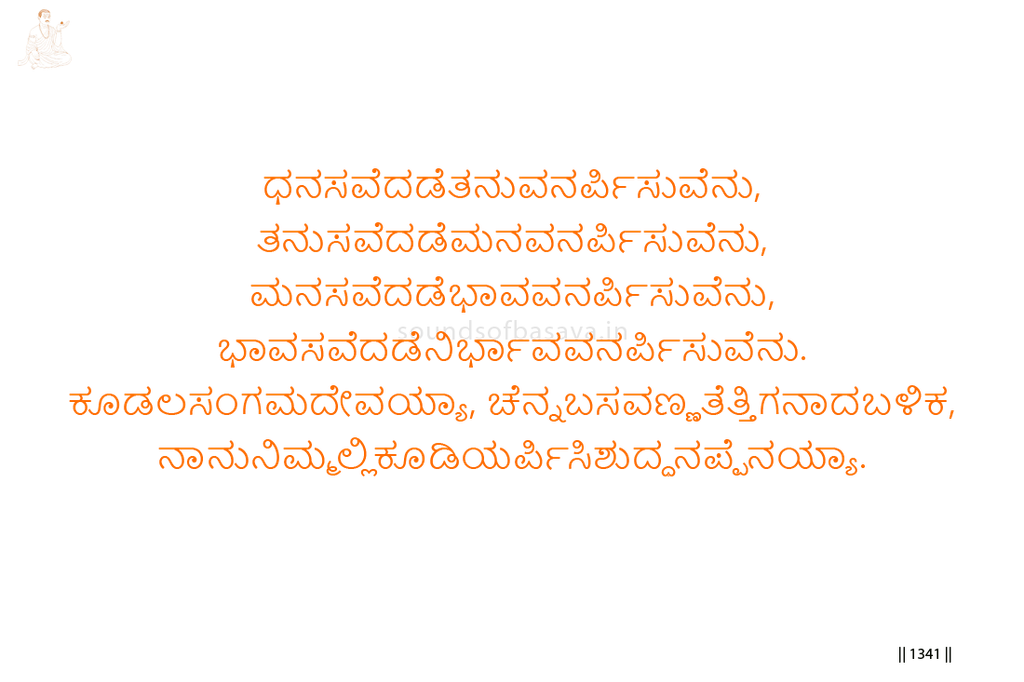
Basavanna presents a complete progression of surrender: when wealth is exhausted, he offers the body; when the body is exhausted, the mind; when the mind is exhausted, Bhava; and when Bhava is exhausted, even Nirbhava.
After Chennabasavanna enables the crossing, Basavanna joins Kudalasangama Deva, offers himself fully, and becomes pure.
Nothing remains protected as a separate possession or spiritual attainment.
Imagery & Symbolic Relevance
The vachana moves from the outermost possession to the subtlest inward condition.
Wealth is offered first. When outward possessions are exhausted, the giver can no longer remain separate from the gift.
The body is then offered through service, labour, and endurance. When bodily offering is complete, the mind cannot remain as a private centre of ownership.
The mind is offered next. This removes the inward claim:
“I gave”;
“I served”;
“I endured.”
When the mind is exhausted, Bhava is offered. Bhava includes devotional identity, inward relationship, longing, and spiritual experience. Even the claim “I am the devotee” cannot remain.
Finally, Nirbhava is offered. The condition beyond Bhava must not itself become a possession expressed as, “I have reached the highest state.”
The surrender therefore reaches beyond objects, body, thought, devotion, and attainment.
Chennabasavanna makes the crossing possible. Basavanna does not present the movement as an independent achievement.
The culmination is joining Kudalasangama Deva and offering the one who had been making the offerings. Purity arises when no remainder is withheld.
Lingayoga
In Lingayoga, surrender must pass through every level at which ownership may survive.
The progression is exact:
wealth is released;
the body becomes service;
the mind relinquishes authorship;
Bhava loses devotional self-claim;
Nirbhava is not retained as attainment;
the entire self is offered in Kudalasangama Deva.
This is not bodily neglect or self-destruction. It is the ending of possessiveness at progressively subtler levels.
Chennabasavanna’s role is essential. The crossing occurs through the realized Sharana, not through isolated personal effort.
Purity is the condition in which neither possession, practice, experience, nor realization remains claimed as “mine.”
Editorial Commentary
Dhana means wealth or outward possession.
Tanu means the body or embodied being.
Mana means the mind—the field of intention, thought, memory, and judgment.
Bhava is the inwardly formed devotional and spiritual condition.
Nirbhava is the condition beyond separately formed Bhava. It does not mean unconsciousness or emotional emptiness.
The repeated savedade carries the sense of being spent, exhausted, or brought to completion.
The line concerning Chennabasavanna identifies him as the one who enables the crossing.
Nimmalli kūḍi arpisi means joining in Kudalasangama Deva and offering oneself there.
Shuddhanappenu means “I shall become pure.” Purity is the fruit of surrender without remainder.
Related Vachana
Supporting Vachana
Sharana Sthala Vachana 729 — The Useless Treasure
Sharana Vachana 729 asks why one who has entered the battlefield still clings to the weapon, why a servant clings to life, and why a Bhakta still desires body, mind, and wealth.
It exposes the contradiction between sacred commitment and retained possession.
Vachana 1226 gives the fulfilled response: wealth, body, mind, Bhava, Nirbhava, and finally the whole self are offered.
What Sharana Vachana 729 questions as attachment becomes complete surrender in Aikya.
Advancing Vachana
Aikya Sthala Vachana 1228 — The Tree Between Earth and Sky
Aikya Vachana 1228 presents a single mango tree with two branches, three leaves, thirty-six flowers, and one fruit.
When the leaves fall, the fruit loses its support, falls away, and becomes formless. Through Prabhu’s compassion and Prasada, Kudalasangama Deva receives the seeker into His heart-lotus.
Vachana 1226 offers each layer of possession and identity. Vachana 1228 shows the corresponding falling away of the structures surrounding the final fruit.
Complete surrender thus advances into Divine reception and inward establishment within Kudalasangama Deva.
