

Summary
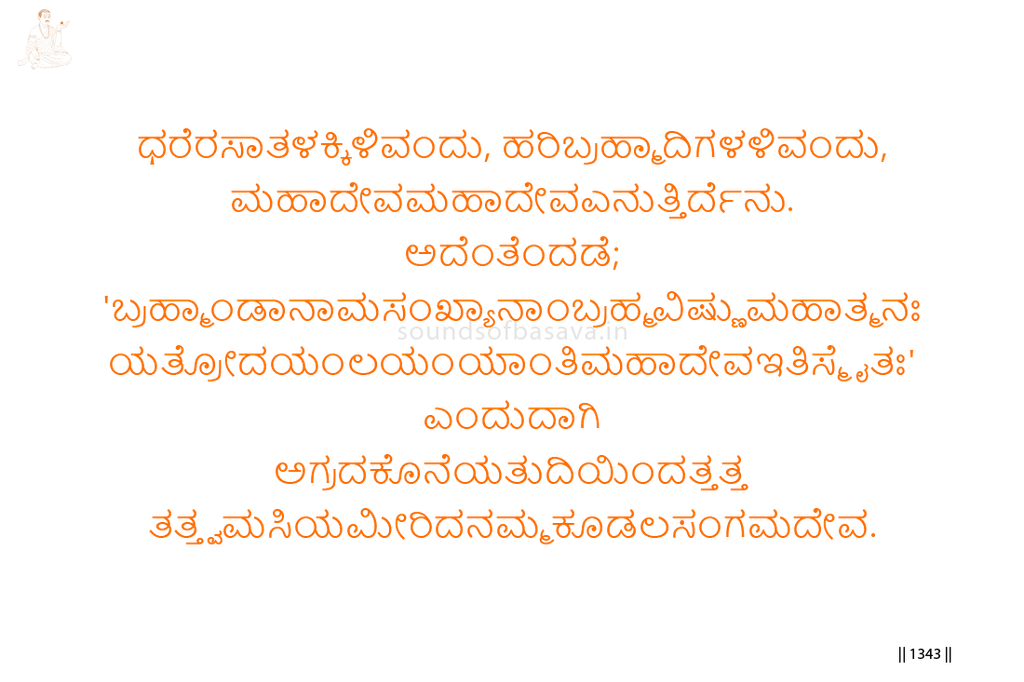
When the earth descends toward Rasatala and Hari, Brahma, and the other deities pass away, Basavanna continues to call, “Mahadeva, Mahadeva.”
Beyond the furthest extremity of every height and beyond even the declaration Tat Tvam Asi, Kudalasangama Deva alone remains.
The vachana moves from the dissolution of the world and its deities to the limit of the highest verbal statement, placing the Lord beyond them all.
Imagery & Symbolic Relevance
The opening presents the earth descending toward Rasatala. What appears stable and foundational no longer retains its place. The manifested world itself moves toward dissolution.
Hari, Brahma, and the other deities are then said to perish or pass away. Their exalted functions do not place them outside the movement of arising and dissolution.
Amid this collapse, Basavanna says:
“Mahadeva, Mahadeva.”
The invocation is his response when neither the earth nor the divine hierarchy can provide a final ground.
The movement then passes beyond the furthest tip of the summit. Every measurable height, rank, attainment, and spiritual culmination has an extremity. Kudalasangama Deva stands still further beyond.
The final limit named is Tat Tvam Asi—“You are That.” It is one of the great declarations expressing the identity of the individual with the Absolute.
Basavanna does not argue against the declaration. He places Kudalasangama Deva beyond even its verbal reach. The statement may direct understanding, but it cannot contain the Lord.
The order is exact:
the earth loses stability;
Hari, Brahma, and the other deities pass away;
Basavanna invokes Mahadeva;
every summit is exceeded;
even Tat Tvam Asi is surpassed;
Kudalasangama Deva alone remains beyond all these limits.
Lingayoga
In Lingayoga, refuge must not depend upon what is subject to dissolution.
Worldly stability, exalted powers, theological rank, and scriptural formulations may guide the seeker, but none becomes the final ground.
Even the declaration “You are That” must become realization rather than remain a statement repeated by the mind.
The practitioner therefore turns wholly toward Kudalasangama Deva when outer support, conceptual certainty, and spiritual status reach their limit.
The practical direction is simple: do not mistake the world, divine function, attainment, or sacred language for the Lord whom they seek to indicate.
Editorial Commentary
Dhare Rasatalakke iḷivandu means that the earth descends toward Rasatala. The line presents collapse or dissolution.
Hari-Brahmādigaḷ aḷivandu means that Hari, Brahma, and the other deities perish or pass away. They are not described as standing permanently in Rasatala.
Mahadeva, Mahadeva ennutiddenu means, “I was saying, ‘Mahadeva, Mahadeva.’” Basavanna is the speaker who invokes the Lord.
Agrad koneya tudiyindattatta indicates beyond the furthest extremity or final tip of the summit.
Tat Tvam Asi means “You are That.” The vachana places Kudalasangama Deva beyond the reach of even this highest verbal declaration.
Related Vachana
Supporting Vachana
Sharana Sthala Vachana 697 — Death Is No Threat to the One Who Walks With the Lord
Sharana Vachana 697 declares that death may come tomorrow, today, or at this very moment. Since death belongs to the condition of birth, fear and grief cannot become the Sharana’s final guide.
It concludes that what Kudalasangama Deva has written cannot be altered even by Hari or Brahma.
This prepares Vachana 1229 directly. In the Sharana vachana, Hari and Brahma cannot overturn the Lord’s decree. In Aikya Vachana 1229, even they pass away when cosmic dissolution comes.
What Sharana Sthala establishes as the supremacy of Kudalasangama Deva’s will becomes, in Aikya, the recognition that He remains beyond the world, the deities, and every final formulation.
Advancing Vachana
Aikya Sthala Vachana 1230 — The Primacy of Grace
Aikya Vachana 1230 gathers the entire spiritual path into Kudalasangama Deva:
His sacred form is central to meditation;
His sacred feet are central to worship;
the nectar of His Name is central to mantra;
His immense grace is central to liberation;
He is the Guru of Knowledge.
Vachana 1229 removes every inadequate final ground. Earth dissolves, the deities pass away, the highest summit is exceeded, and Tat Tvam Asi cannot contain the Lord.
Vachana 1230 gives the positive fulfilment of that transcendence. The One who exceeds all worlds, deities, and declarations becomes the sole centre of meditation, worship, mantra, knowledge, and liberation.
The movement is from nothing else being final to Kudalasangama Deva alone being essential.
