

Summary
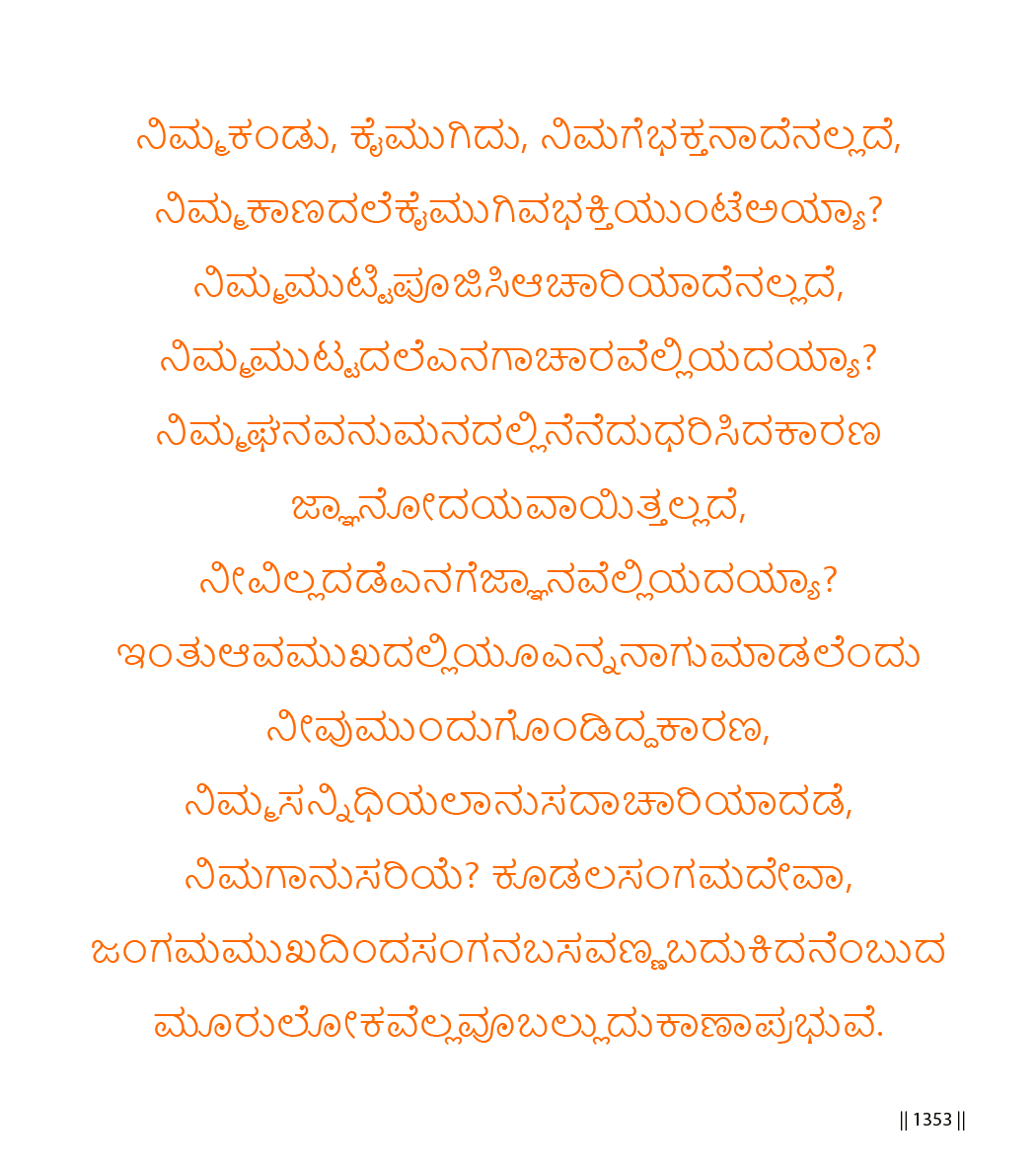
Seeing Kudalasangama Deva and joining his hands before Him, Basavanna becomes a Bhakta. Touching and worshipping Him establishes Achara, while holding His greatness within the mind brings the dawn of knowledge.
None of these arises independently. Without the Lord there is no Bhakti, Achara, or knowledge. Kudalasangama Deva has taken the initiative to form and steady Basavanna through every mode of encounter.
Even when established in Sadachara within the Lord’s presence, Basavanna refuses to claim equality with Him. He concludes that Sangana Basavanna lived through the face of Jangama—a truth known throughout the three worlds.
Imagery & Symbolic Relevance
The vachana contains no natural or material comparison. Its movement is carried by three direct actions: seeing, touching, and inwardly holding.
Seeing Kudalasangama Deva leads Basavanna to join his hands and become a Bhakta. The folded hands express reverence arising from encounter. The following question preserves the source’s negative force: without seeing the Lord, such Bhakti cannot arise.
Touching and worshipping the Lord form the next movement. Achara is not presented as an independently constructed discipline; it takes shape through direct sacred relation. Without that contact, Basavanna asks where Achara could exist for him.
The third movement enters the mind. Basavanna remembers and bears the Lord’s ghana—His greatness, fullness, or profound reality—within. Knowledge does not result from intellectual collection; it dawns through inwardly holding the Divine presence.
The repeated questions establish dependence:
without seeing You, where is Bhakti?
without touching You, where is Achara?
without You, where is knowledge?
Kudalasangama Deva is therefore the initiating and transforming agent. Basavanna does not produce these conditions by personal capacity; the Lord comes forward to form him through every mode of encounter.
The next question protects this nearness from becoming self-elevation. Even if Basavanna becomes a Sadachari in the Lord’s presence, he cannot claim equality with Kudalasangama Deva.
The final line turns from direct encounter with the Lord to Jangama-mukha, the face of living sacred presence. Sangana Basavanna’s life is sustained through that face. The three worlds are invoked as witnesses to this realized relation.
The concluding Prabhuve means “O Lord” and addresses Kudalasangama Deva.
Lingayoga
In Lingayoga, Bhakti, Achara, and knowledge must remain joined to living encounter rather than becoming separate attainments.
Seeing awakens devotion; touch and worship establish conduct; inward remembrance allows knowledge to arise. These are not three unrelated practices but successive expressions of one relation with Linga.
The practitioner must therefore not claim, “I created devotion,” “I perfected conduct,” or “I obtained knowledge.” Each arises because the Lord becomes present, acts first, and steadies the Anga.
The final movement toward Jangama prevents realization from becoming private or isolated. Life through Jangama-mukha means that the relation with Linga continues through living sacred presence.
Humility remains essential. Nearness, Sadachara, and knowledge do not make the Anga equal to Linga. They deepen receptivity and service without transferring the Lord’s primacy to the practitioner.
Editorial Commentary
Ghana indicates greatness, fullness, depth, or substantial Divine reality. Here it is inwardly remembered and borne, resulting in the dawn of knowledge.
Jñānōdaya means the arising or dawning of knowledge. The Kannada presents knowledge as arising through Kudalasangama Deva, not as information acquired independently.
Sadachari means one established in right and truthful conduct. Even this condition does not authorize a claim of equality with the Lord.
Jangama-mukha is the living face through which sacred presence is encountered and life is sustained. It must not be reduced to an abstract idea or separated from the realized Sharana.
Related Vachana
Supporting Vachana
Sharana Sthala Vachana 1048 — The Servant of the Servants
In Sharana Vachana 1048, Basavanna calls himself the servant of the Lord’s servants, the follower of His followers, and the bearer of the burden carried by those who bear His work. Standing before Kudalasangama Deva’s Sharanas, Sangana Basava asks to be joined to their true state through grace.
This prepares Vachana 1251 by removing spiritual rank and independent self-claim. Entry into the state of the Sharanas is not seized through personal merit; it is sought through service, humility, and grace.
Vachana 1251 reveals how that relation becomes lived. Bhakti arises through seeing, Achara through touching and worshipping, knowledge through inwardly bearing the Lord’s greatness, and life through Jangama-mukha.
The movement is from standing humbly at the threshold of the Sharanas to living through their sacred face, while still refusing equality with Kudalasangama Deva.
Advancing Vachana
Aikya Sthala Vachana 393 — No Greater, No Lesser
Aikya Vachana 393 places touching the Linga with the hand beside bowing the head before Jangama and asks which is greater and which is lesser. It removes this hierarchy and concludes that Jangama itself is Linga.
Vachana 1251 establishes that Sangana Basavanna lives through Jangama-mukha. The face of Jangama is the living medium through which devotion, conduct, knowledge, and life become fulfilled.
Vachana 393 deepens this recognition by removing the remaining distinction between Linga-darshana and Jangama-darshana. What appears in Vachana 1251 as life through the face of Jangama becomes explicit non-difference: Jangama itself is Linga.
