

Summary
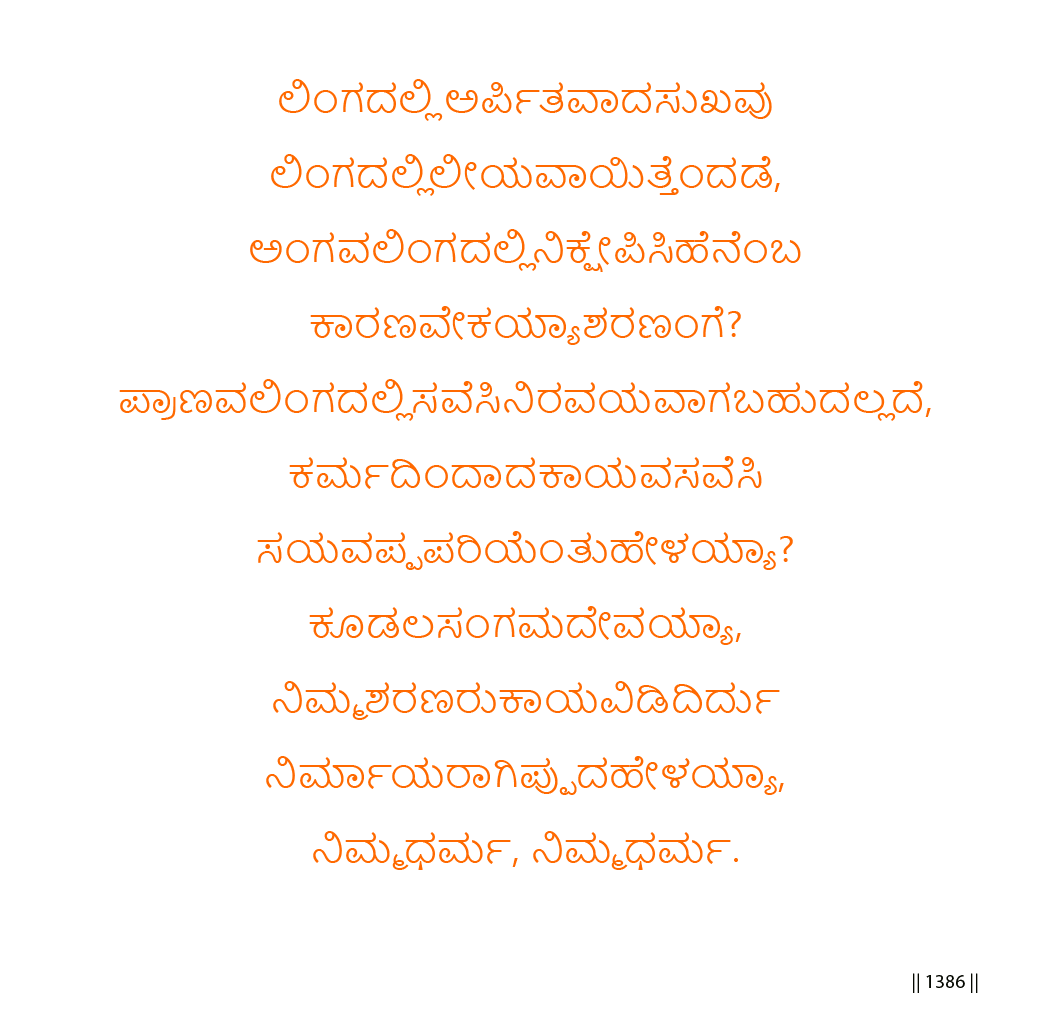
Basavanna asks whether, once the sukha offered into Linga has become absorbed in Linga, the Sharana can still speak of physically depositing the Anga in Linga.
Prana may be offered into Linga and become Niravaya. But the body has arisen through karma; how can such a body be consumed, dissolved, or made to merge in the same manner?
Kudalasangama Deva’s Sharanas reveal the distinction. They continue to bear the body, yet remain Nirmaya—free from Māyā’s binding power.
Basavanna does not turn this into a theoretical answer. He repeatedly asks Kudalasangama Deva to reveal this as His own Dharma.
Imagery & Symbolic Relevance
The vachana contains no material comparison. Its movement is formed through a series of searching questions concerning sukha, Anga, Prana, the karma-born body, and the embodied yet Nirmaya condition of the Sharanas.
Sukha Absorbed in Linga
The opening begins with sukha offered into Linga and becoming absorbed in Linga.
Sukha here is not retained as the personal experience of an enjoyer. Once offered, it no longer returns as “my joy,” “my experience,” or “my spiritual attainment.” It belongs wholly to Linga.
Basavanna therefore asks what reason remains for the Sharana to say, “I have deposited the Anga in Linga.”
The question exposes the danger of describing offering as though a separate person had transferred a separately owned body into Linga. If what is offered has already lost personal ownership, the claim “I placed it there” becomes questionable.
Depositing the Anga in Linga
The Anga is not presented as a physical object placed inside another object.
Basavanna questions language that may turn Linga–Anga relation into a bodily transaction. The body remains visible and active; therefore its offering cannot simply mean that the physical body has disappeared into Linga.
What is challenged is the claim of possession and authorship:
“This Anga was mine”;
“I placed it in Linga”;
“I caused its merger.”
The question remains before Kudalasangama Deva because true offering cannot be reduced to a formula spoken by the separate self.
Prana Becoming Niravaya
Basavanna then distinguishes Prana from the karma-born body.
Prana may be spent, fulfilled, or absorbed in Linga and become Niravaya. This indicates life no longer standing in fear, division, or separate dependence before Linga.
The statement does not describe breath-control or a technical subtle-body process. Prana is the living principle whose relation to Linga may become free from separateness.
This possibility is contrasted with the physical body.
The Body Born of Karma
The body is explicitly described as arising through karma.
It bears the consequences, limitations, changes, and conditions belonging to embodied existence. Basavanna therefore asks how such a body can be consumed and merge in the same way as Prana.
The question prevents bodily disappearance from being made the measure of realization.
The body does not become free by denying its karmic condition. It continues to age, act, experience consequence, and remain within embodied life. What must cease is its power to establish a separate and binding identity.
The Sharanas Who Bear the Body
The decisive evidence is found in Kudalasangama Deva’s Sharanas.
They bear the body. Basavanna does not describe them as physically absent, disembodied, or removed from action.
Yet they are Nirmaya.
The two statements must remain together:
the body continues;
Māyā’s binding claim does not.
Their realized state therefore cannot be explained as the physical body entering and disappearing within Linga. The Sharanas live through the body without allowing bodily identity, karmic consequence, or personal ownership to become the final ground of their being.
“Tell Me Your Dharma”
The repeated appeal, “Your Dharma, Your Dharma,” gives the conclusion its force.
Basavanna does not claim to have resolved the question through argument. He asks Kudalasangama Deva to reveal how the Sharanas remain embodied and yet Nirmaya.
Dharma here is the Lord’s own governing truth made visible through the lives of His Sharanas. Their embodied freedom is the living answer, but Basavanna continues to ask for its true understanding.
Lingayoga
Lingayoga must distinguish the offering of embodied life from fantasies of bodily disappearance.
The practitioner may offer body, action, experience, and Prana to Linga, but should not imagine that realization requires the physical body to dissolve. The immediate discipline is to remove personal ownership from embodied life while accepting responsibility for karma and conduct.
The Nirmaya condition belongs to realized Sharanas. It cannot be claimed merely because one performs Linga-Arpita or speaks of Anga–Linga unity. The test is whether the body remains a centre of possession, fear, pride, and binding identity.
Editorial Commentary
Sukha indicates joy, experience, or enjoyment. Once offered into Linga, it is no longer retained as the possession of an independent enjoyer.
Anga-nikṣepa means placing or depositing Anga in Linga. The vachana questions a literal or self-claiming understanding of this expression.
Prana is the living principle. The text does not authorize an unrelated interpretation through Ida, Pingala, Sushumna, or breath-retention techniques.
Niravaya indicates freedom from fear, limiting division, or vulnerable separateness in the relation with Linga.
Karma-born body means the embodied form arising within karmic consequence. Its continued existence is not denied.
Nirmaya means free from Māyā’s binding power. It does not mean bodilessness or physical disappearance.
Related Vachana
Supporting Vachana
Sharana Sthala Vachana 1345 — The Vigilance of Linga-Arpita
Sharana Vachana 1345 teaches that offering to Linga must be protected through uninterrupted vigilance. The offered body and senses must not return to injustice, the six inner enemies, or personal ownership.
Through such vigilance, the body becomes Prasāda-Kāya. The body is not destroyed; its relation changes from private possession to sacred receiving and service.
This prepares Vachana 1338 by establishing that bodily offering does not mean bodily disappearance. Vachana 1338 carries the distinction further by asking how the karma-born body could merge like Prana and by pointing to Sharanas who remain embodied yet Nirmaya.
Advancing Vachana
Aikya Sthala Vachana 1122 — Behold the One Beyond Body and Ego
Vachana 1338 asks Kudalasangama Deva to reveal how His Sharanas bear the body while remaining free from Māyā.
Vachana 1122 makes that condition visible. In the realized one, the eyes are free from darkness, the body from Māyā, and the mind from ego. He cannot be confined either to bodily identity or to a claim of bodilessness.
The question of Vachana 1338 thus advances into the embodied example of Vachana 1122. The body remains, but it no longer becomes the seat of Māyā or ego; realized life abides without either bodily bondage or imagined escape from the body.
