

Summary
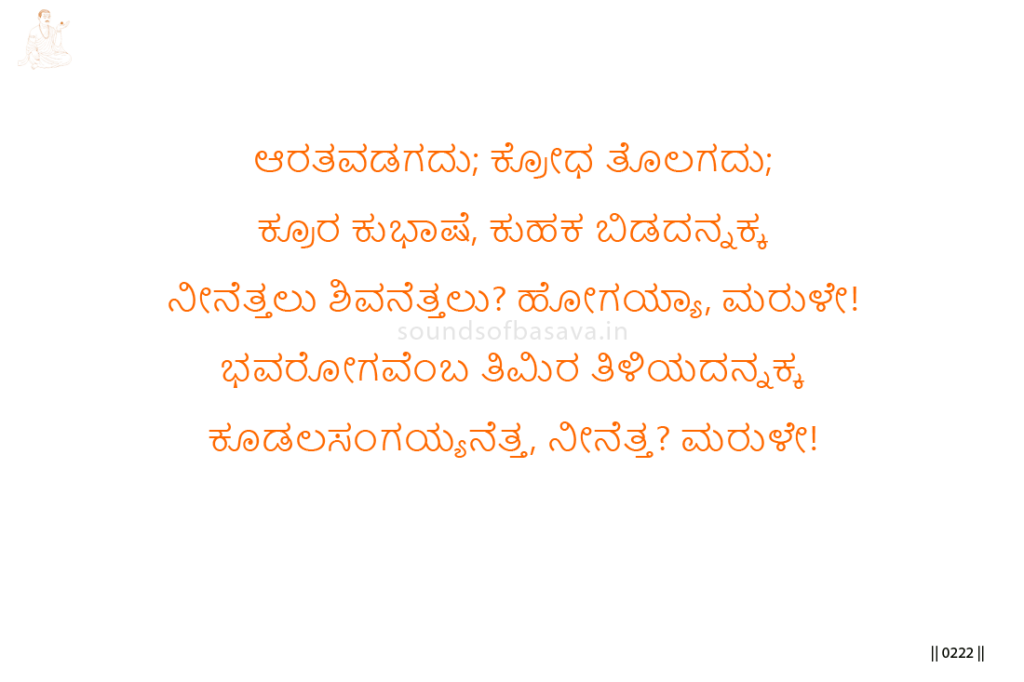
In this vachana, Basavanna confronts the one who speaks of reaching Shiva while distress has not subsided and anger has not left.
Cruel speech and crookedness still remain. When these are still active, the claim of nearness to Shiva becomes delusion.
Basavanna then names the deeper condition: the darkness of the disease of becoming has not been understood or cleared. Before Kudalasangayya, he asks the deluded one where he stands and where the Divine stands.
Imagery & Symbolic Relevance
The first image is distress that does not leave. The inner condition remains unsettled.
The second image is anger that does not fall away. Anger shows that purification has not yet taken hold.
The third image is cruel speech. Speech reveals the condition within; harsh words show that the inner state is still disturbed.
The fourth image is crookedness. This shows distortion in conduct and intention.
The fifth image is speaking of reaching Shiva. Basavanna exposes the contradiction between claim and condition. One cannot speak of arrival while the signs of bondage remain.
The sixth image is the disease of becoming. This is the deeper illness beneath distress, anger, speech, and crookedness.
The final image is darkness. Until this darkness is known, the seeker remains far from the truth he claims.
Together, these images show the impossibility of claiming nearness while inner affliction remains. Distress, anger, cruel speech, crookedness, and the disease of becoming must be faced before the claim can stand.
Lingayoga
In Lingayoga, this vachana tests the truth of spiritual claim by the condition of life. Speech about Shiva has no value if anger, harshness, and crookedness remain active.
The disease of becoming must be recognized, not covered by devotional language. Without this recognition, the seeker remains deluded.
The practical movement here is honest self-examination. Basavanna asks the seeker to see the remaining afflictions before speaking of nearness to Kudalasangama Deva.
Editorial Commentary
This vachana should be read as a warning against premature spiritual claim. Basavanna does not reject the longing to reach Shiva. He rejects the claim made while distress, anger, cruel speech, crookedness, and the disease of becoming still remain.
Related Vachana
Supporting Vachana
Bhakta Sthala Vachana 649 — The Dog That Dreams of a Steed
Bhakta Sthala Vachana 649 supports this vachana by asking whether bhakti can arise in one ruled by sin and anger. Vachana 131 carries that warning into Maheshwara Sthala: one cannot speak of reaching Shiva while anger, harsh speech, and crookedness still remain.
Advancing Vachana
Prasadi Sthala Vachana 483 — The Grace That Burns Delusion.
Prasadi Sthala Vachana 483 advances this movement by showing the purification that Vachana 131 demands. Vachana 131 names the disease of becoming and the darkness that still binds the deluded seeker. Vachana 483 carries this into Prasadi Sthala, where Kudalasangama Deva washes the stains of birth, cuts the bonds of becoming, and burns the knots of delusion.
