

Summary
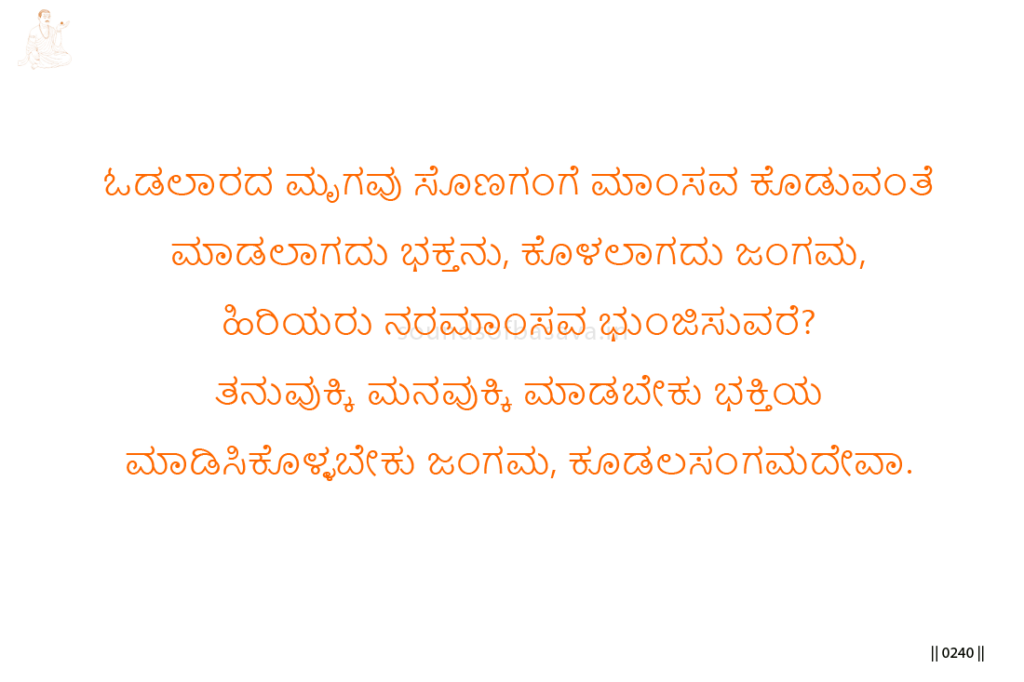
In this vachana, Basavanna asks whether a wild animal can give flesh to a lion and become a bhakta. The image shows that raw instinct cannot become devotion merely by being offered.
He then asks whether such a one can become Jangama. Jangama is not a title placed upon an unrefined condition. It is the living primordial presence that pervades the seeker, the Linga, and the community. To become aligned with Jangama, body and mind must be refined.
Basavanna asks whether the elders eat human flesh. Here the elders point to the higher life-force, the primordial presence within the body of the seeker. That presence is not nourished by crude bodily impulse. Before Kudalasangama Deva, the bhakta must work upon body and mind, and the Jangama must be realized through that transformation.
Imagery & Symbolic Relevance
The first image is the wild animal. It represents a condition still governed by raw impulse and bodily instinct.
The second image is flesh offered to the lion. The act may appear like offering, but it remains within the field of appetite. Nothing has been transformed merely because something has been given.
The third image is the lion. The lion represents a higher force before which raw offering is exposed. It is not satisfied by instinct renamed as devotion.
The fourth image is the question of becoming a bhakta. Basavanna rejects the idea that one becomes a devotee by outward act alone. The bhakta must be shaped through body and mind.
The fifth image is the question of becoming Jangama. Jangama is the moving, living presence of the same primordial reality that pervades the seeker, the Linga, and the community. It cannot be reduced to an external role, nor can it be claimed while the body and mind remain unrefined.
The sixth image is the elders not eating human flesh. The elders indicate the higher life-force, the primordial presence within the seeker. This presence does not live on raw bodily instinct. It requires refinement, not crude offering.
The final image is the shaping of body and mind. The bhakta must work upon body and mind, and the Jangama must be realized through that work. The movement is not from body-hatred, but from bodily rawness into living alignment.
Together, these images distinguish instinct from devotion. A wild animal offering flesh to a lion does not become bhakta; one who remains unrefined does not become Jangama. Body and mind must be transformed so that the primordial presence can be recognized and lived.
Lingayoga
In Lingayoga, this vachana tests whether devotion has entered the body and mind. The seeker cannot remain governed by instinct and call that state bhakti.
Jangama must be understood as living primordial presence, not merely as an outer designation. It pervades the seeker, the Linga, and the living community. To recognize Jangama is to allow body and mind to be reshaped by that presence.
The practical movement here is refinement. Basavanna asks the seeker to move from raw offering to transformed living before Kudalasangama Deva.
Editorial Commentary
This vachana should be read as a warning against confusing instinctive offering with devotion. Basavanna does not reject the body or mind. He rejects the condition in which body and mind remain unshaped, while their raw impulses are presented as sacred offering.
Related Vachana
Supporting Vachana
Bhakta Sthala Vachana 245 — The Mirror of Authenticity
Bhakta Sthala Vachana 245 supports this vachana by showing the seeker approaching the devotees with humility, restraint, servant-conduct, and inward attention. Vachana 230 carries that requirement into Maheshwara Sthala: the bhakta must not remain wild or unrefined, but must allow body and mind to be shaped.
Advancing Vachana
Prasadi Sthala Vachana 990 — Transformed Through the Touch of Grace
Prasadi Sthala Vachana 990 advances this movement by showing the fruit of true sacred company. Vachana 230 says that body and mind must be shaped so that Jangama is realized as living presence. Vachana 990 carries this into Prasadi Sthala, where the company of Mahānubhāvas purifies body, mind, wealth, and the whole being before Kudalasangama Deva.
