

Summary
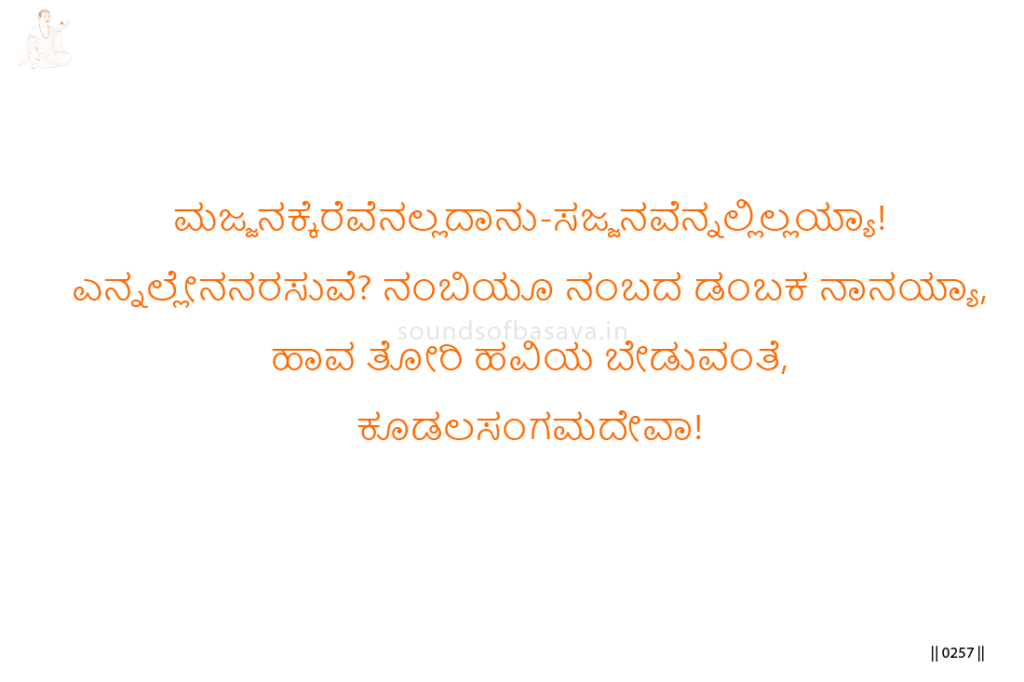
In this vachana, Basavanna confesses that true ritual bathing has not become real in him. The quality of the sajjana, the good and noble person, is not present in him.
He then asks what can be found in him. The question strips away false claim. He names himself as a deceiver who says he trusts, yet does not truly trust.
The final image is severe: he is like a snake-charmer who shows the snake while begging for rice. Before Kudalasangama Deva, Basavanna exposes the contradiction between what is displayed and what is sought.
Imagery & Symbolic Relevance
The first image is ritual bathing. Basavanna does not allow the act of bathing to become a claim of purity when inward transformation is absent.
The second image is the absence of sajjana-quality. The goodness of the noble person has not become established in him.
The third image is the question, “What can be found in me?” This is self-examination without concealment. Basavanna refuses to claim what is not present.
The fourth image is the deceiver who trusts yet does not trust. This is divided faith. Trust is spoken, but it has not become inwardly true.
The final image is the snake-charmer showing the snake while begging for rice. The snake is displayed, yet nourishment is requested. The image reveals contradiction: one presents what creates fear or unease, while asking to be fed. In the same way, the seeker presents devotion outwardly, yet inwardly remains unfit for the fruit of devotion.
Together, these images show spiritual contradiction. Ablution is claimed, but goodness is absent. Trust is spoken, but trust is not real. The snake is shown, yet rice is begged.
Lingayoga
In Lingayoga, this vachana tests whether practice has become inwardly truthful. Ritual bathing, speech of trust, and devotional appearance cannot replace actual transformation.
The seeker must examine whether trust has become real, or whether it remains a word covering inner division.
The practical movement here is truthful self-recognition. Basavanna brings the contradiction before Kudalasangama Deva so that false trust and false purity are exposed.
Editorial Commentary
This vachana should be read as a confession of divided trust. Basavanna does not reject ritual bathing or trust. He rejects the condition in which one claims purity and faith while goodness and real trust remain absent.
The snake-charmer image clarifies the contradiction. One cannot display what unsettles and still expect nourishment as though nothing is wrong. Likewise, one cannot display devotion while inwardly remaining divided and expect the fruit of true bhakti.
Related Vachana
Supporting Vachana
Bhakta Sthala Vachana 649 — The Dog That Dreams of a Steed
Bhakta Sthala Vachana 649 supports this vachana by asking whether bhakti can arise in one ruled by sin, anger, and false claim. It also names the hypocrite who says he trusts Kudalasangama Deva, yet does not truly trust. Vachana 283 carries the same concern into Maheshwara Sthala: the seeker confesses that he trusts and yet does not trust, like a snake-charmer showing the snake while begging for rice.
Advancing Vachana
Prasadi Sthala Vachana 483 — The Grace That Burns Delusion
Prasadi Sthala Vachana 483 advances this movement by showing the correction of divided trust. Vachana 283 confesses false trust and inner contradiction. Vachana 483 carries this into Prasadi Sthala, where Kudalasangama Deva washes the stains of birth, severs the bonds of becoming, burns the knots of delusion, and establishes trust in Shiva as the way.
