

Summary
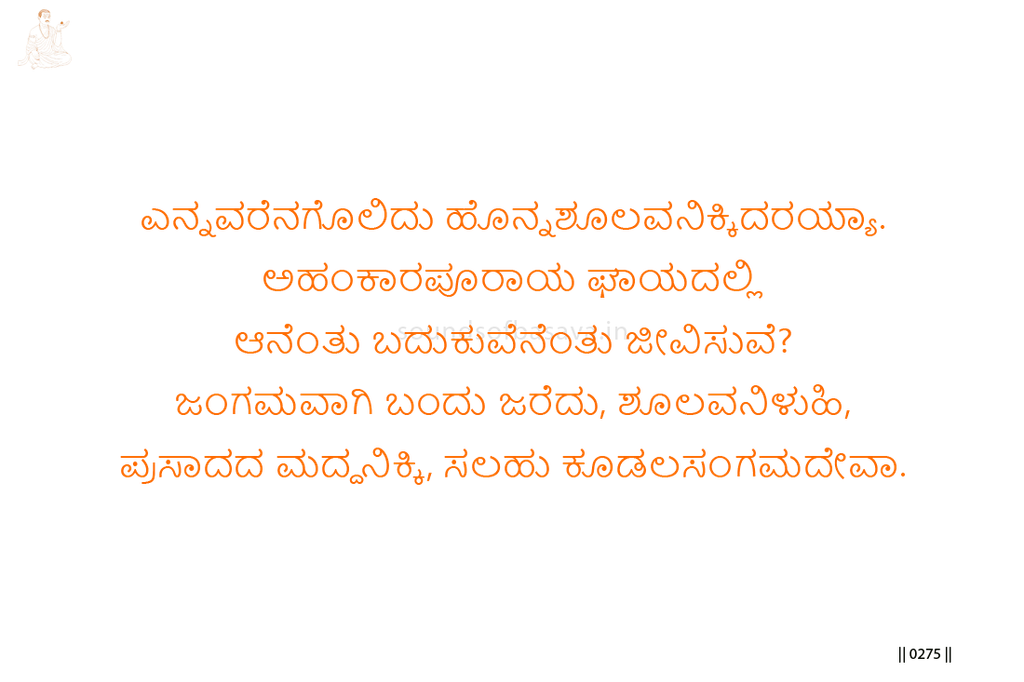
In this vachana, Basavanna describes praise as a golden spear. Those who love and honour him may intend good, yet their praise can pierce inwardly and fill the wound with Ahamkara.
The danger is not praise itself, but what it awakens within. Once recognition becomes self-importance, the seeker asks how he can continue on the spiritual path.
Basavanna therefore turns to Kudalasangama Deva with a prayer: come as Jangama, correct me, remove the spear, apply the medicine of Prasada, and save me.
The vachana reveals both the wound and its remedy: ego born through praise is healed through Jangama-correction and the receiving of Prasada.
Imagery & Symbolic Relevance
The golden spear is the central image. Gold suggests honour, affection, value, and admiration; the spear represents the hidden injury they can cause. What appears pleasing outwardly may become dangerous when it enters the seeker as self-importance.
The wound filled with Ahamkara shows that ego does not always arise through wealth, power, or open pride. It may grow through appreciation itself. Praise begins outside, but the wound is formed within.
Basavanna’s question—“How can I live? How can I survive?”—shows the seriousness of this condition. For the seeker, an inflated self can obstruct the very relation with Linga that spiritual practice is meant to deepen.
The Jangama appears as the healing presence. Basavanna does not ask merely for comfort. He asks the Jangama to rebuke or correct him. True sacred company does not only praise; it also exposes what must be removed.
The removal of the spear represents freedom from the source of inward injury.
Finally comes Prasada as medicine. What has been wounded by self-importance is healed through humble receiving. Correction, grace, and Prasada restore the seeker to right relation with Kudalasangama Deva.
Lingayoga
In Maheshwara Sthala, devotion must withstand the tests that arise through Achara, relationship, and recognition.
The Anga may begin with sincere bhakti, yet praise can quietly redirect awareness from Linga toward the praised self. The danger is subtle because nothing outwardly appears wrong.
The Jangama becomes essential here as living correction. The seeker must be willing not only to honour the Jangama, but also to receive truth from the Jangama when that truth exposes Ahamkara.
Prasada then becomes more than something sacred that is received externally. It becomes the inner acceptance of grace without resistance or self-claim.
The movement is: praise → Ahamkara → Jangama-correction → removal of self-importance → Prasada → restored relation with Linga. Maheshwara practice matures when even honour is brought under Achara and does not become nourishment for the ego.
Editorial Commentary
This vachana reveals one of the subtler dangers of spiritual life: the seeker may survive criticism more easily than praise.
Open opposition can make one alert. Praise, however, may enter unnoticed because it appears favourable.
Basavanna therefore does not blame those who honour him. He examines what their honour can produce within himself.
The prayer to Kudalasangama Deva is especially important. He does not ask that the wound simply disappear. He asks for the Divine to come as Jangama, correct him, remove what has pierced him, and heal him through Prasada.
The teaching is precise: true spiritual friendship does not merely elevate us; it also corrects us. And true humility is not refusing honour outwardly, but refusing to build an identity from it.
Related Vachana
Supporting Vachana
Bhakta Sthala Vachana 305 — The Palanquin of Ego
Bhakta Sthala Vachana 305 supports this vachana by showing that public elevation does not create inner capacity. A dog may be carried in a palanquin, but it does not become fit for the hunt. Vachana 388 carries the same warning into Maheshwara Sthala: praise may lift the seeker outwardly, but inwardly it can pierce like a golden spear.
Advancing Vachana
Prasadi Sthala Vachana 60 — The Ripening Fruit
Prasadi Sthala Vachana 60 advances this movement by surrendering honor and dishonor to Kudalasangama Deva. Vachana 388 asks that praise not come near because honor can wound the seeker. Vachana 60 carries this into Prasadi Sthala, where gain and loss, rise and fall, honor and dishonor all belong to Kudalasangama Deva, and the seeker ripens without being ruled by self-measure.
