

Summary
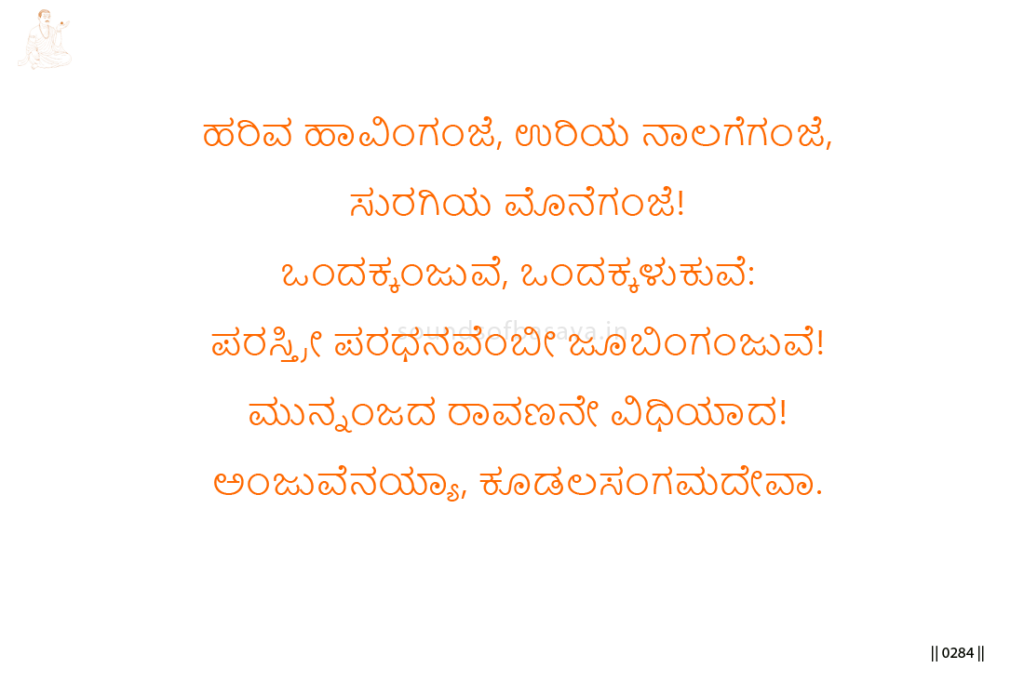
In this vachana, Basavanna names the dangers that people usually fear: the moving serpent, the tongue of fire, and the sharp point of a weapon.
He then shows the deeper danger. What he truly fears is the snare called another’s spouse and another’s wealth. These do not merely threaten the body; they threaten the seeker’s integrity.
He invokes Ravana as the warning. Even one of great power fell through such transgressive desire. Therefore Basavanna says, “I fear, O Kudalasangama Deva.”
Imagery & Symbolic Relevance
The first image is the serpent. It represents visible danger, something one instinctively fears.
The second image is the tongue of fire. Fire burns openly; its danger is direct and easily known.
The third image is the sharp point. The point of a weapon wounds the body and is recognized as danger.
The fourth image is another’s spouse and another’s wealth. This is the inward danger Basavanna fears more deeply. It is not merely an outer object; it is the desire to cross rightful bounds.
The fifth image is Ravana. Basavanna invokes him as the example of one whose fall came through desire for what was not his.
Together, these images reorder fear. The seeker may fear serpent, fire, and sharp weapon, but Basavanna teaches that coveting another’s spouse or wealth is more dangerous because it corrupts the inner path.
Lingayoga
In Lingayoga, this vachana tests the seeker’s restraint. The danger is not only outside the body; it is within desire.
The practitioner must guard against crossing sacred boundaries. Desire for what belongs to another turns attention away from Kudalasangama Deva and toward appropriation.
The practical movement here is vigilance. Basavanna does not ask only for protection from outer harm. He asks for fear of the inner danger that can destroy discernment.
Editorial Commentary
This vachana should be read as a discipline of rightly placed fear. Basavanna does not deny the danger of serpent, fire, or weapon, but he says that the danger of covetous desire is greater.
The Ravana reference gives the warning its force. Greatness, power, and learning do not protect one who desires what is not his. Basavanna therefore turns fear into vigilance before Kudalasangama Deva.
Related Vachana
Supporting Vachana
Bhakta Sthala Vachana 677 — The Five Pillars of Integrity
Bhakta Sthala Vachana 677 supports this vachana by teaching that the Sharana must not desire another’s wealth or another’s companion. Vachana 447 carries the same principle into Maheshwara Sthala through fear and warning: the seeker must fear the inner danger of parastrī and paradhana more than visible dangers.
Advancing Vachana
Prasadi Sthala Vachana 507 — Free of All Wanting
Prasadi Sthala Vachana 507 advances this movement by showing the purified state beyond wanting and return-seeking. Vachana 447 fears the desire that crosses boundaries toward another’s spouse and another’s wealth. Vachana 507 carries this into Prasadi Sthala, where sacred action becomes pure only when desire, expectation, and inward claim have fallen away before Kudalasangama Deva.
