

Summary
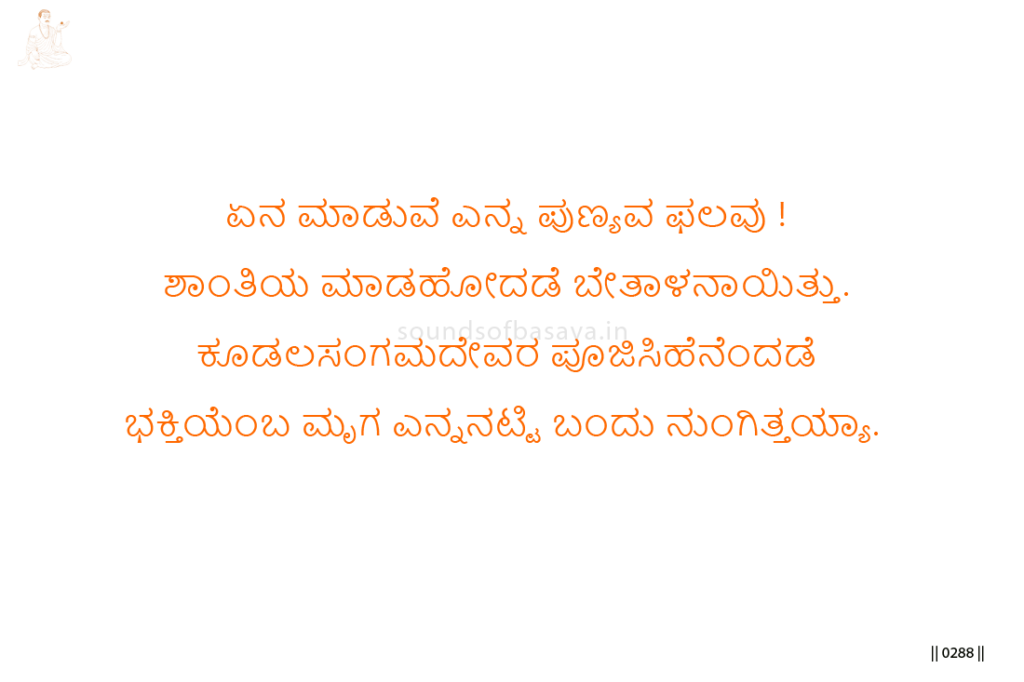
In this vachana, Basavanna asks what one will do with what has been received. If the fruit of merit does not become peace, it turns into a restless betal.
He then turns to worship itself. One may say that one has worshipped Kudalasangama Deva, but if bhakti does not flower, that very bhakti becomes a beast.
The final image is severe: bhakti comes near and devours the seeker. The teaching is clear: merit and devotion must mature into peace and lived transformation. If they are held without ripening, they turn against the seeker.
Imagery & Symbolic Relevance
The first image is the fruit of merit. Merit is not rejected. It is shown as something that must ripen properly.
The second image is peace. Peace is the proper fruit of merit. If merit does not settle into peace, its purpose has failed.
The third image is the betal. The betal suggests restlessness and unsettled movement. Merit that does not become peace becomes inward disturbance.
The fourth image is worship of Kudalasangama Deva. Basavanna does not dismiss worship. He asks what becomes of worship after it is performed.
The fifth image is bhakti as a beast. Bhakti should flower into transformation, but if it remains unripe or possessed, it becomes dangerous.
The final image is the beast devouring the seeker. What was meant to save becomes the force that consumes. This is the danger of devotion that has not matured.
Together, these images show spiritual incompletion. Merit must become peace. Worship must become transformation. Bhakti must flower, or it can turn into a devouring force.
Lingayoga
In Lingayoga, this vachana tests what practice becomes after it is received. The question is not only whether one has merit or devotion, but whether they have ripened.
The seeker must not hold bhakti as possession, identity, or emotional force. It must become peace, steadiness, and lived offering.
The practical movement here is maturation. Basavanna asks the seeker to examine whether spiritual effort has settled into peace, or whether it has become another form of inner unrest.
Editorial Commentary
This vachana should be read as a warning about incomplete devotion. Basavanna does not oppose merit, worship, or bhakti. He warns that each must reach its proper fruit.
The betal and beast images make the teaching sharp. What is spiritually powerful cannot be handled carelessly. If merit does not become peace, it becomes restless. If bhakti does not flower, it becomes dangerous.
Basavanna’s opening question, “What will you do?” is therefore direct. The seeker is responsible not only for receiving merit and devotion, but for allowing them to ripen rightly before Kudalasangama Deva.
Related Vachana
Supporting Vachana
Bhakta Sthala Vachana 1292 — The Dangerous Wonder Called Bhakti
Bhakta Sthala Vachana 1292 supports this vachana by warning that bhakti is not casual devotion. It is like a vessel of poison and must not be seized rashly. Vachana 525 carries that warning into Maheshwara Sthala: if bhakti does not mature and flower, it becomes a beast that devours the seeker.
Advancing Vachana
Prasadi Sthala Vachana 936 — Dasoha at Every Stage
Prasadi Sthala Vachana 936 advances this movement by showing the mature correction of bhakti. Vachana 525 warns that bhakti can become dangerous when it does not ripen into peace and transformation. Vachana 936 carries this into Prasadi Sthala, where bhakti itself becomes Dasoha, and devotion is no longer held privately but offered at every stage before Kudalasangayya.
