

Summary
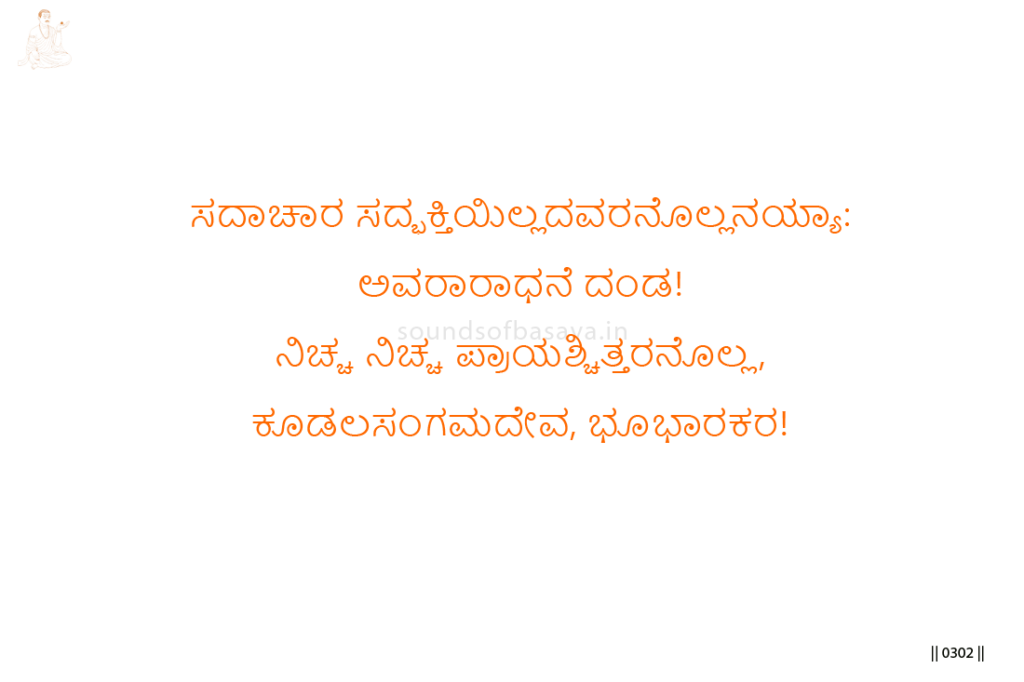
In this vachana, Basavanna rejects worship that lacks sadachara and sadbhakti. Without right conduct and true devotion, worship does not become offering; it becomes punishment.
He also rejects repeated expiation when it does not bring inward change. Repetition alone cannot make a person acceptable before Kudalasangama Deva.
The teaching is direct: worship without right conduct, devotion without sincerity, and expiation without transformation become a burden upon the earth.
Imagery & Symbolic Relevance
The first contrast is between sadachara and its absence. Sadachara is conduct that carries truth. When such conduct is absent, worship has no living ground.
The second contrast is between sadbhakti and empty religious act. Sadbhakti is devotion that is inwardly genuine. Without it, worship becomes an outer act without inner offering.
The image of punishment gives the vachana its severity. Basavanna says such worship becomes danda. What should have lifted the seeker becomes a form of burden and penalty.
Repeated expiation shows religious effort continuing without inward correction. The act is performed again and again, but the person remains unchanged.
The final image is the burden upon the earth. Such a person does not lighten existence through devotion; he adds heaviness through unreformed conduct and hollow worship.
Lingayoga
In Lingayoga, this vachana teaches that practice must carry inner truth. Worship cannot stand apart from conduct, and devotion cannot remain separate from the way one lives.
The seeker must therefore examine whether worship is transforming conduct or merely repeating religious action. Before Kudalasangama Deva, the issue is not how often one performs expiation, but whether sadachara and sadbhakti have arisen.
Editorial Commentary
This vachana should not be expanded into a rejection of worship or expiation itself. Basavanna rejects worship without sadachara and sadbhakti, and expiation that repeats without inward change.
The word “burden” is important. Empty religion is not neutral. When worship does not refine life, it becomes weight rather than release.
Related Vachana
Supporting Vachana
Bhakta Sthala Vachana 188 — The Antidote to Empty Religion
Vachana 188 supports this teaching by asking what use singing, scripture, Veda, and Vedanta have if Linga and Jangama are not lived with devotion. Vachana 651 carries the same principle into Maheshwara Sthala: worship without right conduct and true devotion becomes a burden rather than a path toward Kudalasangama Deva.
Advancing Vachana
Prasadi Sthala Vachana 511 — Practice Goes On, Yet Devotion Is Not Attained
Vachana 511 advances this teaching by showing the deeper confession that practice may continue, yet devotion may still not be attained. Vachana 651 rejects repeated expiation and worship without sadachara and sadbhakti. Vachana 511 carries the movement into Prasadi Sthala: continued practice becomes fruitful only when Kudalasangama Deva turns the mind inward, removes the binding qualities of the body, and makes devotion real.
