

Summary
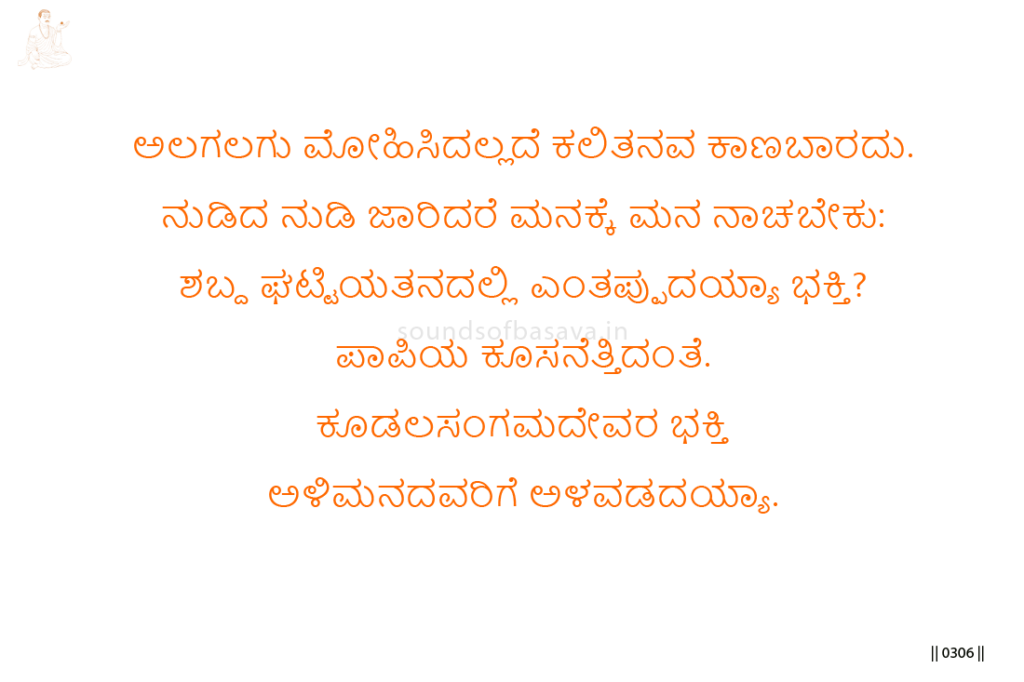
In this vachana, Basavanna says that true learning cannot be seen in a mind that keeps wavering from side to side. A mind that does not remain steady cannot hold what it has learned.
He then turns to speech. If the spoken word slips away, the mind itself should feel shame before itself. Words that do not remain rooted within become only sound.
Basavanna asks what devotion can exist in noisy speech. Devotion to Kudalasangama Deva does not abide in the unsteady heart. Bhakti requires inward firmness, not speech without weight.
Imagery & Symbolic Relevance
The wavering mind is the first image. A mind that moves this way and that cannot hold learning. Its instability prevents the path from becoming clear.
The slipping word is the second image. A word may be spoken, but if it does not remain within the mind, it has no inward force. Basavanna shows the gap between speech and actual state.
The mind feeling shame before itself is the center of the vachana. The correction does not come from public blame or outer accusation. The mind itself must recognize its own failure when speech exceeds realization.
The noise of words shows devotion reduced to sound. Speech may be abundant, but if it is not supported by steadiness, it does not become bhakti.
The image of raising a sinner’s child points to nourishing what will later bring harm. In the same way, restless speech and an unsteady mind feed the very condition that prevents devotion.
Together, the images teach that devotion cannot live in instability. The mind must hold what it speaks, and speech must carry inward truth before Kudalasangama Deva.
Lingayoga
In Lingayoga, this vachana teaches steadiness of mind and integrity of speech. Devotion cannot be carried by words alone.
The seeker must examine whether speech remains inwardly true after it is spoken. If the mind wavers and words slip away, devotion becomes sound without substance.
The practical movement is inward steadiness. The mind must stop moving from side to side, and the spoken word must remain rooted in the heart. Before Kudalasangama Deva, bhakti requires a heart capable of holding steady.
Editorial Commentary
The phrase “the mind should feel shame before the mind” is important. Basavanna is not speaking of public shame. He points to inward self-recognition, where the mind sees the gap between what it says and what it truly holds.
The vachana does not reject speech. It rejects speech that has no inward weight. Devotion must remain in the heart; otherwise, it becomes only noise.
Related Vachana
Bhakta Sthala Vachana 92 — The Soil of the Heart
Vachana 92 supports this teaching by showing that sacred giving does not bear fruit where inward fitness is absent. Even if dīkṣā is given to one whose heart is weak, bhakti does not arise by that act alone. Vachana 668 carries the same principle forward: Kudalasangama Deva’s bhakti cannot abide where the mind wavers and speech lacks inward firmness.
Advancing Vachana
Prasadi Sthala Vachana 280 — The Unadorned Heart
Vachana 280 advances this teaching by showing that devotional expression does not become realization unless it changes the heart and mind. There, the tongue may be sweet, and the speaker may sing, dance, and observe Shivaratri, yet the inner condition may remain unchanged.
Vachana 668 warns that noisy speech is not bhakti when the mind is unsteady. Vachana 280 carries this into Prasadi Sthala by showing that even devotional expression must enter the heart, steady the mind, and transform the seeker before Kudalasangama Deva.
