

Summary
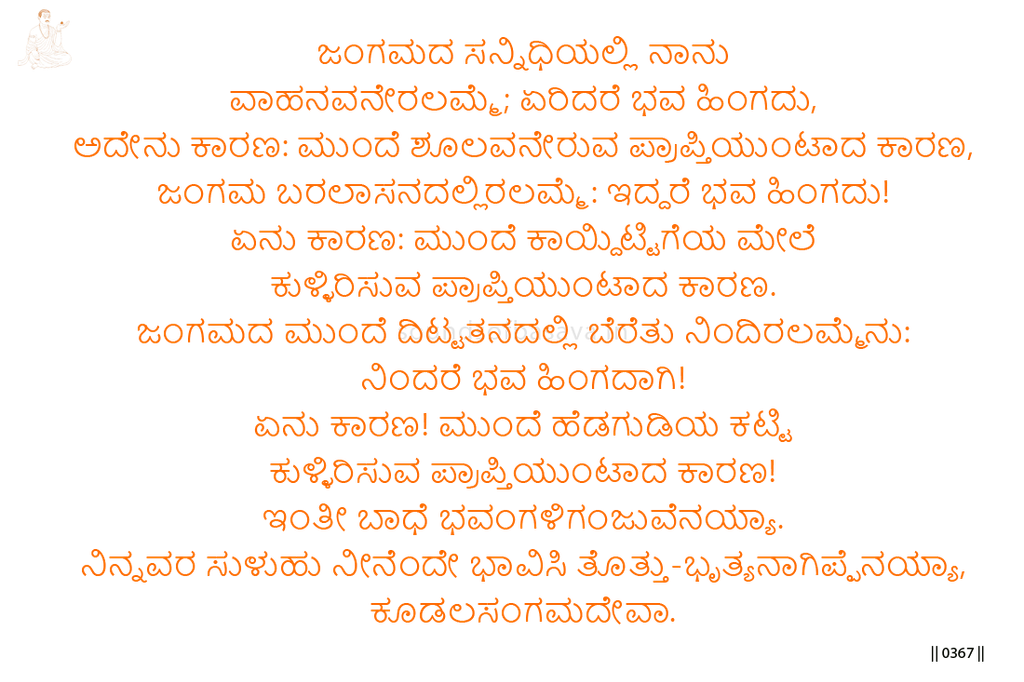
In this vachana, Basavanna examines humility before the Jangama through bodily posture. He asks that he should not remain mounted in the presence of the Jangama, should not remain seated when the Jangama arrives, and should not stand rigidly before the Jangama. Each posture becomes a test of the inner state.
The issue is not etiquette alone. To ride above, sit unmoved, or stand stiffly before the Jangama reveals a subtle self-elevation. Basavanna sees such postures as obstructions because they prevent the seeker from receiving the living presence properly.
The final movement gives the teaching its center. Basavanna sees Kudalasangama Deva’s own presence in the Jangama and therefore chooses the position of servant and attendant. True humility is not verbal modesty. It must enter the body, soften pride, and become lived reverence before the Jangama.
Imagery & Symbolic Relevance
The vehicle represents elevated movement. To remain mounted before the Jangama is to approach living presence while still preserving one’s own height. Movement continues, but humility is missing.
Walking represents shared ground. To come down from the vehicle is to give up superior position and enter the path in a lower, more receptive way. The seeker no longer moves above the Jangama, but stands in relation to the Jangama.
The seat represents retained status. When the Jangama arrives, to remain seated is to hold one’s own place before living sacred presence. The body says what speech may conceal: “I preserve my position.”
Rising from the seat begins the descent from self-importance. It shows readiness to receive. Yet rising alone is still not complete if rigidity remains.
Rigid standing represents subtler pride. Even after leaving the vehicle and the seat, the body may still remain stiff, self-held, and unbent. Basavanna therefore presses the correction deeper.
Bowing represents softened surrender. It is not mere social politeness. It is the body’s confession that it no longer claims central authority before the Jangama.
Becoming the servant of servants is the final posture. Basavanna does not seek nearness to the Jangama as status. He seeks to remain as one who serves those who belong to Kudalasangama Deva.
Lingayoga
In Lingayoga, this vachana shows that reverence must become embodied. The seeker’s relation to Jangama is not completed by thought, speech, or doctrine. It is tested through how the body stands, sits, moves, and bends.
For Prasadi Sthala, the relevance lies in receiving the Jangama without egoic posture. The seeker receives living presence by lowering himself inwardly and outwardly. Riding high, sitting unmoved, and standing rigidly obstruct reception. Bowing and servanthood open the way.
Editorial Commentary
This vachana gives a precise map of how pride survives in posture. Basavanna does not speak only of inner pride in a general way. He identifies its bodily forms: height, seat, stiffness, and refusal to bend.
The movement is progressive: do not remain above, do not remain seated, do not remain rigid. Each step removes another layer of self-positioning. Humility is not complete until the body itself becomes available to reverence.
The phrase “seeing You in them” is decisive. Reverence to Jangama is not directed merely to an individual person. Basavanna sees Kudalasangama Deva’s presence there. Therefore, the bodily posture before Jangama becomes a spiritual act.
The closing self-description as servant and attendant is not self-degradation. It is alignment. The seeker gives up superior position so that the relation to Jangama may become clear, receptive, and truthful.
Related Vachana
Supporting Vachana
Maheshwara Sthala Vachana 254 — The Performance of Devotion
Maheshwara Vachana 254 supports this vachana by exposing the danger of outward devotional posture without true servanthood. In Vachana 397, Basavanna refuses to ride high, remain seated, or stand rigid before the Jangama, and chooses to become servant of Kudalasangama Deva’s servants. In Maheshwara Vachana 254, he asks how one can sit as lord without first becoming servant. The support is direct: spiritual authority or elevated posture becomes false when servanthood has not entered the heart.
Advancing Vachana
Pranalingi Sthala Vachana 928 — The Measureless State
Pranalingi Vachana 928 advances this movement by showing what humility before living presence becomes in the subtler stage. In Vachana 397, the seeker lowers himself before Jangama and receives Kudalasangama Deva through embodied reverence. In Vachana 928, the Guru becomes the living touchstone through whom the truth of subtle states is discerned. Thus the Prasadi humility before Jangama advances into Pranalingi as reliance on the living Guru-touchstone, where the seeker no longer trusts self-measure but submits to realized discernment.
