

Summary
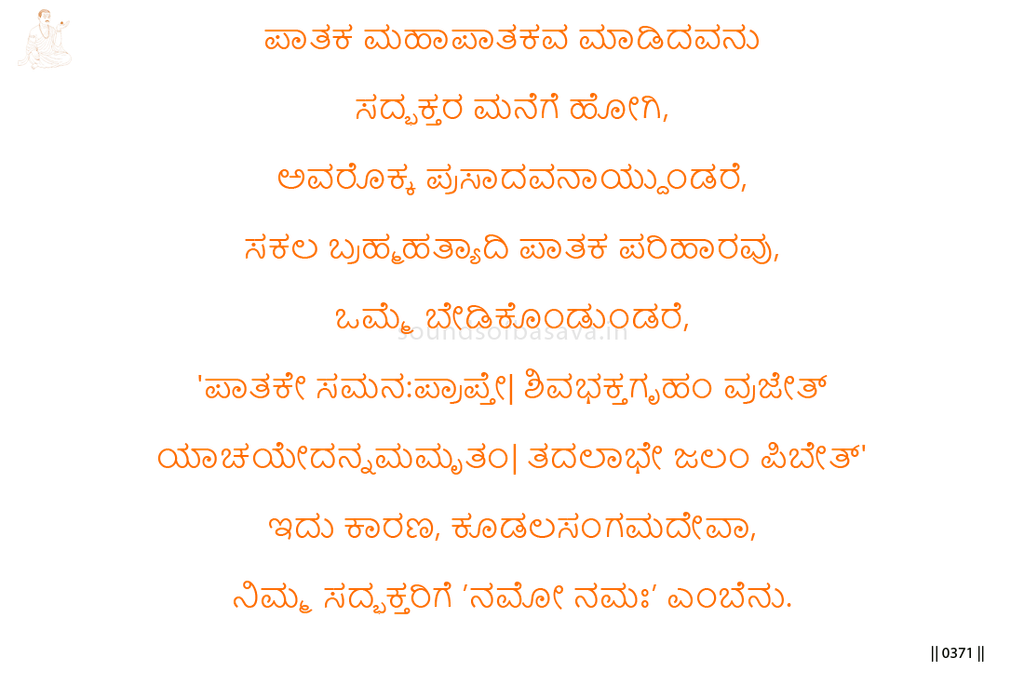
In this vachana, Basavanna declares the transforming power of the true devotees. Even one who has committed grave faults may go to the house of the Sadbhaktas, receive their Prasada, and ask even once with sincerity.
The teaching does not make wrongdoing small. Basavanna names even great sin to show that no burden is beyond true turning. The change occurs when the fallen one enters the field of true devotees and receives Prasada with humility.
For this reason, Basavanna bows again and again to Kudalasangama Deva’s true devotees. Their house becomes a place where grace is received and the direction of life is changed.
Imagery & Symbolic Relevance
Pātaka and Mahāpātaka represent grave fault and deep spiritual burden. Basavanna begins with the heaviest condition to show the reach of grace.
The house of the Sadbhakta represents sacred nearness. It is not merely a domestic place; it is a field shaped by lived devotion.
Prasada is the central image. It is not food alone. When received rightly from true devotees, it becomes grace that turns the seeker inward.
The phrase “asking once” shows the force of sincere appeal. A single true request, made in the right field, can open the way to purification.
The repeated bowing, “namo namo,” expresses Basavanna’s reverence for the Sadbhaktas. They are honoured because their presence becomes a channel of Kudalasangama Deva’s compassion.
Lingayoga
In Lingayoga, this vachana teaches the power of Sharana-sanga. The seeker is not transformed by self-judgment or isolation, but by entering the company of true devotees with humility.
For Prasadi Sthala, Prasada must be received in the right relation. When the seeker receives from the Sadbhaktas with sincerity, Prasada does not remain external. It enters the heart as grace and becomes the beginning of inner purification.
Editorial Commentary
This vachana should not be read as permission to commit wrong. It is a teaching on the power of sincere turning.
The Sadbhakta’s house is important because the true devotee embodies living devotion. Prasada received there carries the force of that devotion.
The removal of sin is linked to genuine reception. The person must come, receive, and ask. This is not mechanical eating; it is humble participation in grace.
Basavanna bows to the Sadbhaktas because they make compassion accessible. Through them, even one burdened by grave fault may turn toward Kudalasangama Deva.
Related Vachana
Supporting Vachana
Bhakta Sthala Vachana 246 — The Anubhava Mantapa as a Model for Sacred Community
Bhakta Vachana 246 supports this vachana by showing the devotee’s home as a sacred place of service, humility, listening, and shared truth. In Vachana 470, Basavanna says that even one burdened by grave fault may go to the house of the Sadbhaktas and receive Prasada. In Vachana 246, the meeting of devotees becomes a living sacred community where ego falls away and Kudalasangama Deva abides. The support is direct: the house of true devotees becomes a field of grace.
Advancing Vachana
Pranalingi Sthala Vachana 979 — Without Experience, Nothing Ripens
Pranalingi Vachana 979 advances this teaching by clarifying that Prasada must become Anubhava. In Vachana 470, Prasada received from the true devotees removes grave burden through sincere turning. In Vachana 979, Basavanna shows that Prasada without lived experience does not ripen into transformation.
