

Summary
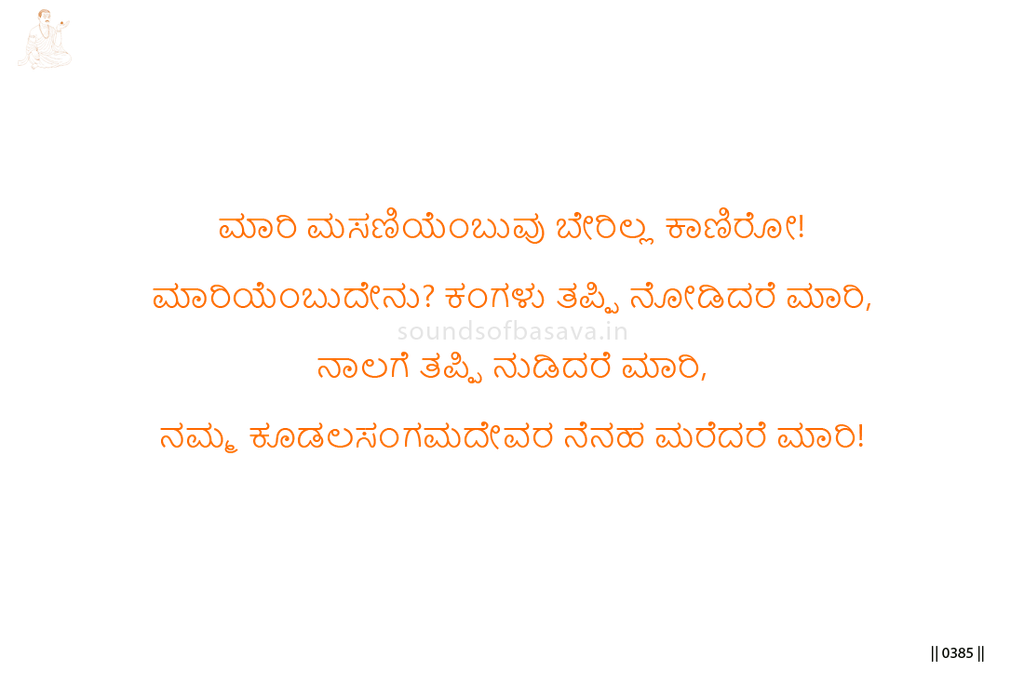
In this vachana, Basavanna says that Māri and the cremation-ground are not somewhere far away.
He asks, “What is Māri?” When the eyes go astray and see wrongly, that is Māri. When the tongue goes astray and speaks wrongly, that is Māri. When the remembrance of Kudalasangama Deva is forgotten, that is Māri.
The teaching is direct: inner ruin begins when seeing, speech, and remembrance lose their right direction. The body may still be alive, but when Kudalasangama Deva is forgotten, spiritual life has entered the cremation-ground.
Imagery & Symbolic Relevance
Māri and the cremation-ground are the opening images. Basavanna does not place them outside the seeker. He brings them into the faculties of daily life.
The eyes represent seeing. When they look wrongly, perception itself becomes misdirected. The seeker no longer sees in relation to Kudalasangama Deva.
The tongue represents speech. When it speaks wrongly, speech becomes separated from truth. The fault is not speech alone, but speech that has slipped from remembrance.
The final image is forgetfulness. Basavanna makes this the root of Māri. Wrong seeing and wrong speech become spiritually destructive because remembrance of Kudalasangama Deva has been lost.
Lingayoga
In Lingayoga, this vachana teaches vigilance over sight, speech, and remembrance.
The eyes must not wander into wrong seeing. The tongue must not speak apart from truth. Above all, remembrance of Kudalasangama Deva must not be allowed to fade.
For Prasadi Sthala, the point is precise: grace must remain alive in awareness. If remembrance dies, receiving itself becomes distorted. Right Prasadi life therefore requires guarded seeing, truthful speech, and continuous remembrance.
Editorial Commentary
“Māri” should be retained because it is the key term of the vachana. Here it means the destructive condition that enters when the seeker falls away from right seeing, right speech, and Divine remembrance.
The cremation-ground should not be read only as a physical place. Basavanna says it is not separate or elsewhere. It appears wherever remembrance of Kudalasangama Deva has been lost.
The order of the vachana is important. First the eyes go astray, then the tongue goes astray, and finally remembrance is forgotten. Basavanna shows that spiritual death begins in the faculties and reaches its root in forgetfulness.
Related Vachana
Supporting Vachana
Maheshwara Sthala Vachana 272 — The Wavering Devotion
Maheshwara Vachana 272 supports this vachana by showing devotion becoming unstable when sight is clouded, desire burns, bodily pull dominates, and speech does not remain inwardly steady.
In Vachana 630, Basavanna calls wrong seeing, wrong speech, and forgotten remembrance Māri. Both vachanas show that spiritual danger begins within the faculties themselves. When sight, speech, and remembrance lose steadiness, devotion weakens before Kudalasangama Deva.
Advancing Vachana
Pranalingi Sthala Vachana 498 — The Breath of Remembrance
Pranalingi Vachana 498 advances this teaching by showing the positive state opposite to Māri. There, remembrance of Kudalasangama Deva is dawn, life, and prana; forgetfulness is sunset.
In Vachana 630, forgetting Kudalasangama Deva is Māri. In Vachana 498, remembrance becomes the breath of life itself. The Prasadi warning against forgetfulness therefore advances into Pranalingi as continuous remembrance held in the heart and carried on the lips before Kudalasangama Deva.
