

Summary
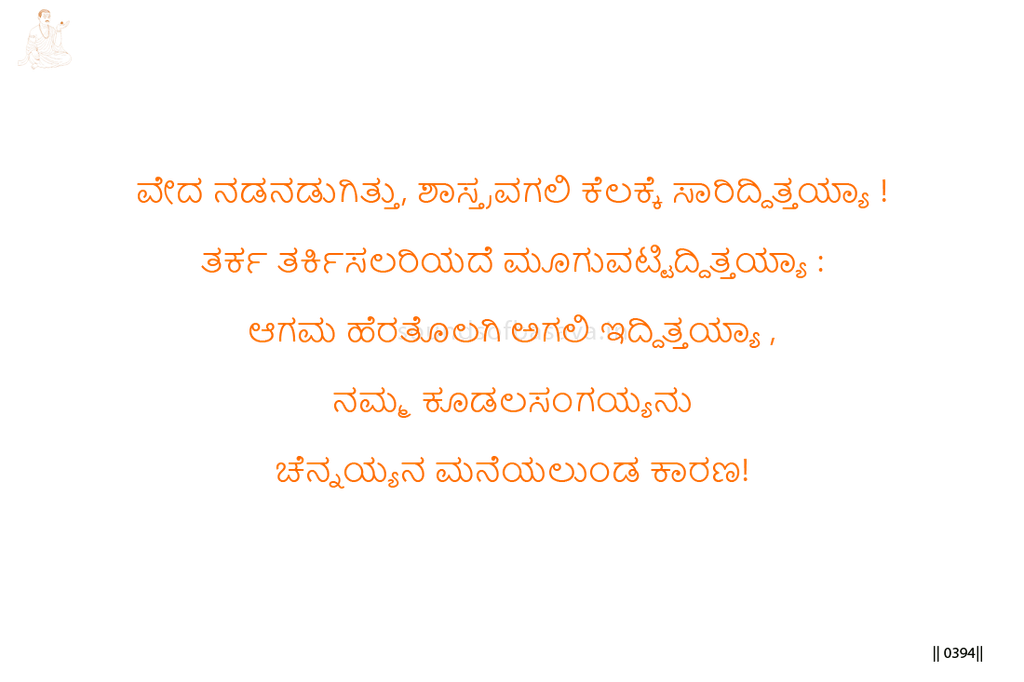
In this vachana, Basavanna shows that inherited religious authority cannot stand as the final measure when Kudalasangayya accepts Madara Chennayya.
The Veda trembles. The Shastra loses its standing. Logic becomes unable to argue. The Agama withdraws.
Basavanna gives one reason for this: Kudalasangayya ate in Madara Chennayya’s house.
The teaching is precise. Scripture, doctrine, reasoning, and ritual order are shaken when Divine acceptance appears where social and religious expectation would not place it.
Imagery & Symbolic Relevance
The Veda trembling shows established sacred authority becoming unstable.
The Shastra losing its standing shows that formal doctrine cannot hold its usual superiority before this event.
Logic becoming mute shows that argument cannot explain or control Kudalasangayya’s acceptance.
The Agama withdrawing shows that ritual order cannot claim final authority over living Divine response.
All four images lead to one act: Kudalasangayya ate in Madara Chennayya’s house.
Chennayya’s house becomes the point where accepted measurement is overturned. The issue is not learning, debate, ritual qualification, or social standing. The issue is where Kudalasangayya chooses to accept.
Lingayoga
In Lingayoga, this vachana teaches that direct Divine acceptance is higher than inherited authority.
For Prasadi Sthala, it shows that Prasada is not governed by caste, status, or formal religious claim. Kudalasangayya’s acceptance reveals the true measure.
The seeker must therefore look beyond outer authority and recognize the living relation between Kudalasangayya and the Sharana.
Editorial Commentary
The vachana does not require a broad rejection of Veda, Shastra, logic, or Agama. Its force lies in showing their limitation before Kudalasangayya’s acceptance of Chennayya.
Madara Chennayya’s name must remain central, because the vachana corrects both religious and social measurement through him.
Related Vachana
Supporting Vachana
Maheshwara Sthala Vachana 433 — The Robe Without Inquiry
Maheshwara Vachana 433 supports this vachana by rejecting outer appearance as the measure of spiritual truth. It asks whether Hari becomes servant to a garment and invokes Chennayya as a sign that realization is not determined by status or religious form.
In Vachana 750, Veda, Shastra, logic, and Agama are shaken because Kudalasangayya ate in Madara Chennayya’s house. Both vachanas place Chennayya against external measurement and show that living acceptance outweighs formal claim.
Advancing Vachana
Pranalingi Sthala Vachana 979 — Without Experience, Nothing Ripens
Pranalingi Vachana 979 advances this teaching by declaring that devotion, Linga, Prasada, knowledge, and fellowship do not ripen without Anubhava.
In Vachana 750, established authorities cannot stand as the final measure before Kudalasangayya’s act in Chennayya’s house. In Vachana 979, this becomes the Pranalingi principle: sacred forms and knowledge must ripen into lived experience.
