

Summary
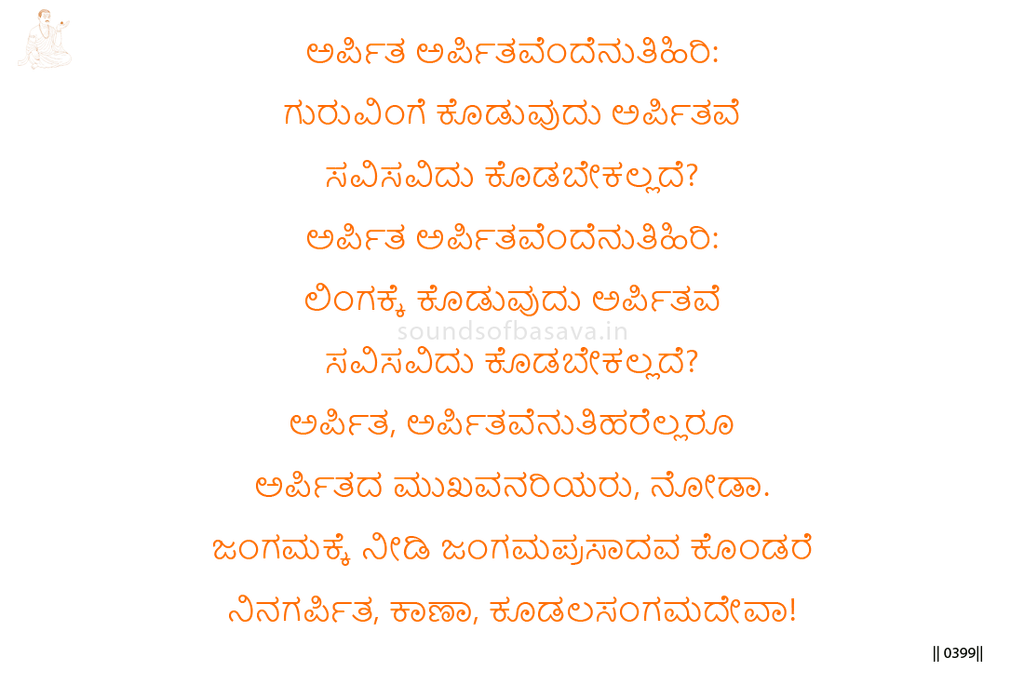
In this vachana, Basavanna questions the repeated claim, “I have offered, I have offered.”
He asks: is giving to the Guru truly offering? Is giving to the Linga truly offering? It must become sav-savidu — lived, tasted, and put into practice — before it can be called real offering.
Basavanna says that many speak of offering, but they do not know the true face of offering.
The offering becomes complete when it is given to the Jangama and received back as Jangama-Prasada. Then, O Kudalasangama Deva, it becomes offering to You.
Imagery & Symbolic Relevance
The repeated word “arpita” means offering. Basavanna uses the repetition to show that sacred language can become empty when it is not lived.
Giving something to the Guru is not enough by itself. The Guru’s teaching must enter use, conduct, and experience. Only then does the act become meaningful.
The same applies to Linga. Placing something before Linga does not complete the offering if the seeker remains unchanged. The offering must become sav-savidu — tasted and realized in living practice, like honey known by the tongue.
“The face of offering” means the real form of offering. Basavanna says that those who only repeat the word do not know this inner form.
The final movement turns to Jangama. Jangama is the living, moving presence of Linga. When one gives to Jangama and receives Jangama-Prasada, offering passes from word and object into lived relation. Then it reaches Kudalasangama Deva.
Lingayoga
In Lingayoga, offering is not completed by declaration or external giving.
Guru must become guidance in life. Linga must become living alignment. Jangama must become the field where offering is tested through direct relation.
For Prasadi Sthala, Prasada is not a mere return of what was given. It is grace received after the offering has become lived experience.
The seeker must therefore move from saying “I have offered” to allowing offering to become conduct, use, and inward transformation.
Editorial Commentary
The Kannada turns on the word sav-savidu. It means that offering must be tasted, applied, and made alive in experience. It is like honey rolled on the tongue: one knows it by direct taste, not by speech alone.
Basavanna does not reject offering to Guru or Linga. He asks whether such giving has entered lived practice.
Jangama-Prasada is the turning point. The offering becomes complete when it passes through Jangama and returns as Prasada.
The central teaching is that true offering is not merely giving something. It is allowing what is given to become lived, tasted, and transformed.
Related Vachana
Supporting Vachana
Maheshwara Sthala Vachana 219 — The Two Suns of Devotion
Maheshwara Vachana 219 supports this vachana by showing that Linga-bhakti must mature into Jangama-bhakti. Linga devotion gathers the seeker inwardly, but Jangama devotion tests whether that devotion becomes living service.
In Vachana 777, Basavanna questions the claim of offering to Guru and Linga until the act becomes sav-savidu and reaches Jangama-Prasada. Both vachanas show that devotion must move from sacred claim into lived encounter.
Advancing Vachana
Pranalingi Sthala Vachana 1041 — The Living Jangama Within
Pranalingi Vachana 1041 advances this teaching by saying that without Jangama one cannot truly see Linga, Guru, or Prasada.
In Vachana 777, Jangama-Prasada completes the meaning of offering. In Vachana 1041, this becomes a deeper Pranalingi insight: Jangama is the living knowledge through which Guru, Linga, and Prasada are recognized.
