

Summary
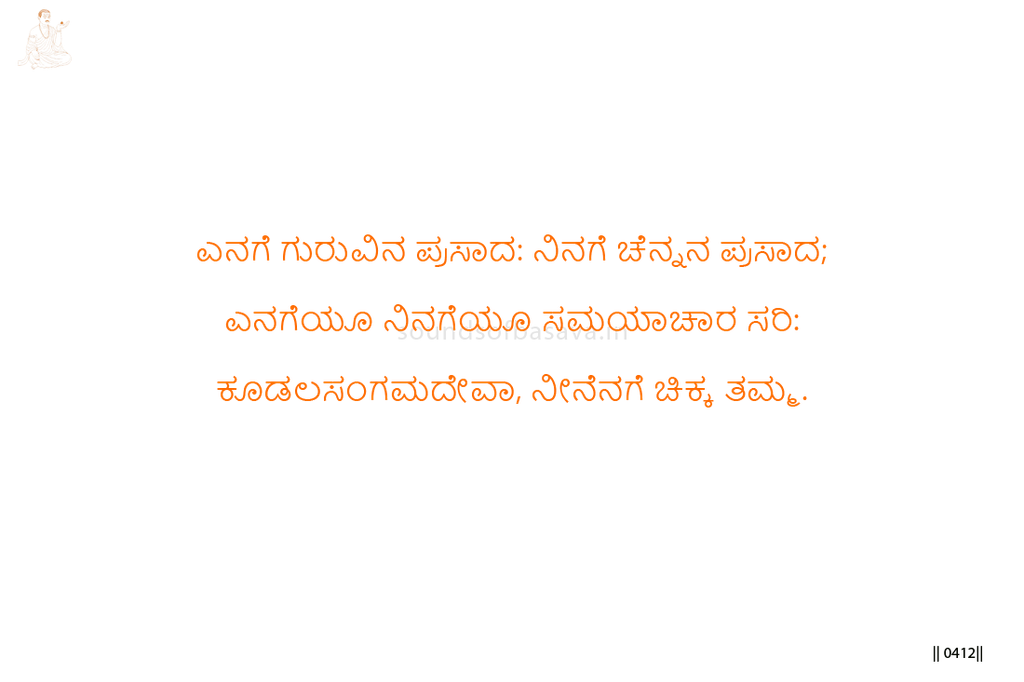
In this vachana, Basavanna speaks with striking intimacy to Kudalasangama Deva.
For Basavanna, there is the Guru’s Prasada. For Kudalasangama Deva, there is Madara Chennayya’s Prasada. For both, the same Samayachara is proper.
Basavanna then says: “O Kudalasangama Deva, You are my younger brother.”
The teaching is that Prasada is not measured by outward status. Guru’s Prasada and Madara Chennayya’s Prasada stand within the same sacred conduct. Where Samayachara is one, distinction loses its authority.
Imagery & Symbolic Relevance
The vachana rests on two names: Guru and Madara Chennayya.
The Guru represents recognized spiritual transmission. The Guru’s Prasada is not ordinary food or favor; it is grace received through the guiding source of the path.
Madara Chennayya represents realized devotion beyond social rank. His Prasada is accepted by Kudalasangama Deva Himself. This makes Chennayya’s place spiritually decisive.
Basavanna places these two together without division. One receives the Guru’s Prasada; the other receives Chennayya’s Prasada. Yet the conduct binding both is the same.
Samayachara means the right sacred conduct of the path. Here it means that the rule of lived truth is not different for one person and another, nor even for Basavanna and Kudalasangama Deva in this intimate speech.
The final phrase, “You are my younger brother,” should not be weakened. It expresses nearness. Basavanna speaks to Kudalasangama Deva in the intimacy created by shared Prasada and shared Samayachara.
Lingayoga
In Lingayoga, this vachana teaches that Prasada must be understood through realization, not social distinction.
The seeker must not assume that grace flows only through recognized authority. It may also come through the realized Sharana whose outward social place is low, but whose inner state is high.
For Prasadi Sthala, this is central. Prasada equalizes the field. When it is truly received, it dissolves superiority and inferiority.
The path becomes clear: Guru, Sharana, Prasada, and Samayachara must be held together in lived truth.
Editorial Commentary
The force of the vachana depends on this reading. Basavanna sets the Guru’s Prasada and Madara Chennayya’s Prasada side by side.
The statement is not casual equality. It is equality within Samayachara. What matters is not birth, status, or formal position, but the sacred conduct through which Prasada is rightly received.
The final line is intimate and daring. By calling Kudalasangama Deva his younger brother, Basavanna shows the closeness born from shared Prasada and shared truth.
Related Vachana
Supporting Vachana
Maheshwara Sthala Vachana 433 — The Robe Without Inquiry
Maheshwara Vachana 433 supports this vachana by invoking Madara Chennayya as proof that divine nearness does not belong to outer religious appearance or social status. Kudalasangama Deva stands where realization is, not where status claims authority.
In Vachana 905, Basavanna says that Guru’s Prasada and Madara Chennayya’s Prasada stand within the same Samayachara. Both vachanas teach that realization and sacred conduct, not outward rank, determine spiritual worth.
Advancing Vachana
Pranalingi Sthala Vachana 979 — Without Experience, Nothing Ripens
Pranalingi Vachana 979 advances this teaching by saying that devotion, Linga, Prasada, fellowship, and sacred practice remain incomplete without Anubhava.
In Vachana 905, the equality of Guru’s Prasada and Madara Chennayya’s Prasada is established through shared Samayachara. In Vachana 979, this matures into Pranalingi understanding: Prasada and fellowship become complete only when they ripen into direct lived experience.
