

Summary
In this vachana, Basavanna removes the pride of spiritual conquest.
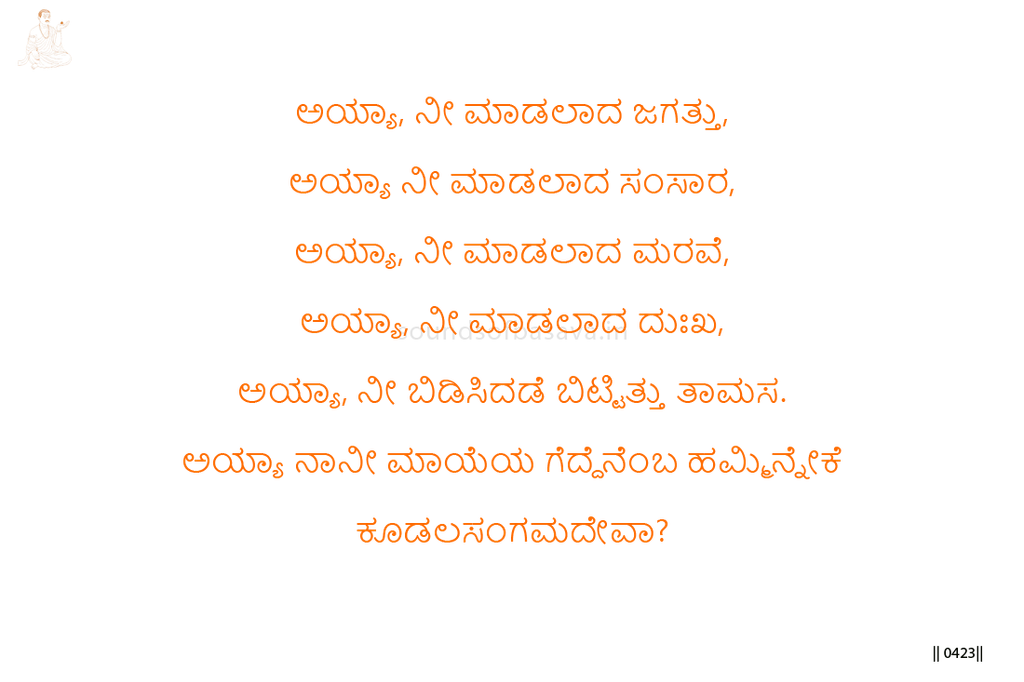
He says: O Lord, this world is made by You. This samsara is made by You. This forgetfulness is made by You. This sorrow is made by You. If You release it, tamas falls away.
Then Basavanna asks: Why should I have the pride of saying, “I have conquered this Māyā,” O Kudalasangama Deva?
The teaching is that the seeker must not claim personal victory over Māyā. World, samsara, forgetfulness, sorrow, and the removal of tamas all stand within Kudalasangama Deva’s power.
Freedom from Māyā is therefore not an achievement to boast about. It is grace.
Imagery & Symbolic Relevance
The vachana is built through repetition: “You made…”
Basavanna first names the world. The world is not the seeker’s creation.
He then names samsara, the field of becoming, relationship, attachment, and repeated entanglement. This too is not outside Kudalasangama Deva’s power.
He names forgetfulness. This is important. Spiritual forgetfulness is not treated as a small lapse alone. It is part of the condition in which the seeker finds himself.
He names sorrow. Sorrow too belongs to the field through which the seeker is tested and ripened.
Then comes the decisive line: if Kudalasangama Deva releases it, tamas falls away. Tamas means darkness, inertia, dullness, or obscuring heaviness. It does not fall because the seeker boasts. It falls when Kudalasangama Deva releases it.
The final question cuts spiritual pride at the root. To say “I conquered Māyā” is itself another form of Māyā, because the “I” has returned as claimant.
Lingayoga
In Lingayoga, effort, vigilance, and practice are necessary, but they must not become ownership.
The seeker may struggle against forgetfulness, sorrow, tamas, and Māyā. Yet the final release is not self-manufactured. It depends on Kudalasangama Deva’s grace.
For Prasadi Sthala, this teaching is central. Prasada cannot be claimed as personal achievement. Grace is received, not possessed.
The right posture is humility: to act, remember, surrender, and serve without saying, “I conquered.”
Editorial Commentary
The Kannada repeats “Ayya, You made…” before world, samsara, forgetfulness, and sorrow. This repetition should be preserved because it shifts agency away from the ego.
The word tamas should be retained or briefly explained. It means the darkening force of dullness, inertia, and obscuration.
The final phrase, “Why this pride that I have conquered Māyā?” is the heart of the vachana. Basavanna is not denying spiritual effort. He is denying the ego’s right to claim the result.
The teaching should not be turned into fatalism. It is a correction of pride. The seeker remains responsible, but does not own grace.
Related Vachana
Supporting Vachana
Maheshwara Sthala Vachana 327 — The Impurity Hiding in the Mind
Maheshwara Vachana 327 supports this vachana by warning that the claim “I have known the truth” itself summons spiritual death, because knowledge becomes possession and pride.
In Vachana 1002, Basavanna asks why he should claim, “I have conquered Māyā,” when world, samsara, forgetfulness, sorrow, and the release from tamas belong to Kudalasangama Deva. Both vachanas expose the subtle ego that hides inside spiritual attainment.
Advancing Vachana
Pranalingi Sthala Vachana 178 — The Steady Hand of Remembrance
Pranalingi Vachana 178 advances this teaching by showing that when remembrance slips, Māyā enters; when Kudalasangama Deva is remembered steadily, what binds melts away like camphor in flame.
In Vachana 1002, Basavanna refuses the pride of conquering Māyā by himself. In Vachana 178, this matures into Pranalingi steadiness: Māyā is not conquered by boastful self-claim, but dissolved through unbroken remembrance of Kudalasangama Deva.
