
Summary
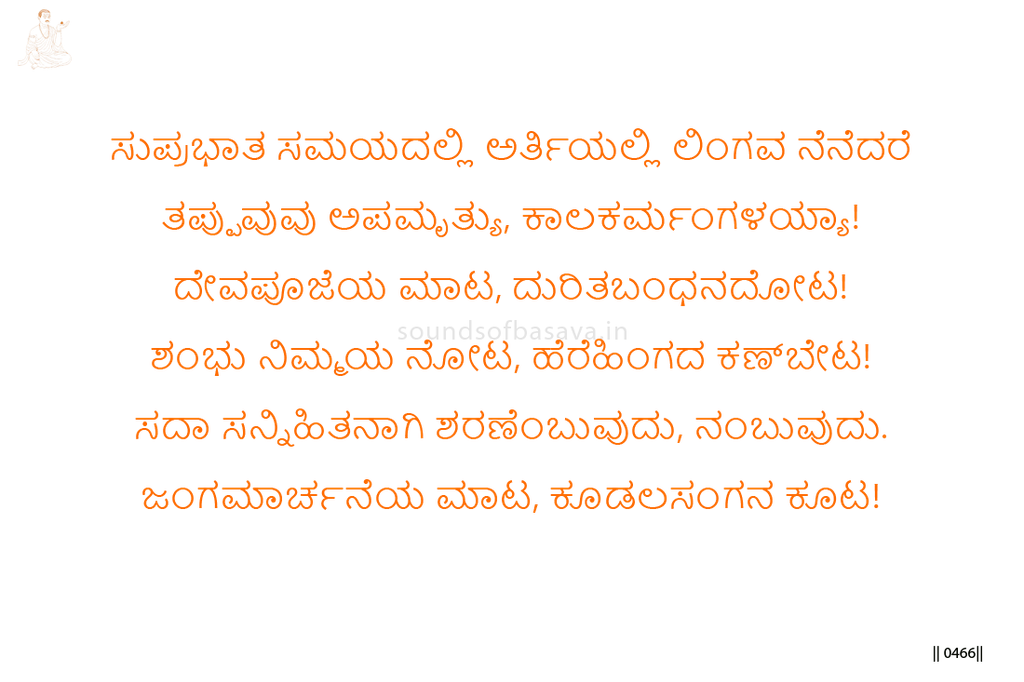
In this vachana, Basavanna places the first movement of the day before the Linga. At the auspicious dawn, if the Linga is remembered with inward earnestness, untimely death, time-bound affliction, and karmic force lose their hold.
This remembrance becomes true Deva-puja. Worship is not presented only as an outer act; it is the cutting away of the bondage of wrong and suffering. The gracious gaze of Lord Shambhu (Shiva) and the seeing of the Linga become the protection and direction of the seeker.
Basavanna then joins this remembrance with surrender and Jangama-archana. To remain always in nearness and to trust the state of Sharana is part of the same movement. Worship of the Jangama becomes the meeting with Kudalasangama Deva.
Imagery & Symbolic Relevance
The first image is suprabhata, the auspicious dawn. It is the beginning of the day, but also the first opening of awareness. Basavanna gives importance to this first turning because what is remembered at the beginning shapes the movement that follows.
The remembrance of the Linga is the central act. It is not delayed until later practice, nor treated as one action among many. At dawn itself, the seeker is to turn toward the Linga with inward urgency.
Apamrityu, kala, and karma form the next cluster. Basavanna names the forces that trouble human life: untimely death, the movement of time, and the binding effect of karma. He says that these lose their force when the Linga is remembered rightly.
Deva-puja is then described as the cutting away of durita-bandhana, the bondage of wrong, affliction, or sin. Worship is therefore not only an act offered to the Divine; it is also the loosening of what binds the seeker.
The sight of Shambhu and the seeing of the Linga are important. The seeker is not merely performing an outward ritual. He is brought under the Lord’s sight and into the vision of the Linga.
The next movement is constant nearness. To remain always sannihita is to live close to the Divine presence. Basavanna joins this with the trust and surrender contained in the word Sharana.
The final image is Jangama-archana. Worship reaches completion when it moves toward the Jangama. This is called the meeting of Kudalasangama, showing that living reverence is not separate from Divine worship.
Lingayoga
In Lingayoga, this vachana teaches the importance of first orientation. The day begins rightly when remembrance of the Linga is placed before all other movements.
The vachana also joins Linga remembrance, Deva-puja, surrender, and Jangama-archana. Worship does not remain confined to one moment or one form. It begins in remembrance, cuts bondage, remains in nearness, and reaches living expression through reverence to Jangama.
Editorial Commentary
“Suprabhata” should be kept as more than ordinary morning. In this vachana, it marks the first available moment for remembrance.
“Apamrityu,” “kala,” and “karma”. Basavanna names them as forces whose hold is broken through Linga-remembrance.
“Jangama-archana” is the closing movement. The vachana begins with remembering the Linga and ends with worship of the Jangama, showing that the path is complete only when inward remembrance becomes living reverence.
Related Vachana
Supporting Vachana
Prasadi Sthala Vachana 189 — The Bowing Stalk
Prasadi Vachana 189 supports this vachana by teaching that Linga worship must continue into reverence before the Jangama. There, after worshipping the Linga, the seeker must bow before Jangama like a ripened stalk. Vachana 177 carries the same movement into daily continuity: remembrance of the Linga at dawn becomes Deva-puja, surrender becomes constant nearness, and Jangama-archana becomes the meeting of Kudalasangama Deva.
Advancing Vachana
Sharana Sthala Vachana 1337 — Show Me the Difference Between Prana and Prana-Linga
Sharana Vachana 1337 advances this teaching by carrying worship from right beginning into inner realization. In Vachana 177, the seeker remembers the Linga at dawn and joins Deva-puja with Jangama-archana. In Vachana 1337, the seeker admits that external worship is not enough unless the intimate relationship between Prana and Linga is realized. Thus the Pranalingi movement of dawn-remembrance advances into Sharana Sthala as the prayer to know the living relation between one’s own life-breath and Prana-Linga.
