

Summary
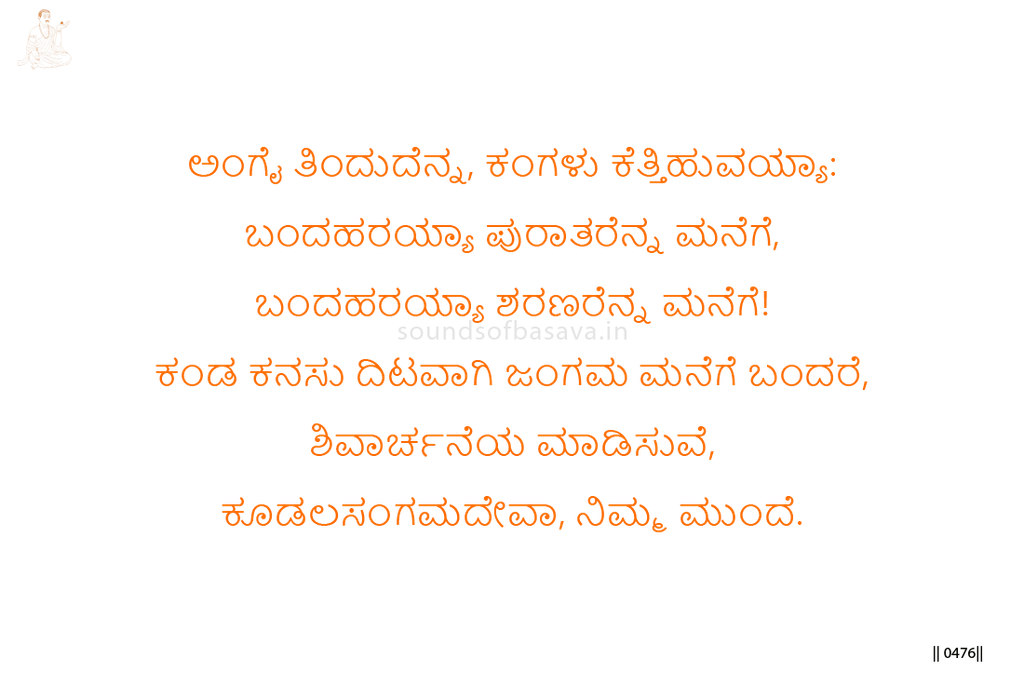
In this vachana, Basavanna describes the body’s response before sacred arrival. The hand trembles, the eyes quiver, and the body is stirred. This trembling is not ordinary weakness; it is the body responding to the presence it recognizes.
He then says that the Ancients have come to his house, and the Sharanas have come to his house. The longed-for presence is no longer distant. It has entered the seeker’s own dwelling.
Basavanna then places a condition before Kudalasangama Deva. If the vision he has seen becomes true and the Jangama comes to the house, he will perform Linga-archana before them. Worship becomes complete when inner vision, Jangama presence, and Linga worship meet in the Lord’s presence.
Imagery & Symbolic Relevance
The trembling hand is the first image. The hand is the organ of holding, offering, and worship. Its trembling shows that the act of worship is no longer routine; the body itself has been touched by reverence.
The quivering eyes show altered seeing. Basavanna does not describe calm observation. He shows a perception shaken by the arrival of realized presence.
The arrival of the Ancients is the next image. The Ancients are not merely visitors by age or social standing. They represent the prior current of realized devotion that has come into the seeker’s house.
The arrival of the Sharanas repeats and clarifies the same movement. What is ancient and realized is present through the Sharanas. Their coming turns the house into a field of worship.
The house is important. It is the place where the seeker receives the Sharanas. It may be the physical dwelling, but in the movement of the vachana it also becomes the inward space where sacred presence is welcomed.
The vision becoming true is the turning point. What was inwardly seen must become living presence. Basavanna does not leave the vision as private experience; he seeks its truth in the arrival of Jangama.
The final act is Linga-archana before them. Worship of the Linga becomes complete before the Jangama and before Kudalasangama Deva. The fixed, the living, and the Divine presence are brought together.
Lingayoga
In Lingayoga, this vachana teaches that worship must involve the whole being. The hand, eyes, body, house, vision, Jangama, and Linga are all drawn into one movement.
For Pranalingi Sthala, the body’s trembling has significance because the Linga is not held as an outer object alone. The seeker’s very body responds when living realization arrives.
The practice-point is clear: inner vision must not remain isolated. It must be confirmed and fulfilled through reverence to Jangama and through Linga-archana performed before Kudalasangama Deva.
Editorial Commentary
The trembling should not be treated as spectacle. In this vachana, it is the body’s reverent response before the arrival of the Ancients and Sharanas.
The house should not be reduced to physical space alone. It is the place of reception, where inward vision and living presence meet.
The final line is central. Basavanna does not separate Linga worship from Jangama presence. He will perform Linga-archana before them, and all of this stands before Kudalasangama Deva.
Related Vachana
Supporting Vachana
Prasadi Sthala Vachana 196 — The Rain of Compassion
Prasadi Vachana 196 supports this vachana by teaching that Linga-archana has no true force when it remains only with the fixed form. There, Basavanna says that when the offering reaches Jangama, even the Sthavara becomes wet.
Vachana 372 carries this teaching into embodied reverence. The Ancients and Sharanas arrive at the house, the Jangama comes as living presence, and Basavanna performs Linga-archana before them. Thus Prasadi Vachana 196 supports the Pranalingi teaching that Linga worship becomes complete only when joined to Jangama.
Advancing Vachana
Sharana Sthala Vachana 1339 — Before Bhava Covers My Devotion Again
Sharana Vachana 1339 advances this teaching by showing the next danger after sacred encounter. In Vachana 372, the arrival of the Sharanas and Jangama makes Linga-archana living and true. In Vachana 1339, after entering the radiance of the Linga, the seeker becomes concerned that Bhava may cover devotion when attention moves outward.
Thus the Pranalingi meeting of Linga, Jangama, vision, and worship advances into Sharana Sthala as vigilance. The seeker must not let the living encounter become another outward occupation. He asks Kudalasangama Deva to hold him before he slips away from the Linga-awareness already received.
