

Summary
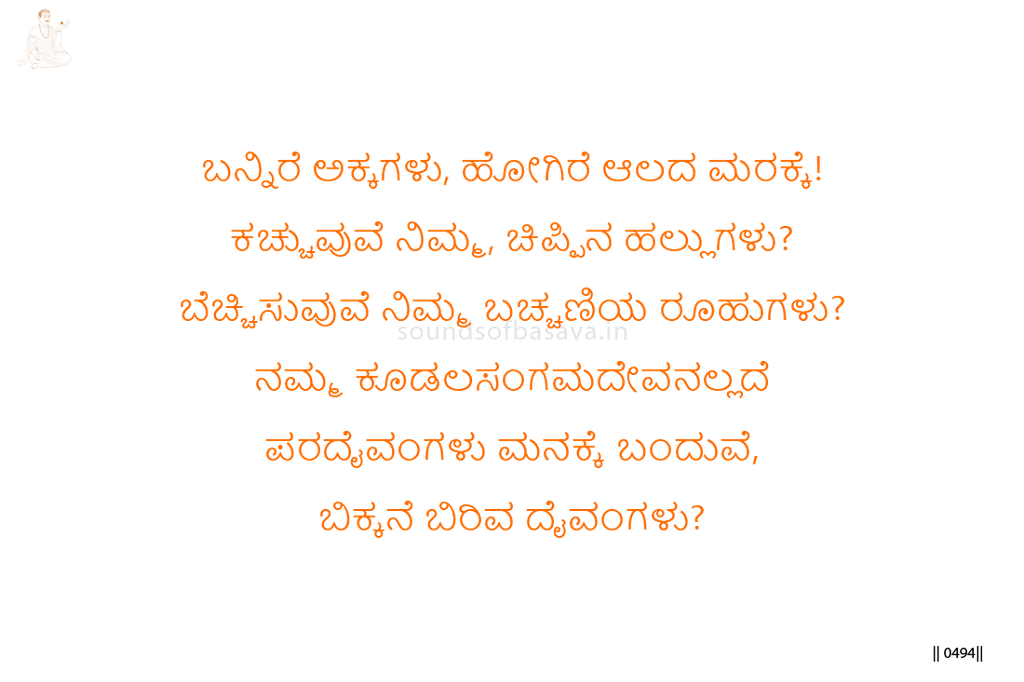
In this vachana, Basavanna addresses those who go to the banyan tree and perform anxious acts around it. He asks whether biting teeth, chattering mouths, and fearful gestures can make such worship true.
The correction is direct. Apart from Kudalasangama Deva, the other gods that enter the mind only make it tremble. Basavanna exposes divinities shaped by fear, habit, and mental projection.
The teaching is not a general rejection of reverence. It is a warning against worship born from fear and confusion. The seeker must turn from mind-made gods toward Kudalasangama Deva, who alone is the true refuge.
Imagery & Symbolic Relevance
The first image is the call to the women or elders who go to the banyan tree. Basavanna brings attention to a familiar inherited practice.
The tree is the central outward image. It stands before the worshipper as a visible object, but fearful action around it does not make it Divine.
Biting teeth and chattering mouths show anxiety. Worship has become disturbed by fear rather than clarified by recognition.
The final image is the god that enters the mind and makes it tremble. This is the center of the vachana. Basavanna is not describing living Linga-awareness, but a mental formation that frightens the worshipper.
Kudalasangama Deva is placed against these mind-made gods. He is not produced by fear, custom, or imagination. He is the one Lord before whom false projections fall away.
Lingayoga
In Lingayoga, this vachana teaches discernment between living truth and mental projection. The seeker must not allow fear to become worship.
For Pranalingi Sthala, the emphasis is inward clarity. The mind can manufacture forms, powers, and anxieties, but what is mind-made cannot become the Linga.
The practice-point is direct: examine what is being worshipped. If a form depends on fear and trembling, it cannot be the final refuge. Turn toward Kudalasangama Deva alone.
Editorial Commentary
The banyan-tree image should remain concrete. Basavanna’s teaching depends on the contrast between an outer object and the fearful imagination built around it.
The final question should remain central. The problem is not the tree itself, but the mind’s power to create gods that frighten itself.
This vachana should not be expanded into a broad rejection of tradition. Its precise concern is fear-born worship that mistakes mental projection for Divine truth.
Related Vachana
Supporting Vachana
Prasadi Sthala Vachana 562 — Beyond the Crowded Gods
Prasadi Vachana 562 supports this vachana by showing how ordinary objects become separate centers of worship. There, Basavanna lists pot-god, tree-god, street-stone god, banana-cluster god, twig-god, measuring-vessel god, and others, and then declares that Kudalasangama Deva alone is God.
Vachana 561 carries this Prasadi correction into Pranalingi Sthala through the image of fearful worship around the banyan tree. What Prasadi 562 shows as crowded object-worship becomes here the inward problem of gods that enter the mind and make it tremble. Thus Prasadi one-pointedness supports the Pranalingi rejection of mind-made divinity.
Advancing Vachana
Sharana Sthala Vachana 374 — Household Gods and the Śaraṇa’s Offering
Sharana Vachana 374 advances this teaching by carrying discernment into total offering. In Vachana 561, Basavanna turns the seeker away from gods shaped by fear and mental projection. In Vachana 374, household gods and clan gods are left in their place, while body, mind, and eyes are offered to Kudalasangama Deva’s Sharanas.
Thus the Pranalingi correction of mind-made gods advances into Sharana Sthala as lived surrender. The seeker no longer remains bound by fearful forms or inherited dependence, but offers the instruments of life and perception to Kudalasangama Deva’s Sharanas.
