

Summary
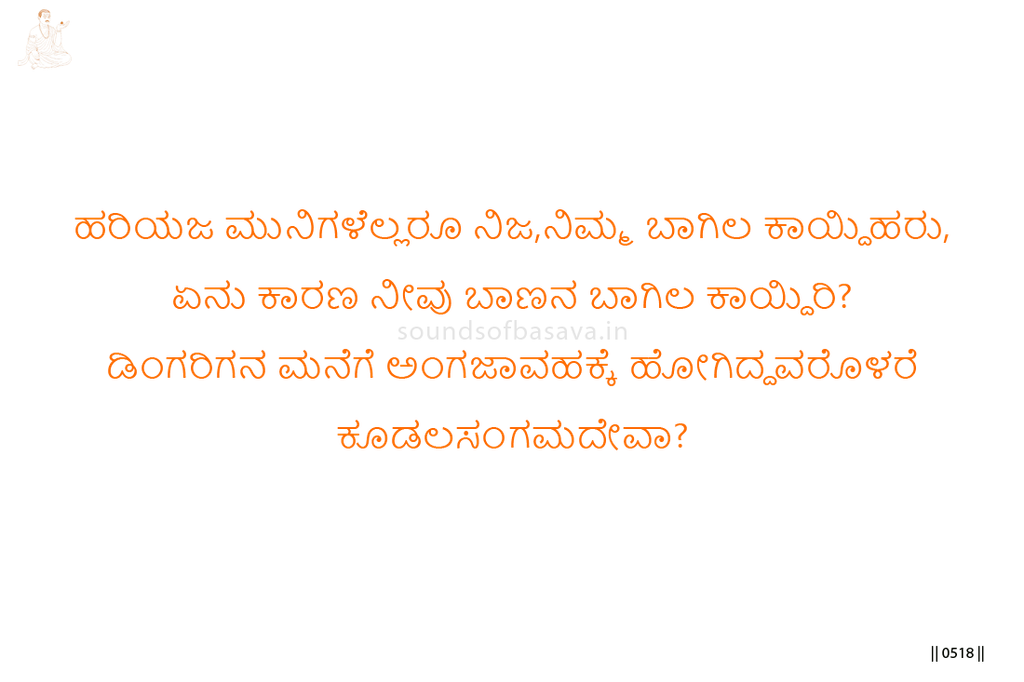
In this vachana, Basavanna questions the venerable munis who stand continually guarding the Lord’s door. They are near the sacred threshold, yet still remain at the door.
He then asks why they wait at Bāṇa’s door—the threshold associated with Bāṇa, the archer—as though expecting the arrow to be released. The image shows suspended expectation: they remain ready, but do not enter into direct realization.
The final question before Kudalasangama Deva exposes the problem of guarding another’s house. A watchman may stand near the house, but he does not live within it. The teaching is that outer guardianship, sacred waiting, and nearness to holy structures do not become realization unless the seeker enters the living truth inwardly.
Imagery & Symbolic Relevance
The first image is the venerable munis. They represent disciplined and respected spiritual persons, but Basavanna does not measure them by reputation alone. He asks what their standing at the door has actually achieved.
The door is the central image. A door is a threshold. It is near the house, but it is not the inner dwelling. To remain at the door is to remain close without entering.
The act of guarding the door shows outer protection. Basavanna questions this role because the Divine is not something that needs to be protected from outside.
Bāṇa’s door and the waiting for the arrow show delayed expectation. The arrow is held for release, but while one waits for the moment of release, realization remains postponed.
The watchman at another’s house gives the clearest image. A watchman may guard the house, yet the house is not his own dwelling. In the same way, one may guard temple, form, rule, or tradition and still remain outside the living presence.
The final address to Kudalasangama Deva gives the measure. The issue is not discipline itself, but outwardness. The seeker must not mistake guarding the threshold for entering the Divine presence.
Lingayoga
In Lingayoga, this vachana teaches the difference between nearness and entry. The seeker may stand near sacred forms, protect sacred structures, and wait for realization, yet still remain outside inward recognition.
For Pranalingi Sthala, the emphasis is direct inward entry. The Linga is not to be guarded as an external object alone; it must become living presence within the seeker.
The practice-point is direct: do not remain as a watchman at the door. Do not wait endlessly for an outer event. Enter the inward relation to Kudalasangama Deva.
Editorial Commentary
The door image should be kept central. Basavanna is not merely criticizing temple service; he is exposing the danger of remaining at the threshold.
The arrow image should be understood as waiting for a decisive event. The vachana warns that spiritual life can become waiting without entry.
Related Vachana
Supporting Vachana
Prasadi Sthala Vachana 375 — The Dawn of Grace
Prasadi Vachana 375 supports this vachana by showing that preparation alone does not complete realization. There, the lamp is prepared with oil and wick, yet awakening comes through the arrival of Kudalasangama Deva’s Sharanas at the door and the living utterance of “Śiva.”
Vachana 743 shows the danger of remaining at the door as a guard or watcher. Vachana 375 supports it by showing the right use of the door: not endless guardianship, but living reception of Sharana-presence. Thus Prasadi Vachana 375 prepares the Pranalingi teaching that the threshold must become entry, not permanent waiting.
Advancing Vachana
Sharana Sthala Vachana 5 — The Eye-Opening Conduct
Sharana Vachana 5 advances this teaching by moving from outer watching to living seeing. In Vachana 743, Basavanna questions those who guard the door but remain outside direct realization. In Vachana 5, he sees the conduct of the Sharana again and again, and his inner eye opens before Kudalasangama Deva.
Thus the Pranalingi warning against remaining at the threshold advances into Sharana Sthala as direct recognition through lived Sharana conduct. The door is no longer merely guarded; the inner eye opens through seeing the life of the Sharana.
