

Summary
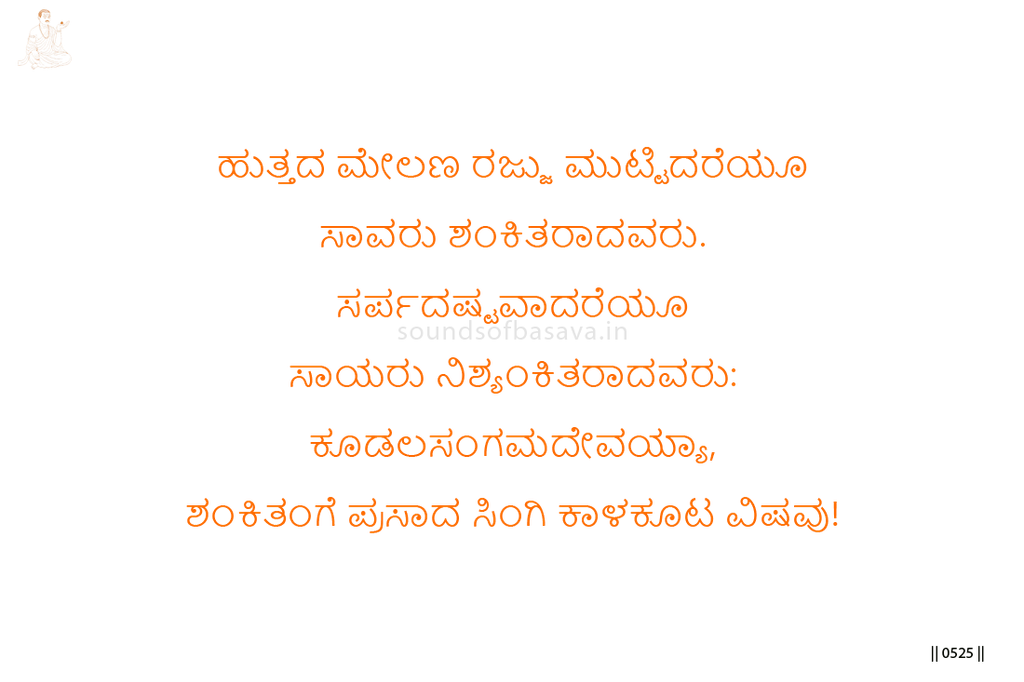
In this vachana, Basavanna shows how doubt changes the way experience is received. A rope lying near an anthill or serpent-hole may be touched, yet one who is filled with doubt may die from fear itself.
He then gives the reverse image. Even if a serpent actually bites, the one who is without doubt may not die. The difference lies not only in the outer object, but in the inner condition of the one who receives the experience.
Basavanna then applies this to Prasada. For the one who doubts, even Prasada becomes like Kālakūṭa poison. The teaching is that sacred receiving depends upon inner steadiness. Where doubt rules, even grace is received as danger; where doubt is absent, even danger loses its binding power before Kudalasangama Deva.
Imagery & Symbolic Relevance
The first image is the rope near the serpent-place. The rope itself is harmless, yet the setting awakens fear. When doubt enters, the mind turns the harmless into the deadly.
The second image is the doubter. Basavanna does not treat doubt as a small intellectual hesitation. In this vachana, doubt becomes a force that distorts perception and weakens life itself.
The third image is the real serpent-bite. This is stronger than the rope image. Even where danger is present, the one who is free from doubt is not inwardly overcome in the same way.
The fourth image is the one without doubt. Nishankita, the doubt-free state, gives steadiness. It does not mean carelessness; it means an inner condition not broken by fear or suspicion.
The final image is Prasada becoming Kālakūṭa poison. Kālakūṭa means deadly poison. Basavanna’s point is sharp: the fault is not in Prasada, but in the doubting receiver. What should nourish and sanctify becomes harmful when received through suspicion.
Kudalasangama Deva is the final measure. Prasada must be received with inner clarity; otherwise the seeker’s own doubt corrupts the act of receiving.
Lingayoga
In Lingayoga, this vachana teaches that the state of the receiver matters. The object, act, or offering alone does not determine the fruit; the inner condition through which it is received is decisive.
For Pranalingi Sthala, the emphasis is inward steadiness. The seeker must not allow doubt to interrupt the relation to Linga and Prasada. When doubt enters, perception becomes divided and sacred receiving becomes unstable.
The practice-point is direct: receive Prasada without suspicion. Do not let fear turn rope into serpent, and do not let doubt turn grace into poison before Kudalasangama Deva.
Editorial Commentary
The rope and serpent images should be kept together. Basavanna first shows imagined danger, then actual danger, and then tests both through the presence or absence of doubt.
The word “doubt” here should not be reduced to ordinary questioning. In this vachana, doubt is the inner wavering that changes how reality is received.
The final line governs the whole teaching. Prasada itself is not poison. For the doubting one, Prasada is experienced as Kālakūṭa poison because the receiver’s inner condition has become distorted.
Related Vachana
Supporting Vachana
Maheshwara Sthala Vachana 90 — The Mirror of the Beholder
Maheshwara Vachana 90 supports this vachana by showing that perception changes the way a thing is received. There, the same pot under the toddy palm is seen by one as milk and by another as liquor. The substance is not divided, but the perceiver’s condition divides it.
Vachana 772 carries this same teaching into Pranalingi Sthala through a sharper image. A rope may become deadly to the doubter, and Prasada itself may become Kālakūṭa poison. Thus Maheshwara Vachana 90 supports the Pranalingi teaching that the inner condition of seeing and receiving determines whether reality is received rightly before Kudalasangama Deva.
Advancing Vachana
Sharana Sthala Vachana 782 — The Company That Binds and the Refuge That Frees
Sharana Vachana 782 advances this teaching by showing how the inner condition is shaped and protected through association. There, the company of those who do not abide in Linga and Prasada is called bondage and fall, while refuge in the Sharanas preserves purity.
In Vachana 772, doubt corrupts perception and turns Prasada into poison. In Vachana 782, this advances into Sharana Sthala as the discipline of remaining in the company where Linga and Prasada are lived without division. Thus the Pranalingi warning against doubt matures into Sharana refuge, where right association protects the seeker from distorted receiving before Kudalasangama Deva.
