

Summary
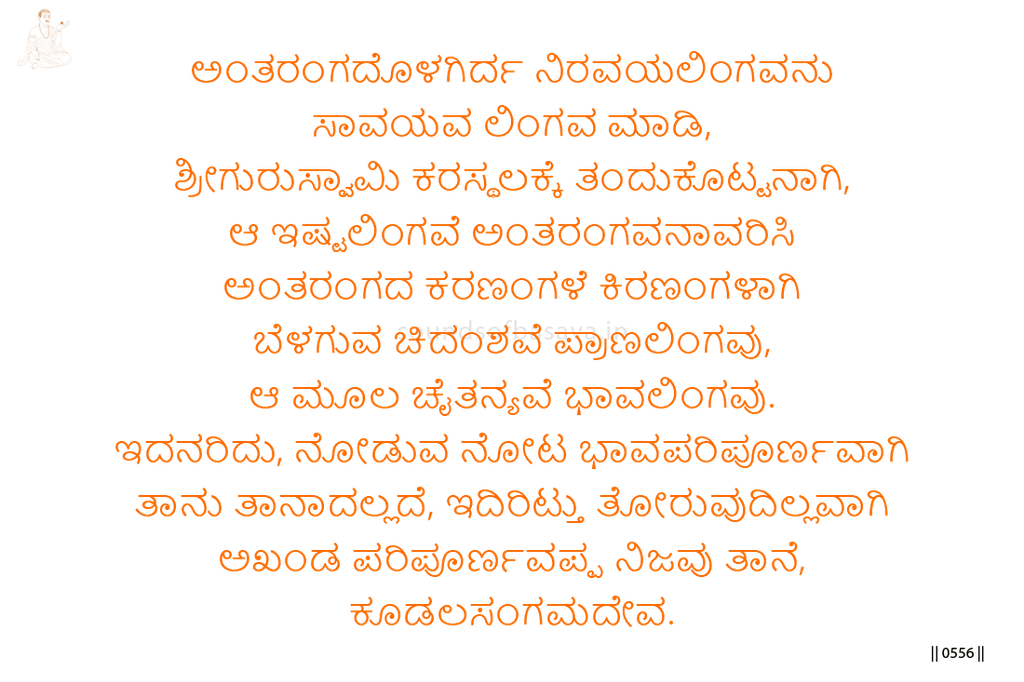
In this vachana, Basavanna explains the inward movement of Linga through several precise terms. Niravayalinga means the undivided Linga, free from separate parts or division. This inner Niravayalinga is made available as Sāvayalinga or Ishtalinga, the Linga that can be received and worshipped in form.
Śrī Guru Swami places this Ishtalinga in the palm. The palm is important because it shows direct receiving. The Linga is not distant or hidden in an external shrine; it is brought into the seeker’s own hand through the Guru’s grace.
The Ishtalinga then enters the antaranga, the inner field of the seeker. It fills the inner being, and the inner faculties, or karaṇas, become rays. These rays are the shining movements of inner awareness made luminous by the Linga.
Basavanna then says that this chidamsha, this living portion or spark of consciousness, is Pranalinga. The root Chaitanya, the original consciousness from which this awareness arises, is Bhavalinga. Knowing this, the very act of seeing becomes Bhava-paripurna — full in being. Nothing remains outside to be separately shown. The complete Real itself stands as Kudalasangama Deva.
Imagery & Symbolic Relevance
The first image is Niravayalinga. Niravaya means without separate parts or division. Niravayalinga is therefore the undivided inner Linga, not yet considered through form, limb, or external object.
The second image is Sāvayalinga or Ishtalinga. Sāvaya means possessing manifest aspects or discernible expression, in contrast to the undivided Niravaya state. The undivided inner Linga becomes accessible as the Ishtalinga, the chosen and worshipped Linga given by the Guru. Basavanna does not present this as a separate reality, but as the same Linga made available for direct relation.
The third image is Śrī Guru Swami placing the Linga in the palm. This is the act of transmission. The Guru does not merely explain the Linga; he places it in direct living relation with the seeker.
The fourth image is the Ishtalinga entering the antaranga. Antaranga means the inner field, the inward seat of awareness and experience. The Linga placed outwardly in the palm must enter inwardly and fill the inner being.
The fifth image is the inner karaṇas becoming rays. Karaṇas are the inner faculties or instruments. When the Linga fills the antaranga, these faculties are no longer dark or scattered; they become rays of illumination.
The sixth image is chidamsha as Pranalinga. Chidamsha means the living spark or portion of consciousness. When this consciousness shines through life, it is known here as Pranalinga.
The seventh image is root Chaitanya as Bhavalinga. Chaitanya means consciousness, and amūla, meaning original, foundational, or without a prior source, Chaitanya points to the root-consciousness. Bhavalinga is the Linga known as the ground of being and becoming.
The final image is seeing becoming Bhava-paripurna. When this is known, seeing itself becomes full in being. There is nothing left outside to be separately displayed. The complete Real itself stands revealed before Kudalasangama Deva.
Lingayoga
In Lingayoga, this vachana teaches the inward completion of the Linga received through Guru. The movement begins with the Linga placed in the palm, but it does not stop there. The Ishtalinga must enter the antaranga and illumine the inner faculties.
For Pranalingi Sthala, the point is direct. Pranalinga is not merely an outer object of worship. It is the living radiance of consciousness within prana and inner awareness. When the inner faculties become rays, the seeker’s seeing itself becomes transformed.
The practice-point is clear: receive the Ishtalinga through Guru, hold it with reverence, and allow it to enter the inner field. Let the inner faculties become luminous. Know Chidamsha as Pranalinga and root Chaitanya as Bhavalinga, until seeing becomes Bhava-paripurna.
Editorial Commentary
Niravayalinga is the undivided Linga. Ishtalinga is the Linga given into direct worship through Guru. Antaranga is the inner field. Karaṇas are the inner faculties. Chidamsha is the conscious spark that shines as Pranalinga. Amūla Chaitanya is root-consciousness, known here as Bhavalinga. Bhava-paripurna means fullness of being in which nothing remains outside to be separately shown. This vachana also serves as Basavanna’s directive for Lingayoga and its methodology: the seeker receives the Ishtalinga through Guru, allows it to enter the antaranga, lets the inner faculties become illumined, recognizes the living consciousness as Pranalinga and the root-consciousness as Bhavalinga, and thereby arrives at the fullness of realization where seeing itself becomes complete.
Related Vachana
Supporting Vachana
Maheshwara Sthala Vachana 42 — The Thumb-Sized Infinite
Maheshwara Vachana 42 supports this teaching by showing the paradox of the Linga held in the palm: though small in form, it points to what is immeasurable, but the mind fails to recognize it when distorted by doubt and mis-seeing. Vachana 971 carries this into Pranalingi Sthala by showing the completion of that same movement: the Linga placed in the palm by Guru enters the inner field, illumines the inner faculties, and is known as Pranalinga and Bhavalinga. What Maheshwara Vachana 42 presents as the overlooked Infinite in the palm becomes, here, the inward radiance that fills seeing itself.
Advancing Vachana
Sharana Sthala Vachana 1233 — The Sharanas Within My Being
Sharana Vachana 1233 advances this teaching by carrying inward illumination into complete internalization. There, Basavanna breaks open the body, mind, and eyes and places the Sharanas within them, making the Sharanas of Kudalasangama the Lords of his being.
In Vachana 971, the Ishtalinga enters the antaranga, the inner faculties become rays, and Chidamsha and Chaitanya are known as Pranalinga and Bhavalinga. In Vachana 1233, this matures into Sharana Sthala as the full opening of body, mind, and vision to realized presence. The inward radiance of the Linga becomes inward habitation by the Sharanas, and devotion arises from the transformed bhava before Kudalasangama Deva.
