

Summary
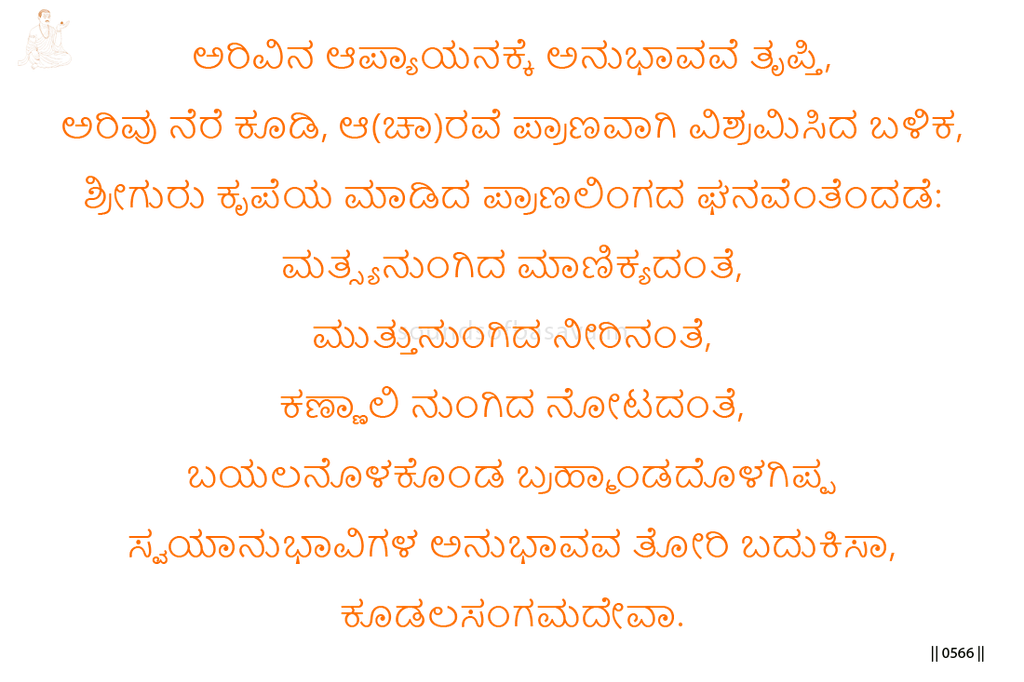
In this vachana, Basavanna teaches that Anubhava is the fulfilment of Arivu. Knowing does not become complete by itself; it is nourished and satisfied only when it becomes lived experience.
He then says that when Arivu joins fully with Arivu, and Achara itself rests as prana, the greatness of Pranalinga is known through the grace of Śrī Guru. This is not merely conceptual understanding. It is the stabilization of knowledge, conduct, and life-force in the Pranalinga.
Basavanna gives four images to explain this greatness: a fish within the ocean, a pearl within water, the eye that holds what it sees, and the universe resting within the vast expanse. Each image shows absorption, inclusion, and non-separation.
The spiritual concern placed before Kudalasangama Deva is therefore clear. Basavanna asks Him to reveal the Anubhava of the Swayānubhavis — those who know through direct realization — and to sustain him in that experience.
Imagery & Symbolic Relevance
The first image is Arivu needing Anubhava for fulfilment. Arivu means knowing or awareness. Anubhava is direct lived experience. Basavanna says that knowing is satisfied only when it becomes Anubhava.
The second image is Arivu joining with Arivu. This points to awareness becoming gathered into itself, no longer remaining divided between mere knowing and lived realization.
The third image is Achara becoming prana and resting. Achara means right conduct or lived discipline. Here it is no longer only outer discipline; it has become the very life-current of the seeker.
The fourth image is the greatness of Pranalinga known through Śrī Guru’s grace. Pranalinga is the Linga known in relation to prana, the living life-force. Its greatness is not grasped by effort alone but revealed through Guru’s grace.
The fifth image is the fish within the ocean. The fish does not stand outside the ocean and observe it. It lives within the very element that supports it. This image shows immersion in Pranalinga.
The sixth image is the pearl within water. The pearl rests within water without separation from the surrounding field. This image shows intimacy and inner inclusion.
The seventh image is the eye that takes in what it sees. The eye does not travel outward to collect each object. A whole field appears within its seeing. This image shows effortless inclusion within awareness. The final image is the universe resting within the vast expanse. Basavanna moves from the individual to the cosmic. Just as the universe rests within the boundless expanse, the experience of the Swayānubhavis rests in the fullness of Pranalinga.
Lingayoga
In Lingayoga, this vachana teaches the maturation of knowing into lived realization. Arivu must not remain as information or concept; it must become Anubhava. Achara must not remain outer conduct alone; it must become life-breath.
For Pranalingi Sthala, the point is direct. The greatness of Pranalinga is known when awareness, conduct, and prana become inwardly settled through Guru’s grace. The seeker no longer stands outside the Linga as observer, but lives within its field like the fish in the ocean.
The practice-point is clear: let knowing become experience, let conduct become life-current, and seek the grace of Śrī Guru for the revelation of Pranalinga. Ask not merely to understand the Anubhava of the Swayānubhavis, but to be sustained in it before Kudalasangama Deva.
Editorial Commentary
The word Anubhava should remain central. In this vachana, Anubhava is not discussion, memory, or doctrine. It is the fulfilment of Arivu. Swayānubhavis are those who know through direct realization. The four images — fish in ocean, pearl in water, eye holding the field of sight, and universe within the vast expanse — should be read as images of absorption and inclusion, not as separate philosophical categories. The eye-image is especially important: the eye includes a vast field without grasping it. In the same way, realized awareness includes the field of experience without standing apart from it.
Related Vachana
Supporting Vachana
Prasadi Sthala Vachana 1018 — Without Awareness, What Truly Exists?
Prasadi Vachana 1018 supports this teaching by asking whether body, prana, and abiding can have meaning without Arivu, and whether Bhakti can exist without bhava. It establishes awareness as the condition through which body, life, devotion, and inward standing become spiritually meaningful.
Vachana 1016 carries this into Pranalingi Sthala. Arivu is not only necessary; it must be fulfilled by Anubhava. Achara is not only right conduct; it must rest as prana. Through Śrī Guru’s grace, the greatness of Pranalinga is then known. What Prasadi 1018 teaches as the necessity of Arivu and bhava becomes, here, the fulfilled Anubhava of Pranalinga before Kudalasangama Deva.
Advancing Vachana
Sharana Sthala Vachana 1337 — Show Me the Difference Between Prana and Prana-Linga
Sharana Vachana 1337 advances this teaching by bringing the relation between Prana and Prana-Linga into direct Sharana inquiry. Basavanna confesses that outer worship has not revealed the intimate relation between Linga and prana, and he asks Chennabasavanna to show the distinction between his prana and the Prana-Linga.
In Vachana 1016, Arivu is fulfilled by Anubhava, Achara rests as prana, and the greatness of Pranalinga is known through Śrī Guru’s grace. In Vachana 1337, this matures into Sharana Sthala as humble precision: the seeker no longer rests in outer form or assumed knowledge, but asks for the living relation between prana and Prana-Linga to be shown directly in Kudalasangama Deva.
