

Summary
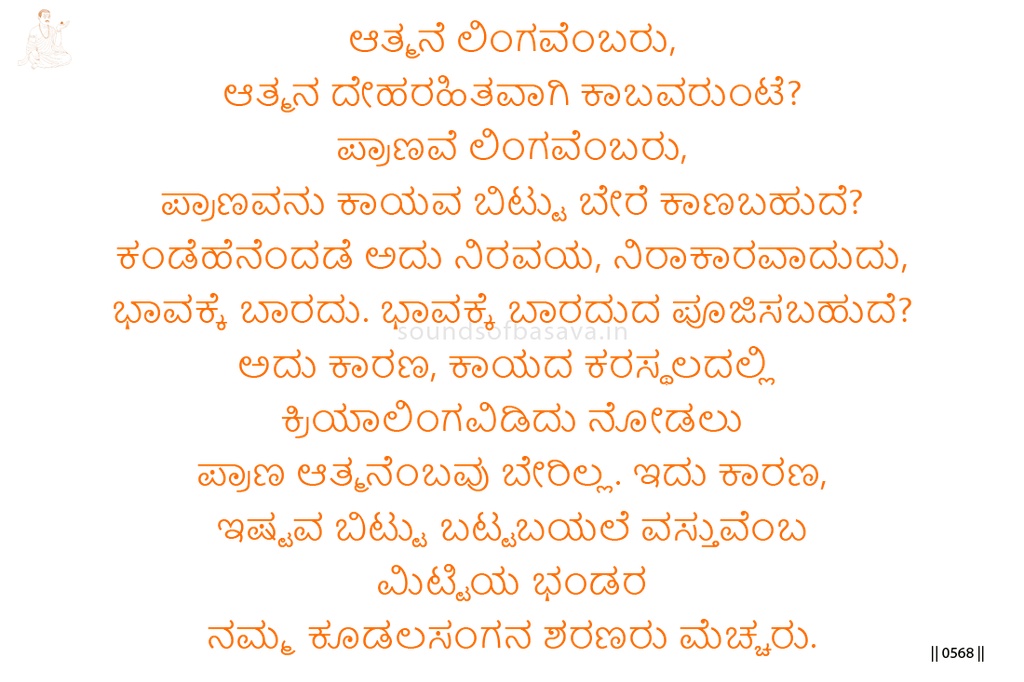
In this vachana, Basavanna corrects a subtle spiritual error. Some say, “The Self is Linga,” but Basavanna asks whether the Self can be known apart from the body. Others say, “Prana is Linga,” but he asks whether prana can be seen apart from the body through which it lives and moves.
He then says that what is truly seen is niravaya and nirākāra — without division and without form. It does not come within ordinary imagination or mental construction. Yet Basavanna asks a practical question: if it cannot come within imagination, how can it be worshipped?
For this reason, Kriya-Linga is placed in the body’s own Karasthala, the palm-field where the Linga is held, seen, and worshipped, so that it may be seen and worshipped. Through this living engagement, it becomes clear that prana, Atma, and Linga are not separate.
The spiritual concern placed before Kudalasangama Deva is therefore balance. The formless is not denied, but it must not become an empty abstraction. The Sharanas of Kudalasangama do not abandon the Ishtalinga in order to chase a barren notion of reality.
Imagery & Symbolic Relevance
The first image is the statement “Atma is Linga.” Basavanna does not reject the statement, but he tests it. If Atma is spoken of apart from the body, it may remain only an idea. The question asks the seeker to avoid abstract speech that has not become lived seeing.
The second image is the statement “Prana is Linga.” Again, Basavanna tests the statement. Prana is not seen apart from the body through which life is expressed. Therefore prana should not be made into an isolated concept.
The third image is the formless reality. Basavanna describes what is truly seen as niravaya and nirākāra — without parts, without division, and without form. It does not fall within ordinary bhava, imagination, or mental grasp.
The fourth image is the question of worship. If the formless cannot be grasped by imagination, how shall it be worshipped? This is not a denial of the formless. It is a practical correction: the seeker needs a living point of approach.
The fifth image is Kriya-Linga in the body’s Karasthala. Karasthala means the palm of the hand. Kriya-Linga is the Linga engaged in worship and practice. The palm-held Linga makes the formless accessible without reducing it to a mere object.
The sixth image is the non-separation of prana, Atma, and Linga. Through the Kriya-Linga held and worshipped in the bodily field, the seeker comes to see that life-force, Self, and Linga are not separate realities.
The final image is the warning against abandoning Ishtalinga for a barren abstraction. The Sharanas do not leave the Ishtalinga behind in pursuit of a lifeless concept of reality. The path is fulfilled by seeing through the Ishtalinga, not by rejecting it.
Lingayoga
In Lingayoga, this vachana teaches that realization must not become merely abstract. It is not enough to say “Atma is Linga” or “Prana is Linga” while separating these from lived embodiment and worship.
For Pranalingi Sthala, the point is direct. Prana, Atma, and Linga are to be known in living relation. The body is not treated as the final truth, but it is the field through which prana is experienced and through which the Linga is worshipped.
The practice-point is clear: do not abandon the Ishtalinga in the name of the formless. Hold the Ishtalinga as Kriya-Linga in the Karasthala, worship with steadiness, and let the visible Linga reveal the non-separation of prana, Atma, and Linga before Kudalasangama Deva.
Editorial Commentary
The key terms should remain clear. Atma means the Self. Prana means the living life-force. Niravaya means without separate parts or division. Nirākāra means formless. Kriya-Linga is the Linga engaged through worship and practice. Karasthala is the palm-field where the Ishtalinga is held and seen.
Basavanna’s warning is not against the formless. It is against abandoning the living means of realization for an abstract idea of the formless. The Sharanas do not reject the Ishtalinga; they see through it. The Ishtalinga becomes the doorway through which the seeker realizes that prana, Atma, and Linga are not separate.
Related Vachana
Supporting Vachana
Prasadi Sthala Vachana 1015 — How Can the Unknown Be Known?
Prasadi Vachana 1015 supports this teaching by questioning the limits of knowledge, bhava, speech, mind, and doctrinal words. Basavanna asks how the unknown can be known through knowledge and how the state beyond speech and mind can be described.
Vachana 1038 carries this concern into Pranalingi Sthala. The niravaya and nirākāra reality cannot be grasped by imagination alone, yet the seeker still needs a living way to worship. Therefore Kriya-Linga is placed in the body’s Karasthala, so that the formless may be approached through living worship. What Prasadi 1015 shows as the limit of knowledge and speech becomes, here, the need for Ishtalinga as the direct doorway to realizing the non-separation of prana, Atma, and Linga.
Advancing Vachana
Sharana Sthala Vachana 1337 — Show Me the Difference Between Prana and Prana-Linga
Sharana Vachana 1337 advances this teaching by bringing the relation between Prana and Prana-Linga into direct Sharana inquiry. Basavanna confesses that outer worship has not revealed the intimate relation between Linga and prana, and he asks Chennabasavanna to show the distinction between his prana and the Prana-Linga.
In Vachana 1038, Basavanna refuses both abstraction and externalism. He does not abandon the formless, but he also does not leave the Ishtalinga for a barren notion of reality. Through the Kriya-Linga in the Karasthala, prana, Atma, and Linga are seen as non-separate. In Vachana 1337, this matures into Sharana Sthala as a humbler and sharper request: let the living relation between prana and Prana-Linga be shown directly before Kudalasangama Deva.
