

Summary
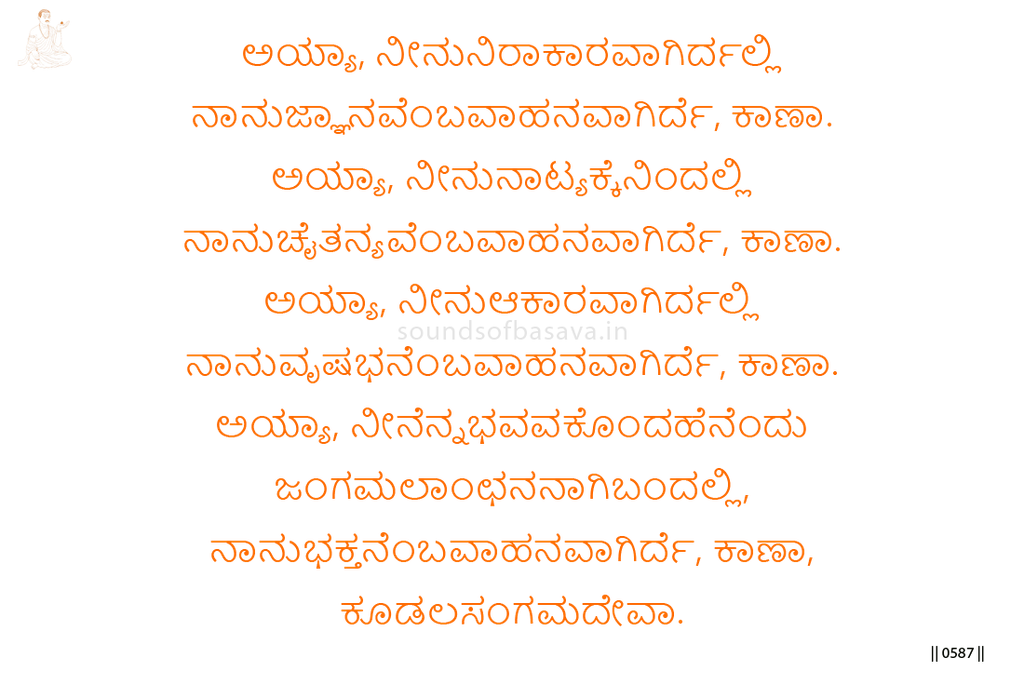
Basavanna presents a self that has no separate role apart from Kudalasangama Deva. When the Lord is formless, the speaker is knowledge as His vehicle; when the Lord dances, he is consciousness; when the Lord takes form, he is the bull that bears Him; when the Lord comes as Jangama to end becoming, he becomes servant.
The movement is from subtle vehicle to surrendered service. None of these states is claimed as personal achievement. Each arises only in response to the Lord’s mode of presence. This is the Sharana-stage teaching of the vachana: the self does not define itself, possess its function, or stand apart; it becomes available to Kudalasangama Deva.
Imagery & Symbolic Relevance
The formless Lord and knowledge form the first image. Since the Lord is without form, the vehicle is not physical support but knowledge. Knowledge here is not self-owned; it serves as the means by which the formless is related to.
The dancing Lord and consciousness form the second image. Dance suggests movement and living expression. Consciousness becomes the vehicle because awakened awareness alone can move with that Divine movement.
The formed Lord and the bull form the third image. The bull signifies steadiness, strength, and bearing. When Kudalasangama Deva takes form, the speaker becomes support without ownership or assertion.
The final image is the Lord coming as Jangama to end becoming. At this point, the earlier role of vehicle gives way to servitude. Jangama is the living presence through which separate becoming is brought to an end, and the speaker’s response is no longer self-positioning but service.
Together, the images show the surrender of independent identity. Knowledge, consciousness, strength, and service are meaningful only because they belong to Kudalasangama Deva’s movement.
Lingayoga
The practice-relevance is direct: the seeker must not claim spiritual capacity as personal possession. Knowing, awareness, support, and service must remain aligned to Kudalasangama Deva. The culmination is not self-claimed attainment, but surrendered availability.
Editorial Commentary
This vachana should be read as a teaching on relational identity. Basavanna’s “I” has meaning only in relation to Kudalasangama Deva’s appearing. The highest point is not the possession of knowledge or consciousness, but the humility of becoming servant when Jangama comes.
Related Vachana
Supporting Vachana
Pranalingi Sthala Vachana 16 — The Name Without Your Name
Pranalingi Vachana 16 supports this vachana by showing that name and identity have no true ground when separated from Kudalasangama Deva’s Name. Sharana Vachana 3 carries that teaching forward by grounding identity entirely in Divine relation. The unsupported name is corrected here as responsive service: knowledge before the formless Lord, consciousness before the dancing Lord, the bull before the formed Lord, and servant before Jangama.
Advancing Vachana
Aikya Sthala Vachana 4 — The Seven Becomings
Aikya Vachana 4 advances this teaching by carrying responsive surrender into complete Divine shaping across becomings. In Sharana Vachana 3, the speaker becomes the proper vehicle according to Kudalasangama Deva’s mode of presence. In Aikya Vachana 4, even successive becomings are received as ordained by the Lord. The Sharana’s surrender of fixed identity therefore advances into Aikya as total availability to Kudalasangama Deva.
