

Summary
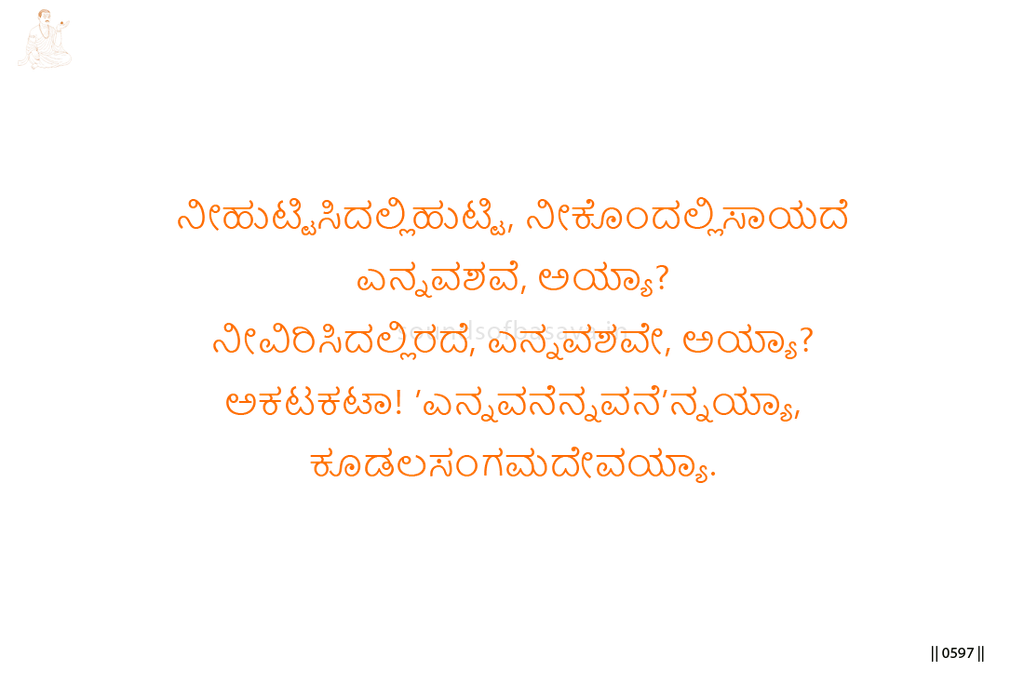
Basavanna says that where Kudalasangama Deva causes him to be born, there he is born. Where Kudalasangama Deva causes him to die, there he dies. He then asks: what is within his control?
The same recognition is extended to placement. Where Kudalasangama Deva places him, there he remains. Again he asks what power is truly his. The vachana ends in astonishment: what can he call his own before Kudalasangama Deva?
Imagery & Symbolic Relevance
Birth is the first image. Basavanna does not treat birth as something self-chosen. He says he is born where Kudalasangama Deva causes him to be born.
Death is the second image. Just as birth is not under personal control, death too is placed under Kudalasangama Deva’s will.
Placement is the third movement. Basavanna says that where the Lord places him, there he remains. The image includes the condition, station, or circumstance in which the seeker stands.
The repeated question, “What is within my control?” is the central force of the vachana. It breaks the assumption that the seeker governs birth, death, or placement.
The final cry, “what is mine?” completes the teaching. Basavanna does not present a doctrine of possession. He questions possession itself before Kudalasangama Deva.
Lingayoga
In Lingayoga, the relevance of this vachana lies in the movement given by the source: birth is not self-held, death is not self-held, placement is not self-held, and therefore ownership is questioned.
The practice-point is direct: the seeker must see where the claim of “mine” arises and place that claim before Kudalasangama Deva.
Editorial Commentary
This vachana should be read as a correction of personal control and possession. Basavanna does not argue abstractly about ownership. He points to birth, death, and placement—three conditions the individual cannot finally command. The force of the vachana lies in the repeated question: if these are not under my control, what can truly be called mine?
Related Vachana
Supporting Vachana
Pranalingi Sthala Vachana 56 — From Cry to Silence
Pranalingi Vachana 56 supports this vachana by showing the repeated call to Kudalasangama Deva coming to rest in silence. There, the seeker calls, cries, asks what he can do, and finally enters mouna before the Lord. Sharana Vachana 57 shows what follows that silence: birth, death, and placement are seen as not belonging to personal control. Thus the silence of Pranalingi advances into Sharana as the release of the claim “mine.”
Advancing Vachana
Aikya Sthala Vachana 1075 — The Eternal Fragrance
Aikya Vachana 1075 advances this teaching by carrying the recognition beyond personal control into freedom from birth and death as defining conditions. In Sharana Vachana 57, Basavanna says he is born, dies, and remains only where Kudalasangama Deva causes or places him, and he asks what can be called his own. In Aikya Vachana 1075, the devotee says, “I know no birth” and “I know no death”; if there is birth, it is for receiving the sacred water of the Lord’s feet, and if there is death, it is for resting at those feet. Thus the Sharana-stage release of ownership advances into Aikya as unchanging abidance in Kudalasangama Deva.
