

Summary
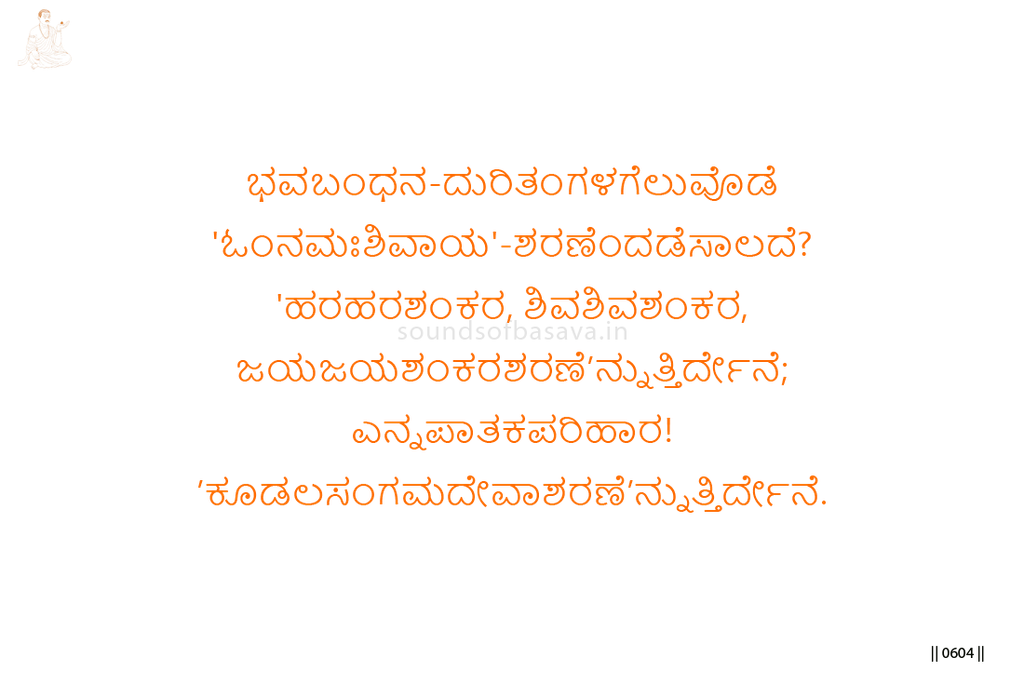
Basavanna asks whether “Om Namah Shivaya” taken as refuge is not enough to loosen the bondage of becoming and wrongdoing. The question does not lead into a complex method. It turns directly toward the Name.
He then repeats the names: “Hara Hara Shankara, Shiva Shiva Shankara, Jaya Jaya Shankara,” and says that he takes refuge. For the removal of his transgressions, he again takes refuge in Kudalasangama Deva.
Imagery & Symbolic Relevance
The bondage of becoming is the first condition named. Basavanna does not describe it through image here; he names it directly as bondage.
Wrongdoing is joined to that bondage. The vachana therefore brings together the condition of becoming and the burden of transgression.
“Om Namah Shivaya” is placed as refuge. Basavanna asks whether this refuge is not sufficient. The force of the vachana rests on the sufficiency of the Name.
The repeated names — “Hara Hara Shankara, Shiva Shiva Shankara, Jaya Jaya Shankara” — enact the taking of refuge. They are not explained as separate doctrines. They are uttered as the movement of surrender.
The final appeal to Kudalasangama Deva completes the vachana. Basavanna seeks the removal of his transgressions and says again: “I take refuge.”
Lingayoga
In Lingayoga, the relevance of this vachana lies in the movement given by the source: the seeker sees bondage and wrongdoing, turns to “Om Namah Shivaya” as refuge, repeats the Divine names, and seeks the removal of transgression before Kudalasangama Deva.
The practice-point is direct: when bondage and transgression are seen, the seeker must take refuge in the Name without multiplying other supports.
Editorial Commentary
This vachana should be read as a teaching on the sufficiency of the Name as refuge. Basavanna does not argue, analyze, or prescribe many practices here. He asks whether “Om Namah Shivaya” is not enough, then takes refuge through repeated invocation.
Related Vachana
Supporting Vachana
Pranalingi Sthala Vachana 77 — The Name Alone Is Sufficient
Pranalingi Vachana 77 supports this vachana by declaring “Om Namah Shivaya” to be mantra and tantra, and by identifying remembrance of Kudalasangama Deva as mantra. Sharana Vachana 79 carries that teaching into refuge: the same Name is now taken as sufficient for loosening bondage and wrongdoing. The support is direct: Pranalingi establishes the Name as the means; Sharana receives the Name as refuge.
Advancing Vachana
Aikya Sthala Vachana 80 — No Other Refuge
Aikya Vachana 80 advances this teaching by carrying refuge in the Name into undivided abidance. In Sharana Vachana 79, Basavanna takes refuge in “Om Namah Shivaya” for the removal of bondage and transgression. In Aikya Vachana 80, there is no other in the mind; “Om Namah Shivaya” is the mantra and japa, and Kudalasangama Deva alone is known as Linga. Thus the Sharana-stage taking refuge in the Name advances into Aikya as the state where the Name, remembrance, and Kudalasangama Deva stand without another support.
